
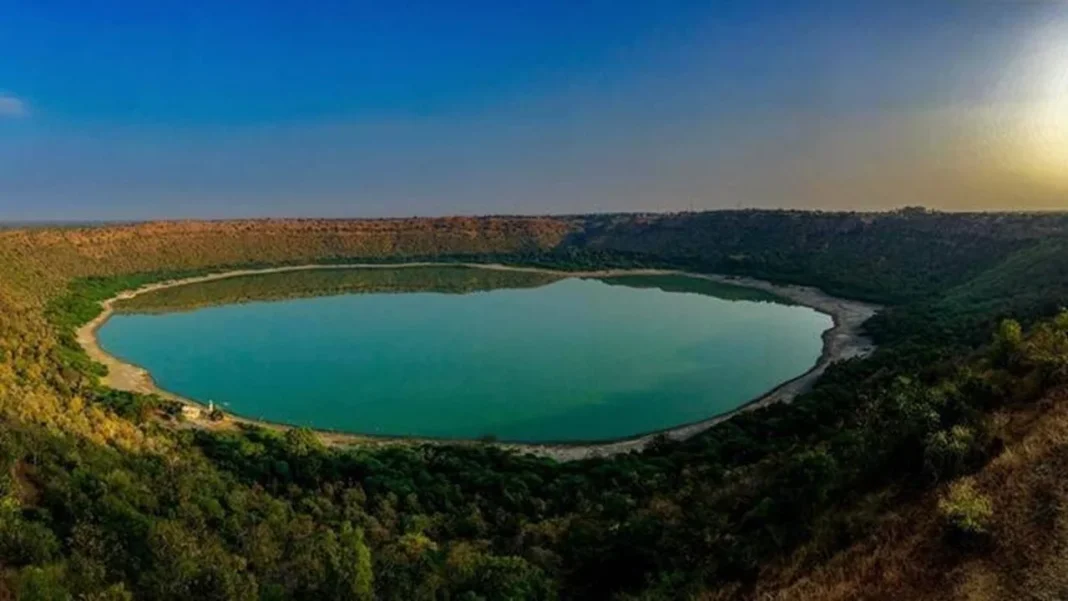

The Lonar Lake Lunar Hub initiative has brought renewed attention to one of India’s most unique natural formations, Lonar Lake in Maharashtra. Formed by a meteor impact thousands of years ago, the site is now being explored for its potential as a lunar analogue research hub, meaning it can help scientists study conditions similar to those on the Moon.
The move reflects growing interest in using Earth-based locations to support space research and planetary science.
What is Lonar Lake?
Lonar Lake Maharashtra, is a rare hyper-velocity meteor impact crater located in the Buldhana district. It was formed around 50,000 years ago when a meteor struck the Earth’s surface, creating a nearly perfect circular depression.
What makes the Lonar Crater in India unique is that it is formed of basalt, unlike most impact craters worldwide, which are typically found in sedimentary terrain. The lake inside the crater is also unusual, with both saline and alkaline water, supporting rare microbial ecosystems.
Why It Is Called a Lunar Hub
The concept of the Lonar Lake lunar hub comes from its similarity to lunar and planetary surfaces.
Scientists consider Lonar Lake a natural laboratory because:
- Its crater structure resembles impact craters on the Moon
- The surrounding terrain mimics planetary geological conditions
- The mineral composition offers insights into extraterrestrial impacts
These features make it valuable for studying impact cratering, planetary geology, and astrobiology.
Scientific Importance of Lonar Lake
The Lonar Lake Significance extends across multiple scientific fields.
Planetary Science
Researchers use the crater to understand how meteor impacts shape planetary surfaces.
Astrobiology
The lake’s unique microorganisms help scientists study life in extreme environments, which may offer clues about life beyond Earth.
Geology
The basaltic composition provides rare insights into impact processes in volcanic rock. Because of these factors, the meteor crater India site is globally recognized among scientists.
Role in India’s Space Research
The development of the lunar research India initiative around Lonar Lake aligns with India’s growing ambitions in space exploration.
The site can support:
- Training and simulation for space missions
- Research related to lunar and planetary environments
- Collaboration between scientific institutions
It complements missions like lunar exploration by providing real-world testing conditions on Earth.
Tourism and Cultural Importance
Beyond science, Lonar Lake Maharashtra is also a major tourist and heritage site.
The area features:
- Ancient temples around the crater
- Scenic landscapes and biodiversity
- Opportunities for eco-tourism
The lunar hub initiative could boost tourism while promoting scientific awareness.
Why This Development Matters
The Lonar Lake Lunar Hub Project is important because it connects science, education, and tourism.
It highlights:
- India’s potential in planetary research
- The value of natural geological heritage
- Opportunities for global scientific collaboration
Such initiatives can transform unique natural sites into centers of knowledge and innovation.
What Happens Next?
The development of Lonar Lake as a lunar hub is expected to involve:
- Increased research activity
- Infrastructure for scientific studies
- Promotion as an educational and tourism destination
This could place the site more prominently on the global scientific map.
Conclusion
The Lonar Lake Lunar Hub represents a significant step in leveraging natural geological formations for advanced scientific research. With its rare crater structure, unique ecosystem, and similarity to lunar terrain, Lonar Lake stands out as one of India’s most important scientific sites.
FAQs
What is Lonar Lake?
It is a meteor impact crater lake in Maharashtra.
Why is it called a lunar hub?
Because its structure resembles lunar craters and helps in space research.
How old is Lonar Lake?
It is around 50,000 years old.
Why is it important?
It is valuable for planetary science, geology, and astrobiology.