
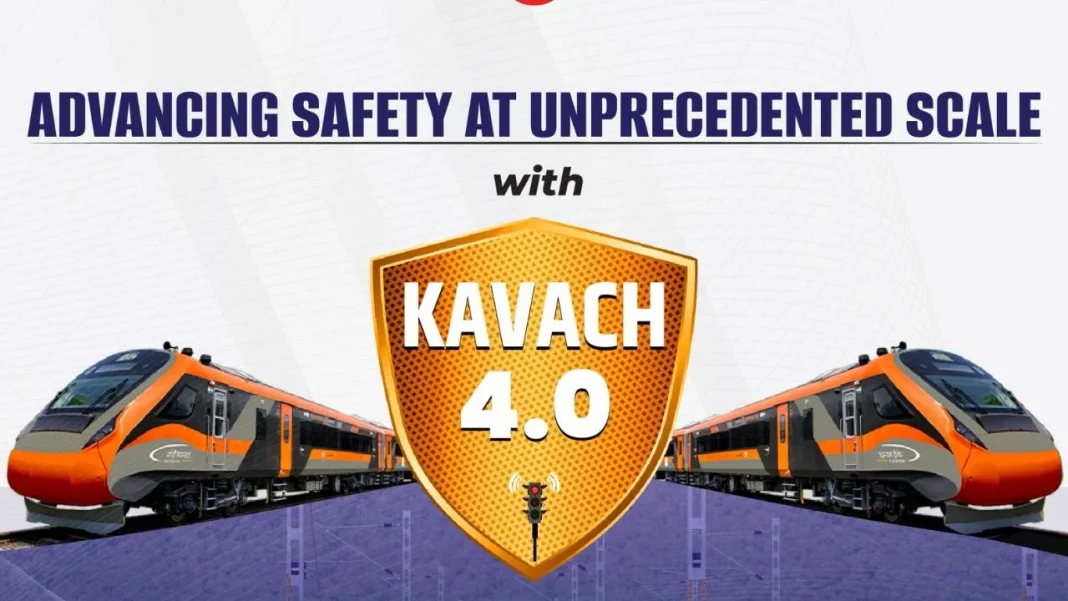

A train moving at speed cannot stop like a car. By the time a loco pilot sees danger, reads the signal, and reaches for the brake, valuable seconds may already be gone. That is where Kavach steps in. Indian Railways is expanding its indigenous Automatic Train Protection system across busy corridors, giving trains a digital safety layer that can intervene when human reaction is too late.
The latest Ministry of Railways update, issued on 5 August 2026, says Kavach 4.0 has been commissioned across 2,633 route kilometres. Of this, 1,423 route km covers Delhi–Mumbai and 1,210 route km covers Delhi–Howrah. Railways also reported ₹3,875 crore spent on Kavach works up to June 2026.
How Kavach Stops A Train Before A Collision Develops
Kavach continuously checks a train’s permitted speed, signal information and movement authority. If a loco pilot fails to brake after a restrictive signal or exceeds the permitted speed, the system can apply the brakes automatically. It does not replace the driver. It adds a second safety layer when a warning is missed, or the response comes too late.
The system also targets Signal Passing at Danger, or SPAD. It communicates between the locomotive, trackside equipment, stations and signalling infrastructure. RFID tags help establish location, while telecom towers and optical fibre support data exchange.
Indian Railways says Kavach carries SIL-4 safety certification. A February 2026 Railway Ministry note also said the technology can assist train movement during poor weather.
What Happens When The Driver Misses A Signal Or Speed Restriction
Imagine a train approaching a red signal faster than it should. Kavach compares its movement with the safe limit allowed by the signalling system. If the loco pilot responds, normal control continues. If not, Kavach intervenes.
Its core protections include:
- Automatic braking when the loco pilot fails to slow the train
- Protection against overspeeding and Signal Passing at Danger
- Continuous exchange of train, track and signal information
- In-cab signal display, useful during fog or low visibility
- Collision-prevention support through coordinated train and trackside data
An official All India Radio News post on X highlighted Kavach commissioning on the Prayagraj–Kanpur section in March 2026. The 190-route-km stretch forms part of the Delhi–Howrah high-density corridor, where trials included WAP-7 locomotives and a Vande Bharat rake.
Why Kavach 4.0 Is Being Rolled Out Faster In 2026
Kavach 4.0 improves location accuracy, provides better signal information in larger yards, and connects directly with electronic interlocking. Station-to-station communication also runs through optical fibre.
The rollout accelerated during 2026. Kavach 4.0 stood at 1,306.3 route km in early February, reached 2,490 route km by 13 July and climbed to 2,633 route km by the end of July. That progression shows how quickly work is moving on the two busiest long-distance corridors.
Railways also approved a ₹206 crore project in July for Kavach 4.0 across 680 route km on the Rewari–Delhi and Shakurbasti–Bathinda sections, including feeder lines. The official project announcement puts Northern Railway firmly in the next expansion phase.
What The Kavach Expansion Means For Faster And Busier Rail Routes
Kavach becomes more important as Indian Railways pushes higher speeds and handles dense traffic on the same corridors. A faster railway needs braking supervision that does not depend only on a person spotting danger at the right second.
On Prayagraj–Kanpur, Railways linked Kavach with preparations for operations up to 160 kmph and said more than 20,000 kilometres of passenger trial runs were completed before commissioning.
In March, the Railway Ministry also announced a Universal Braking Algorithm designed to standardise braking curves across Kavach suppliers. It described “Suraksha,” an AI-based centralised monitoring platform being developed to flag unusual events and support predictive maintenance. The March 2026 Kavach review said work was then in progress across 24,427 route km.
Kavach cannot remove every railway risk. Track defects, infrastructure failures, weather, maintenance and operating discipline still need separate safeguards. What it can do is close one dangerous gap: the seconds between a warning appearing and a human reacting. On a fast-moving train, that gap can change the outcome.
FAQs About Kavach
1. What is Kavach in Indian Railways?
Kavach is India’s automatic train protection system that supervises speed, signals and braking automatically onboard.
2. Can Kavach stop two trains from colliding?
It can automatically apply brakes when collision risk is detected through railway systems during train operations.
3. Does Kavach replace the loco pilot?
No. The loco pilot remains in control, while Kavach intervenes when safety actions get missed.
4. How much route currently has Kavach 4.0?
By July 2026, Kavach 4.0 had been commissioned across 2,633 route kilometres on key corridors.
5. Why is Kavach useful during fog?
Its cab display provides signal information and speed supervision when visibility becomes poor for train drivers.