
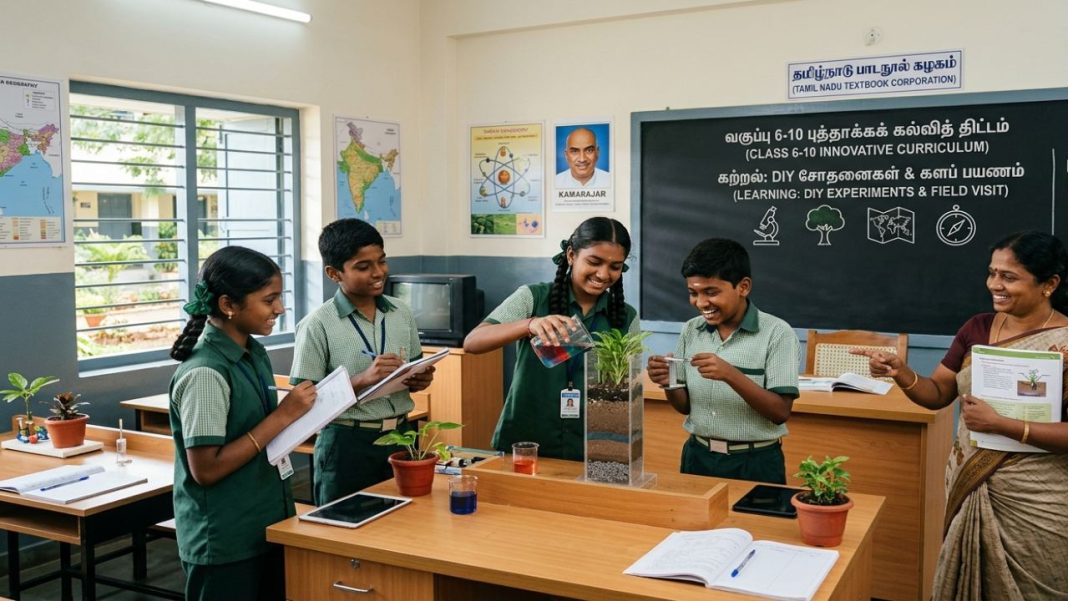

Tamil Nadu is proposing a major rewrite of how Classes 6 to 10 are taught in state-board schools. The new SCERT draft curriculum brings do-it-yourself experiments, projects, field activities, oral questioning and digital tools closer to everyday classroom learning, reducing dependence on textbook recall.
Prepared under the Tamil Nadu State Education Policy 2025, the draft covers Tamil, English, Mathematics, Science and Social Science. It has been open for public feedback on the School Education Department website since August 20, with suggestions accepted until August 31. Lessons are meant to become lighter on text and heavier on doing, observing and applying.
What Changes In Tamil Nadu’s Class 6-10 Draft Syllabus?
For science, social science and mathematics, practical work gets a much larger role. A student learning biodiversity, for instance, may maintain a journal of plants, animals and environmental changes noticed nearby. History and civics lessons are proposed in a more narrative format, while mathematics could use dynamic geometry software, graphing utilities and simulations.
The draft also brings newer everyday technology into school learning. Class 8 social science includes QR codes, mobile banking, cyber fraud and cybersecurity, moving digital literacy beyond the computer lab.
Key proposals include:
- DIY experiments and worksheets built around concepts instead of memorised answers.
- Classroom projects, observation journals and field-based activities.
- Oral questions and practical tasks as part of assessment.
- Digital tools for geometry, graphs and simulations in mathematics.
- Cybersecurity, financial technology and online-fraud awareness in social science.
- More focus on creativity, problem-solving, application and student participation.
Why Is Tamil Nadu Reworking The Syllabus Now?
The overhaul follows the Tamil Nadu State Education Policy released on August 8, 2025. It called for child-centred teaching, future skills, digital literacy and assessment reform while retaining Tamil Nadu’s 10+2 structure and two-language approach.
SCERT released draft syllabi for Classes 1 to 5 in January 2026. Classes 1 to 3 received revamped textbooks for 2026-27, including safety, first aid, life skills and self-care. The School Education Department later instructed officials to ensure students actively participate in at least 70% of classroom activities in Classes 1 to 3.
The government also reconstituted a 17-member curriculum design committee in June 2026 under former ISRO scientist Mylswamy Annadurai. The official Tamil Nadu School Education Department posted about a curriculum-design and high-level expert committee meeting at Anna Centenary Library on July 21. The department’s official X post on the July 21 curriculum committee meeting showed syllabus revision work was already underway before the public draft appeared in August.
Does This Mean Tamil Nadu Is Ending Rote Learning?
It is clearly trying to reduce it, but a draft syllabus alone cannot remove memorisation from classrooms.
The bigger change is assessment. If students visit places, document observations, explain concepts orally, complete projects and use digital tools, teachers have more reason to reward application instead of repeated textbook lines. That is different from adding activities while keeping recall-heavy exams unchanged.
There is also a wider national move towards experiential and skill-based learning. The Union Education Ministry said in July 2026 that Classes 6 to 8 under Samagra Shiksha can receive pre-vocational exposure, including 10 bagless days and off-textbook experiential learning. Tamil Nadu’s draft follows a similar classroom trend, though within the state’s own policy framework.
Execution will decide the outcome. Schools vary in internet access, device availability, laboratory facilities and teacher workload. Field visits need time, transport, safety arrangements and local planning. If final examinations still reward predictable book-back answers, classrooms could drift back towards memorisation.
What Happens Next For Students, Teachers And Parents?
The draft is not final. Teachers, students, educationists and the public can review it through the Tamil Nadu School Education Department portal and submit feedback until August 31.
According to the current rollout reported by SCERT officials, Classes 4 to 8 are expected to receive new books next academic year, while Class 9 and above are scheduled for the following year. That gives the state time to revise textbooks, train teachers and align assessments.
For parents, homework could look less like copying answers and more like journals, experiments, projects or observation tasks. For teachers, success will depend on usable handbooks, manageable classes and assessment rules that support the new approach.
Tamil Nadu is moving away from rote learning on paper. Whether that shift reaches every classroom will depend on the final syllabus, textbooks, teacher training and examinations.
FAQS
What Is New In Tamil Nadu’s Class 6-10 Syllabus?
It adds experiments, projects, field visits, digital tools and application-based assessments across major school subjects.
When Can The Public Submit Feedback On The Draft?
Feedback on the draft curriculum can be submitted until August 31, 2026 via official portal.
Will Students Have More Field-Based Learning?
Yes, the draft proposes field visits, observation journals and practical activities to test conceptual learning.
Which Digital Topics Appear In The New Syllabus?
Class 8 social science includes QR codes, mobile banking, cyber fraud and cybersecurity awareness lessons.
When Will The New Textbooks Reach Students?
Classes 4-8 are expected next academic year; Class 9 and above would follow thereafter later.