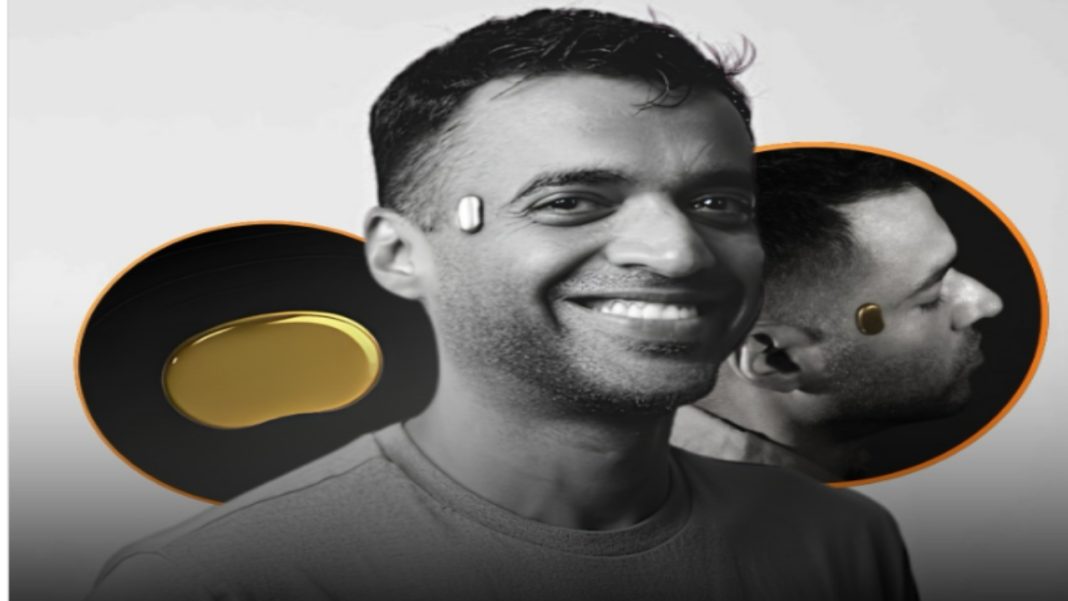

Deepinder Goyal’s Temple wearable is edging closer to an India launch, and it looks nothing like a smartwatch or fitness ring. The tiny device sits near the temple on the side of the forehead and is being developed to track blood-flow-related signals, oxygenation, and physiological changes linked with performance, stress, and recovery.
On August 21, 2026, Goyal said the latest Temple is less than half the size of earlier prototypes. Pre-orders for a limited launch edition are expected soon, with shipments planned before the end of 2026, according to the latest Temple launch update. That moves Temple from an experimental project toward a product consumers may soon buy.
What Has Changed With Deepinder Goyal’s Temple Wearable?
Temple has been shrinking fast. Goyal now calls the latest version the smallest wearable on the market by volume, although that remains a company claim rather than an independently verified ranking. The device had already entered early access in May, when the first 100 units were offered to selected athletes, scientists, doctors, founders and creators through its early-access programme.
Interest rose again after badminton star PV Sindhu was seen wearing Temple during the 2026 BWF World Championships. Her appearance with the forehead sensor arrived just as Temple began talking about wider availability.
Key updates include:
- Limited-edition pre-orders are expected to open soon.
- Temple aims to ship before the end of 2026.
- The newest hardware is less than half the size of the earlier model.
- Early-access testing began with a first batch of 100 devices.
- Final retail pricing has not been officially announced.
Goyal shared the latest launch development directly through his account on X. Here is Deepinder Goyal’s official X post on the redesigned Temple wearable, published on August 21.
How Can A Forehead Wearable Track Brain Blood Flow?
Temple’s placement is central to its pitch. Instead of relying mainly on wrist signals, the device sits over the temple region, where blood vessels are close to the skin and motion conditions differ from those at the wrist.
The broader science behind optical brain monitoring is established. Functional near-infrared spectroscopy, or fNIRS, uses near-infrared light to detect changes in oxygenated and deoxygenated haemoglobin. A recent review of wearable NIRS technology and research indexed by the US National Library of Medicine shows that portable systems can monitor cerebral haemodynamics and oxygenation outside traditional scanners.
Still, that does not mean every tiny forehead sensor automatically measures cerebral blood flow with clinical accuracy. Readings can be influenced by skin, superficial vessels, movement, sensor contact, and measurement depth. Temple has not publicly released enough technical detail for independent researchers to fully compare its readings with laboratory-grade cerebral blood-flow methods.
What Is Temple’s ‘Entropy’ Metric?
Temple also centres on a proprietary score called Entropy. Goyal says it updates every second and reflects changing metabolic cost during sleep, exercise, food intake, coffee, meditation, work and stressful situations.
Temple says Entropy was compared with a metabolic cart across more than 100 cardio sessions and showed a stronger correlation than heart rate. The findings are company-reported and still require independent, peer-reviewed validation. Goyal has said peer-reviewed studies are intended to support health claims around launch, while doctors have already raised questions about the evidence behind the metric. Read more about the scientific scrutiny around Entropy.
Can Temple Really Measure Stress, Recovery And Performance?
Not as directly as a thermometer measures temperature. Stress, fatigue, focus and recovery are complicated states. A wearable can record physiological signals that shift when the body is under load, but software must interpret what those changes mean.
Temple may therefore identify patterns associated with exertion, rest or sympathetic activity, but a high reading should not automatically be treated as proof of psychological stress, neurological fatigue or disease. Even established brain-monitoring technologies face limitations outside controlled settings.
For athletes, the appeal is easier to see. Continuous data could potentially show how quickly the body settles after hard training, how sleep changes baseline readings or how pressure affects physiological load. Sindhu’s appearance with Temple has strengthened that sports-performance angle.
The bigger test is repeatability across different users, skin types, environments and activities. Until independent studies appear, Temple’s stress and recovery features are better viewed as experimental wellness insights, not medical conclusions.
When Will Temple Launch In India And What Could It Cost?
Temple’s limited launch edition is expected to begin shipping before the end of 2026. Goyal has not announced the final India price. Earlier reports placed it near ₹72,000, while a later Economic Times pricing report suggested roughly ₹75,000–₹80,000. Another July report cited a possible $1,000 launch price. Those numbers remain indicative.
The coming pre-order window should reveal whether Temple stays a niche device for athletes, founders and quantified-self enthusiasts or creates a broader category around head-worn health tracking.
FAQs
Is Temple available to buy in India now?
No, wider sales have not started; limited-edition pre-orders are expected to open soon across India.
What does the Temple wearable measure?
Temple tracks blood-flow-related signals, oxygenation, and physiological patterns linked with metabolism, exertion, stress, and recovery.
Can Temple diagnose brain or neurological conditions?
No, Temple is not established as a diagnostic replacement for clinical neurological tests or doctors.
How much could Temple cost in India?
Reports suggest around eighty thousand rupees, but Temple has not officially confirmed its retail price.
When will Temple start shipping?
Deepinder Goyal says Temple’s limited launch edition should begin shipping before the end of 2026.