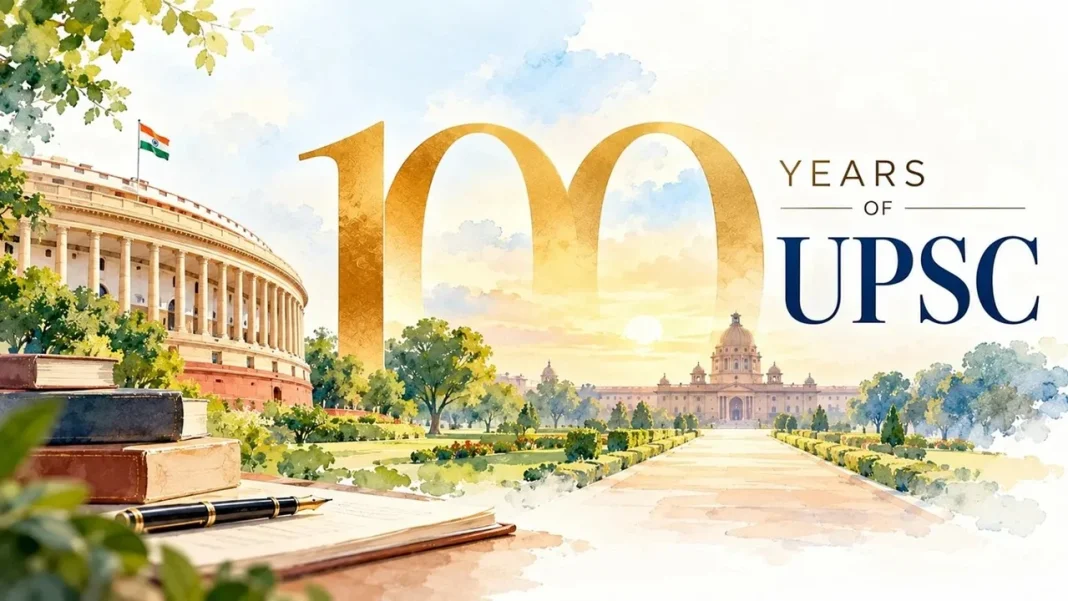

A century ago, India’s first Public Service Commission began with a narrow advisory role. On 1 October 2026, the Union Public Service Commission marked 100 years with a brief covering nationwide recruitment, constitutional safeguards, digital examinations and technology-led checks reaching lakhs of candidates. The Commission traces its origin to the Public Service Commission established on 1 October 1926.
The centenary at Bharat Mandapam closed a year-long programme that began on 1 October 2025. A commemorative coin, postage stamp and a compilation of 100 landmark judgments were released as the Commission looked back at its journey and ahead to its second century.
Key Highlights
- India’s first Public Service Commission was established on 1 October 1926 after the Lee Commission’s 1924 recommendations.
- It became the Federal Public Service Commission in 1937 and the UPSC after the Constitution came into force in 1950.
- Civil Services Prelims 2026 drew 8,19,732 applications, with nearly 5.49 lakh candidates appearing across 2,072 venues in 83 cities.
- UPSC has added AI-based facial authentication and initiatives such as Pratibha Setu to its recruitment system.
From A Colonial-Era Commission To A Constitutional Institution
The roots of UPSC lie in the Government of India Act, 1919 and the Lee Commission report of 1924. The first Public Service Commission started functioning under Sir Ross Barker on 1 October 1926. Its powers were limited, and demands for a stronger recruitment body continued. The Commission’s own historical record documents this early transition.
The structure changed again in 1937, when it became the Federal Public Service Commission. The biggest shift came on 26 January 1950. Under the Constitution, it became the Union Public Service Commission, with Public Service Commissions governed through Articles 315 to 323 of the Constitution.
1926: First Public Service Commission
1937: Federal Public Service Commission
1950: Union Public Service Commission with constitutional status
Under Article 320, the Commission conducts examinations for Union services and is consulted on recruitment methods, appointments, promotions, transfers and disciplinary issues. That constitutional framework remains central even as examination technology changes.
What UPSC’s 100th Anniversary Looked Like In 2026
UPSC held its two-day “Manthan” programme on 30 September and 1 October 2026, bringing together State Public Service Commissions, officials, academics and other stakeholders. The centenary discussions focused on future-ready civil services, institutional innovation and constitutional values.
Prime Minister Narendra Modi attended the 1 October programme and released the commemorative coin, stamp and the book 100 Landmark Judgements: Shaping the Policies of UPSC and Public Service Commissions in India. In his address, he called for recruitment systems to adapt to challenges including AI, deepfakes, algorithmic bias and climate-related governance while retaining independence and fair processes.
An official X post from Narendra Modi’s account described the centenary as a “proud milestone” and referred to UPSC’s century-long role in administration and public service. The post was also embedded in the official PIB account of the event.
The centenary discussion also placed faster recruitment cycles, technology and future-ready civil servants on the agenda. For aspirants, that points to changes beyond the syllabus, including how candidates are identified, verified and recruited.
From Paper-Based Exams To Facial Authentication At National Scale
For the Civil Services Preliminary Examination 2026, 8,19,732 candidates applied and about 5.49 lakh appeared. The examination ran at 2,072 venues across 83 cities, showing how far the recruitment operation has expanded from its early institutional years.
UPSC also scaled AI-enabled facial authentication after a 2025 pilot in Gurugram. In May 2026, live face checks were used for roughly 5.50 lakh candidates. More than 7,000 invigilators could use the system simultaneously, while peak processing reached around 12,000 authentications per minute. A check took roughly six to eight seconds.
Another shift sits outside the examination hall. Pratibha Setu gives verified organisations access, with candidate consent, to profiles of qualified UPSC candidates who reached advanced stages but were not finally recommended. By December 2025, the platform covered more than 13,000 candidates and 159 organizations.
The Commission still runs competitive selection, but technology now touches registration, identity checks, examination security and alternative career pathways.
For aspirants following UPSC reforms, the useful takeaway is straightforward: official notifications deserve priority over coaching-centre summaries. Exam processes may change even when the Commission’s broad constitutional role remains intact.
FAQs
When was the first Public Service Commission established in India?
India’s first Public Service Commission was established on 1 October 1926, following recommendations of the Lee Commission and provisions linked to earlier constitutional reforms in India.
When did the Public Service Commission become UPSC?
The Federal Public Service Commission became the Union Public Service Commission on 26 January 1950, when India’s Constitution came into force and granted it constitutional status.
How many candidates appeared for UPSC Civil Services Prelims 2026?
Nearly 5.49 lakh candidates appeared from 8,19,732 applicants, with the examination conducted across 2,072 venues located in 83 cities nationwide during May 2026.
What technology did UPSC introduce in the 2026 Civil Services examination?
UPSC deployed AI-enabled facial authentication at scale, allowing invigilators to verify candidates through mobile devices while reducing impersonation risks during examination-center entry at centers across India.
What is Pratibha Setu in UPSC recruitment?
Pratibha Setu connects consenting, qualified but non-recommended UPSC candidates with verified organisations, giving strong performers another route to employment beyond final government selection processes today.
UPSC Exam Updates You Shouldn’t Miss
When Will NDA 2 Admit Cards Arrive?
Check out the expected release details and where candidates can download their hall tickets.
What Changes With UPSC Face Authentication?
Find out what candidates should know before the Prelims 2026 exam.
Which Admit Card Errors Should You Avoid?
Uncover three common mistakes candidates should avoid while downloading their CSE 2026 admit card.
When Will UPSC 2027 Exams Begin?
Browse the expected timeline, vacancies, and eligibility details for CSE, NDA, and CDS.
What Should Candidates Check Before Prelims?
Go through this last-minute checklist to prepare for the UPSC Prelims 2026 exam.