
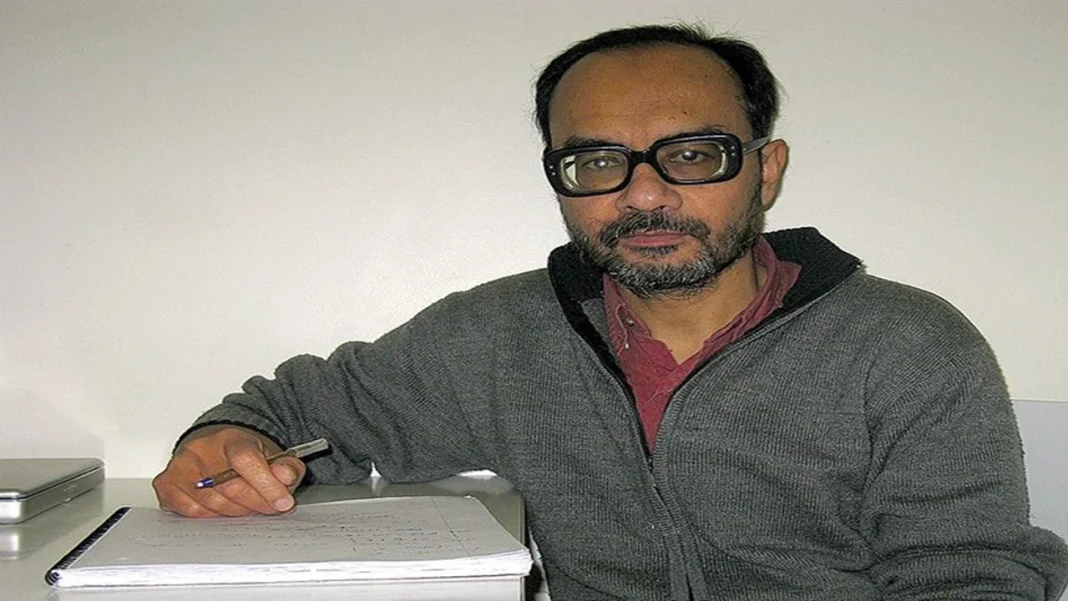

Indian physicist Ashoke Sen has become the first Indian to receive the 2026 Oskar Klein Medal, recognising major advances in string theory and black-hole physics.
The International Centre for Theoretical Sciences (ICTS) in Bengaluru announced the award on 22 October 2026. Sen, the institute’s ICTS-Infosys Madhava Chair Professor, delivered the medal lecture in Stockholm the same day. His research addresses a difficult problem: describing gravity using the quantum rules that govern the smallest particles.
Key Highlights
- The Oskar Klein Medal has recognised theoretical physics research since 1988; Sen is its first Indian recipient.
- Stockholm University and the Nobel Committee for Physics award the medal.
- Sen’s recognised work spans S-duality, microscopic black-hole entropy and string field theory.
- His 2026 Stockholm lecture examined what black holes reveal about quantum gravity.
What Is the Oskar Klein Medal and Who Has Won It Before?
The award honours Swedish physicist Oskar Klein. Its first three recipients were Chen-Ning Yang in 1988, Steven Weinberg in 1989 and Hans Bethe in 1990. All three won Nobel Prizes in Physics. Stephen Hawking also appears on the official Stockholm University list of memorial lecturers.
The distinction involves the Nobel Committee for Physics, but it is not a Nobel Prize. The medal recognises outstanding theoretical work; it does not imply that every underlying scientific proposal has been experimentally established.
India’s Office of the Principal Scientific Adviser acknowledged Sen’s achievement, while ICTS posted its official announcement on X.
Which Discoveries Earned Ashoke Sen the Medal?
String theory replaces the familiar picture of elementary particles as dimensionless points with tiny, vibrating one-dimensional objects. Its mathematical ambition is substantial: to bring quantum mechanics and gravity into one consistent framework. Sen helped establish some of its deepest internal connections.
- S-Duality: Strongly interacting systems are notoriously hard to calculate. Sen found important evidence that certain strongly coupled theories can be related to weakly coupled descriptions. His work helped build the case that apparently different string theories may be limits of a deeper common theory.
- Black-Hole Entropy: Physicists can assign entropy to a black hole, but where do the possible microscopic states behind that number come from? Sen developed methods to count them precisely in particular string-theory models and compare those counts with gravitational predictions.
- String Field Theory: His research into unstable string configurations, including tachyon condensation, clarified how some theoretical objects decay. These results matter for describing processes that cannot be captured simply by treating strings as isolated objects.
One distinction is worth keeping: these are powerful mathematical results within theoretical models, not laboratory proof that the universe is built from strings. Sen’s ICTS research profile also lists superstring perturbation theory among his interests.
What Did Sen Reveal in His Stockholm Lecture?
On 22 October, Sen spoke at Stockholm University’s AlbaNova Centre on “Gravity from Strings and Strings from Gravity.” The official lecture programme describes three questions at the heart of his talk:
- How might string theory give a consistent quantum description of gravity?
- Why has the vast range of possible string-theory solutions prevented a definite testable prediction?
- Could properties of black holes show that string theory is necessary to explain certain quantum-gravity puzzles?
The second question prevents an exaggerated reading of the medal. String theory remains a research programme, not an experimentally confirmed final account of nature. Sen’s work supplies tools for examining it with unusual mathematical precision.
What Does the 2026 Honour Add to Sen’s Scientific Career?
Sen received the Padma Shri in 2001 and Padma Bhushan in 2013. His international honours include the 2012 Breakthrough Prize in Fundamental Physics and the 2014 Dirac Medal. In April 2026, ICTS also announced his election as an International Honorary Member of the American Academy of Arts and Sciences.
The award highlights research being conducted from Bengaluru rather than an overseas appointment. It also adds to a career that has repeatedly connected highly abstract mathematics with questions about black holes and gravity.
For the primary record, read the ICTS award announcement and Stockholm University’s lecture programme, rather than treating the medal as evidence that string theory has been proven.
FAQs
Who Is Ashoke Sen?
Ashoke Sen is an Indian theoretical physicist and ICTS-Infosys Madhava Chair Professor in Bengaluru, known for major contributions to string theory, black-hole entropy and duality.
Who Awards the Oskar Klein Medal?
Stockholm University and the Nobel Committee for Physics of the Royal Swedish Academy of Sciences award it annually to honour distinguished contributions to theoretical physics.
Is Ashoke Sen the First Indian Oskar Klein Medal Winner?
Yes. ICTS confirmed on 22 October 2026 that Sen was the first Indian physicist ever to receive the honour since the medal began in 1988.
What Is S-Duality in String Theory?
S-duality connects certain descriptions with strong interactions to related weak-interaction descriptions, allowing theoretical physicists to investigate mathematical problems that are otherwise exceptionally difficult to calculate.
Has Ashoke Sen Proved That String Theory Is Correct?
No. His discoveries establish important mathematical relationships and black-hole calculations within string-theory models, while decisive experimental evidence for string theory itself remains unavailable as yet.
Science, Education and Indian Achievements
1. Could Liverpool’s Bengaluru Campus Change Admissions?
Check out the courses and eligibility details for Liverpool’s Bengaluru campus.
2. Can Drishti, Shruti and Sparsh Transform AI?
Discover how these three models are shaping physical AI research.
3. Which Indian Scientists Secured ERC Grants?
Meet the Indian researchers recognised with European research grants.
4. Why Study Microgravity Before India’s Gaganyaan?
Explore India’s microgravity research plans ahead of the Gaganyaan mission.
5. Why Is Annapurni Subramaniam’s COSPAR Medal Historic?
Find out about the Indian scientist’s remarkable space research recognition.