

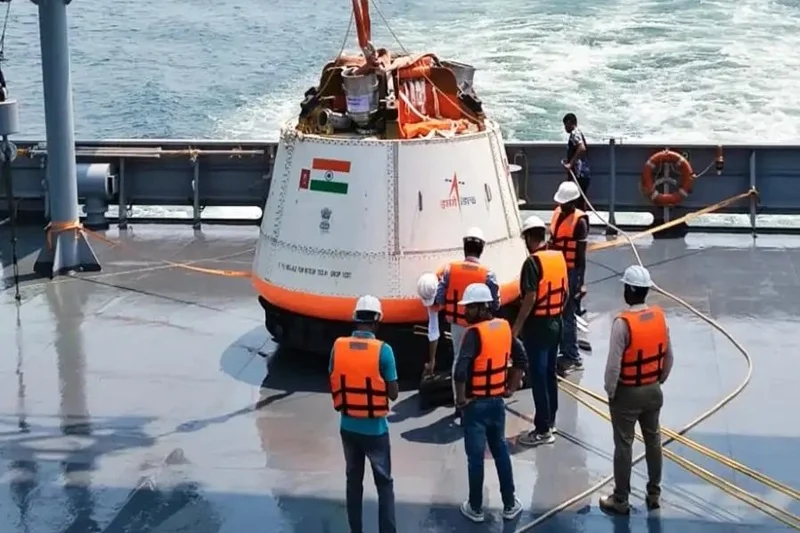

India’s human spaceflight push moved a step further on April 10, 2026, when ISRO completed the second Integrated Air Drop Test, or IADT-02, for Gaganyaan. This was not a launch-day spectacle. It was a safety drill, and a serious one. A simulated crew module was dropped, slowed, stabilised, and recovered at sea to prove that astronauts can be brought down safely if an abort or return sequence demands it. For India’s space roadmap, that is a strong signal: Gaganyaan is still being built around crew survival first, headline value second.
What Happened In The Latest Gaganyaan Crew Escape Test
ISRO said the test used a simulated Crew Module weighing about 5.7 tonnes, matching the mass planned for the first uncrewed Gaganyaan mission, G1. The module was carried by an Indian Air Force Chinook helicopter to about 3 km altitude and released over a sea drop zone near Sriharikota. During descent, ten parachutes from four categories opened in a planned sequence to reduce speed before splashdown. The Indian Navy then recovered the module.
That sequence is the headline. It shows that parachute-based deceleration and sea recovery are advancing from paper design to repeatable field validation. ISRO called it another step toward readiness for the G1 mission. ISRO’s Instagram handle, isro.dos, posted visuals around the April 10 test, while the Indian Air Force also highlighted its role in the operation.
Why This Test Is Bigger Than A Single Drop
Gaganyaan is meant to demonstrate India’s ability to send a crew of three to a 400 km orbit for a three-day mission and bring them back safely to sea. That makes escape, descent, and recovery systems non-negotiable parts of the programme. ISRO’s own mission page lists Integrated Air Drop Tests, pad abort checks, and test vehicle flights as essential precursor missions before astronauts fly.
IADT-02 also builds on IADT-01, which ISRO highlighted earlier as a full parachute deployment and sea recovery milestone. Together, the two tests show a deliberate pattern: verify the hardware, repeat the event, and reduce risk before moving deeper into the uncrewed phase.
How It Fits Into India’s 2026 Space Calendar
ISRO said in January 2026 that Gaganyaan’s first uncrewed mission was in its final phase, with propulsion work completed for human rating and more than 8,000 ground tests already finished. It also noted that software simulations and environmental checks were still being closed out.
Recommended Reads You Shouldn’t Miss Next
Planning UK Study or Work Visa Costs?
Explore the new UK visa fee changes effective from April 2026.
Checked GDS Merit List 2026 Second Update?
Discover how to quickly check your India Post selection status online.
Is India’s Space Sector Growing Rapidly Now?
Explore how ISRO’s approval is boosting private launch missions.
How Successful Was ISRO PSLV-C62 Mission?
Check how 16 satellites reached orbit in India’s 2026 launch milestone.
How Did India Reach Gaganyaan Milestone?
Discover India’s inspiring space journey from Chandrayaan to Gaganyaan.
What Comes Next
The latest air drop success improves confidence around the G1 uncrewed mission, because the crew module must not only fly well but also return in a predictable, recoverable way. Earlier government statements had placed the first human spaceflight demonstration by the end of 2026, though each precursor test still has to clear its own gate before that happens.
Why This Update Boosts India’s Wider Space Ambition
Gaganyaan is not only about sending astronauts up. It is about proving India can manage a full human spaceflight stack: human-rated launch systems, crew safety hardware, recovery operations, mission control, and partner coordination with the Air Force, Navy, and DRDO. That capability feeds future plans in low-Earth orbit, advanced crewed missions, and deeper strategic confidence in India’s space sector. IADT-02 does not finish that job, but it keeps the programme moving in the right direction.
FAQs
1. What is IADT-02 in Gaganyaan?
It is ISRO’s second air drop test for validating crew module parachute descent and recovery.
2. Why was the Chinook helicopter used?
It lifted the simulated module to release altitude for a controlled mid-air descent test.
3. Did the latest Gaganyaan test succeed?
Yes, ISRO said mission objectives were achieved and the crew module was safely recovered.
4. What does this test help verify?
It checks parachute deployment sequence, velocity reduction, splashdown stability, and post-landing recovery operations.
5. When is India’s crewed Gaganyaan mission expected?
India has earlier indicated an end-2026 target, subject to remaining uncrewed milestones and clearances.