

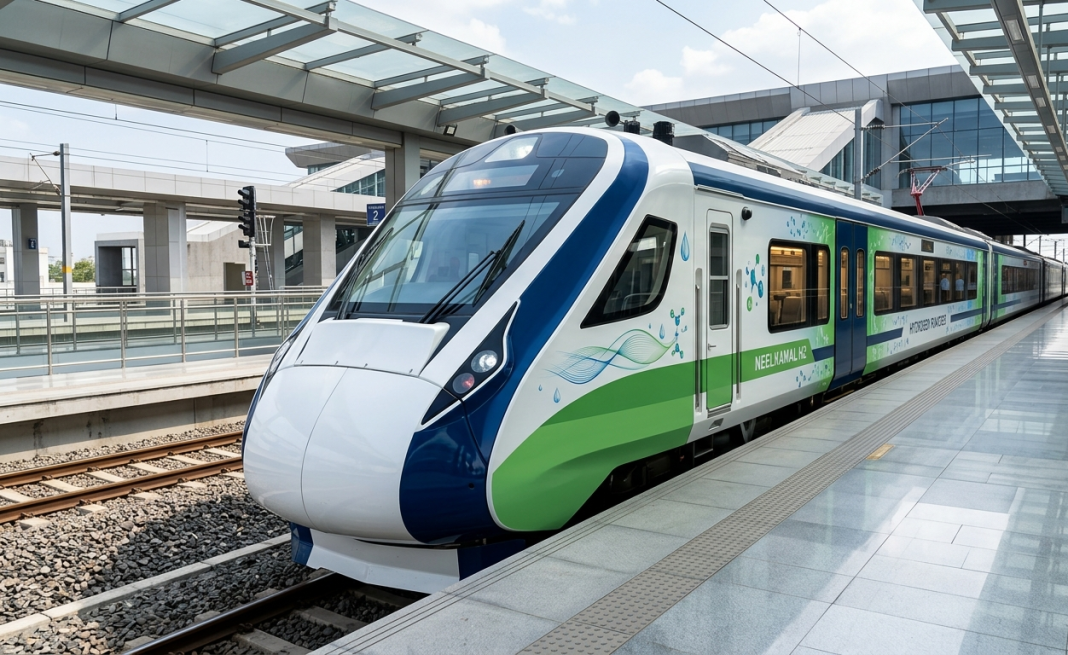

India’s railway network enters a new chapter on July 17, 2026, as Prime Minister Narendra Modi flags off the country’s first hydrogen-powered passenger train from Jind railway station in Haryana. According to the Prime Minister’s official launch programme, the indigenous train will operate on the Jind-Sonipat section of Northern Railway.
For travellers, the launch is not only about a new propulsion system. It introduces daily service numbers, fixed timings, intermediate stops, and affordable local connectivity. The train will also serve as a pilot for hydrogen technology on railway sections where continuous overhead electrification may not suit future operating plans.
What Launches Today And Why It Is Different
The inauguration takes place at Jind, where the Prime Minister is scheduled to flag off the train at around 11 am. Indian Railways has designed, engineered and integrated the train domestically, placing the project within India’s wider push for home-grown railway technology.
Unlike an electric train that continuously draws power from overhead wires, this train produces electricity onboard. Stored hydrogen reacts with oxygen inside its fuel cells. The electricity generated powers the traction motors, while water vapour and heat emerge as direct by-products. There is no diesel combustion, smoke or tailpipe carbon emission during operation.
Key details passengers are searching for include:
- Launch date: July 17, 2026
- Route: Jind Junction to Sonipat, Haryana
- Train numbers: 74010 and 74009
- Distance: About 89 km
- Frequency: Daily
- Approved speed: Up to 75 kmph
- Capacity: Around 2,600 passengers across 10 coaches
The official PIB hydrogen train factsheet calls the project a pilot that will provide operating experience for future hydrogen rail services. India now joins countries including Germany, Japan, China, and the United States in exploring hydrogen-powered passenger trains. Readers can also view the DD News official X post on India’s hydrogen train.
Jind-Sonipat Route, Stops, and Daily Timings
Train number 74010 will depart Jind at 7:40 am and reach Sonipat at 9:40 am, completing the outward journey in two hours. Train number 74009 will leave Sonipat at 10:40 am and arrive at Jind at 1 pm. The service has been approved to operate daily.
The train will stop at Jind City, Pandu Pindara, Lalit Khera, Bhambeva, Ishapur Kheri, Butana, Khandrai, Gohana, Rabhra, Lath, Mohana Haryana, and Barwasni. These intermediate halts will give residents of smaller towns a regular passenger service rather than limiting the project to a ceremonial or premium journey.
The official Railway Board Jind-Sonipat timetable confirms both train numbers, terminal timings, frequency, and commercial stoppages. Primary maintenance has been assigned at Jind.
Jind also houses India’s largest railway hydrogen storage and refuelling facility. It can store nearly 3,000 kg of hydrogen and has received the required Petroleum and Explosives Safety Organisation licence for compressed hydrogen storage and dispensing.
Speed, Coaches, Power, and Passenger Features
The hydrogen train has a design speed of 110 kmph. However, its approved maximum operating speed on the Jind-Sonipat section is 75 kmph. Passengers should therefore not confuse the train’s technical design capability with the speed permitted during regular service. The Railway Board’s speed approval specifically restricts operations to 75 kmph on this section.
The train set includes two hydrogen-powered cars and eight passenger coaches. Each power car produces around 1,200 kW, taking the combined output to approximately 2,400 kW, or nearly 3,200 horsepower. Its 10-coach formation makes it longer and more powerful than many hydrogen trains used for regional journeys overseas.
Safety arrangements include hydrogen-leak detectors, flame and smoke monitoring, continuous ventilation, and automatic fuel shut-off. The driver receives live system-health information, while emergency controls can help move the train safely when required. Trained technical employees will accompany the train during its opening phase.
Ticket Price, Booking Rules, and Passenger FAQs
Several reports place ticket fares between ₹5 and ₹25, depending on the boarding and destination stations. However, neither the Railway Board introduction circular nor the PIB factsheet provides an official station-wise fare chart. Travellers should treat the range mentioned in published hydrogen train fare reports as expected pricing until it appears through an authorised railway channel.
How To Buy Tickets
The coaches are configured for general second-class travel. Passengers should check the authorised Indian Railways unreserved booking service or purchase tickets from a station counter. Search for train number 74010 when travelling from Jind and 74009 for the Sonipat-Jind return service. Since the inaugural run may operate separately, commercial ticket availability should be checked on the intended travel date.
FAQS
When Is India’s First Hydrogen Train Launching?
The train launches on July 17, 2026, with its flag-off scheduled at Jind railway station.
Which Route Will The Hydrogen Train Cover?
It will run daily between Jind and Sonipat in Haryana, covering 89 kilometres each way.
What Is The Hydrogen Train’s Maximum Speed?
Its route-approved speed is 75 kmph, although the trainset has a 110 kmph design speed.
How Much Will Hydrogen Train Tickets Cost?
Reported fares range from ₹5 to ₹25, but passengers should verify prices through railway channels.
Where Can Passengers Buy Hydrogen Train Tickets?
Passengers can check authorised unreserved booking services or purchase tickets directly at railway station counters.