
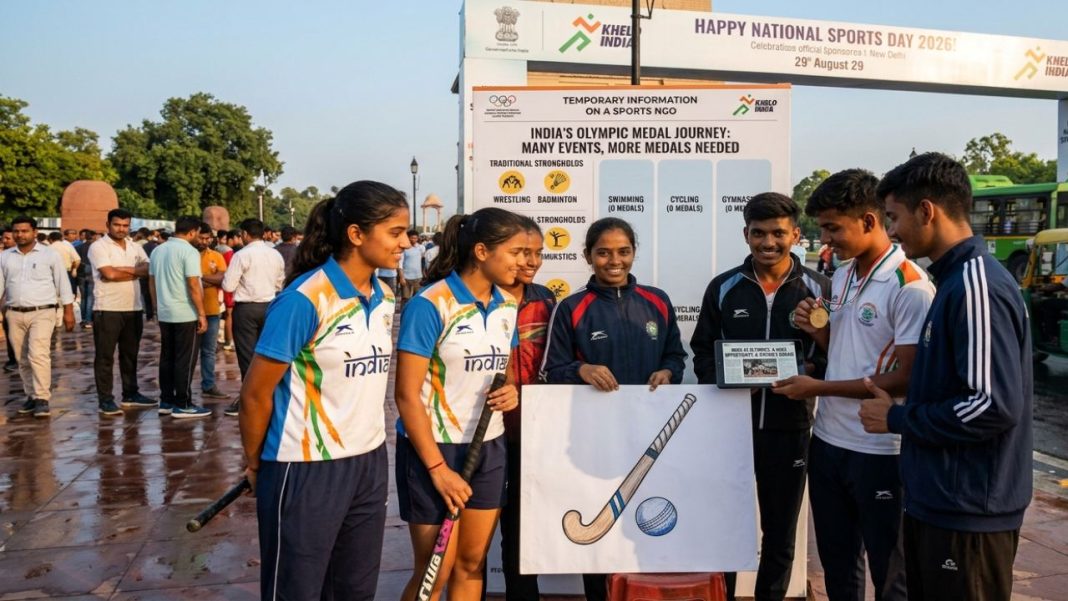

National Sports Day arrives on August 29 with Major Dhyan Chand again at the centre of India’s sporting conversation. But this year, the occasion carries a less comfortable question. Two days earlier, Prime Minister Narendra Modi asked, in effect, how India can expect a much larger Olympic medal tally when it does not even enter large parts of the programme.
The numbers make that question difficult to ignore. According to India’s official Paris 2024 contingent review, 117 Indian athletes competed across 16 sports and entered 69 events. Paris offered 329 medal events across 32 sports. India returned with six medals. That does not prove India lacks talent. It shows that the medal hunt begins from a smaller competitive base than the final table suggests.
Key Takeaways
- India entered 69 of the 329 medal events on the Paris 2024 programme.
- The Paris contingent competed across 16 sports and won six medals.
- National Sports Day 2026 has a three-day “Tribute, Play, and Move” campaign.
- LA28 will feature 36 Olympic sports, including cricket and squash.
- India’s next leap may depend on creating athletes in sports it currently barely contests.
Why India’s Olympic Problem Starts Before Medals
Indian Olympic debates usually begin after the Games. A medal is celebrated, a fourth-place finish becomes heartbreak, and the familiar question returns: why does a country of India’s size win so few?
That framing skips one stage.
At Paris 2024, India was concentrated in sports such as athletics, shooting, hockey, badminton, wrestling, boxing, archery and table tennis. Yet a large section of the Olympic programme remained outside India’s serious medal conversation. The official Paris 2024 programme contained 329 medal events. India entered 69.
Population, therefore, cannot be treated as a medal multiplier. A billion-plus people do not automatically produce Olympic finalists in diving, track cycling, artistic gymnastics, canoe slalom, surfing or modern pentathlon.
Athletes emerge where children can try a sport, find coaching, compete regularly and see a pathway worth staying in.
Participation Is The Missing First Step
Modi put the issue plainly during the Khelo India Dialogue on August 27: other countries are winning medals in sports where India does not participate. He pointed to surfing and sport climbing, arguing that India has coastal and mountainous regions capable of supporting such disciplines.
He also carried the point into an official X post, saying facts about India’s Olympic journey should push the country towards greater sporting excellence.
But participation cannot mean finding one qualifier every four years. India needs depth.
A child trying kayaking in Kerala, climbing in Uttarakhand, cycling in Haryana or gymnastics in Maharashtra should not depend on one enthusiastic coach or a short-lived local programme. The ladder has to continue from school participation to district competition, national ranking, sports science and international exposure.
The revamped Khelo India Scheme, approved this month with a combined ₹36,441 crore outlay for 2026-27 to 2030-31 alongside enhanced federation assistance, gives India considerably more ammunition. The tougher question is where it goes. Will underrepresented Olympic sports receive lasting pathways, or will attention remain centred on disciplines India already knows?
LA28 Gives India A Chance To Rewrite The Pattern
Los Angeles 2028 could make this debate sharper. The Games will feature 36 Olympic sports. Cricket returns, squash makes its Olympic debut, while flag football and lacrosse also join the programme under the LA28 Olympic sports lineup.
For India, cricket and squash are obvious openings. They also demonstrate why breadth helps. India does not need to become world-class in every Olympic sport overnight. It does need to find where geography, facilities, sporting culture and athlete profiles can produce competitive entries.
That calls for a district-by-district approach, not one national template. Coastal regions can feed sailing, rowing and surfing. Mountain states can build climbing and winter-sport pipelines. Cities with suitable facilities can support track cycling. Strong swimming programmes can eventually feed diving, water polo and triathlon.
This is where talent stops being an abstract national resource. A functioning sporting system actually finds it.
National Sports Day Should Become A Participation Audit
The National Sports Day 2026 campaign is being observed from August 28 to 30 under the theme “Tribute, Play, and Move.” The wording is timely because participation itself remains part of the bottleneck.
India has increased sports funding, announced a long-term Khelo India Mission and begun implementing the National Sports Governance Act framework in 2026. Those steps create machinery. Olympic results will eventually reveal what that machinery produces.
The bigger question, then, is not talent versus participation. Talent can stay invisible when participation is narrow. India may already have future Olympians in sports their schools do not offer, their districts cannot coach and their families have never considered viable.
National Sports Day should celebrate champions. It should also count the doors that remain closed.
FAQs
Why is National Sports Day celebrated on August 29?
It marks Major Dhyan Chand’s birth anniversary and celebrates India’s sporting culture, athletes and participation.
How many sports did India contest at Paris 2024?
India competed across 16 sports, with 117 athletes entering 69 events during the Paris Olympic Games.
How many medal events were held at Paris 2024?
Paris 2024 staged 329 Olympic medal events across 32 sports during its official competition programme.
Which new sports at LA28 could help India?
Cricket and squash offer obvious opportunities, while broader investment could open pathways in other disciplines.
Is participation alone enough to increase Olympic medals?
No. Participation must be followed by coaching, competition, sports science, selection and long-term athlete support.