
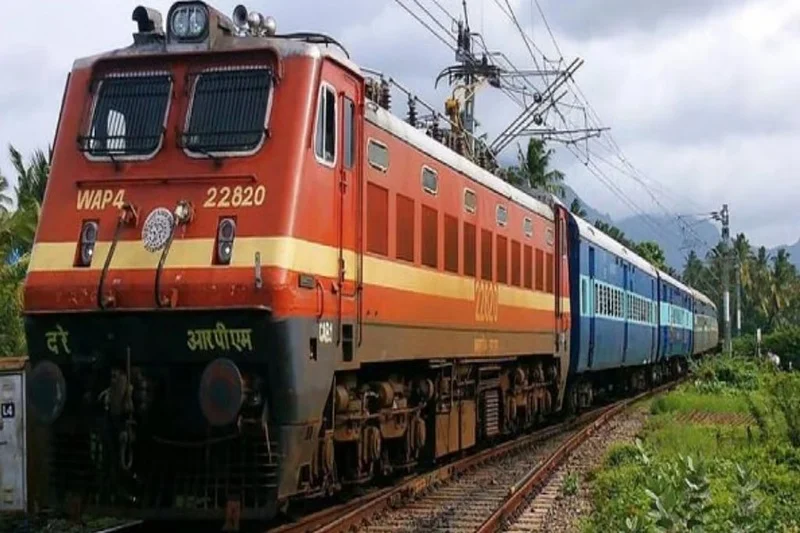

North Eastern Railway created a new freight milestone on August 20, 2026, when its Lucknow Division operated ‘Awadh Mahashakti’, the zone’s longest-ever freight train. Built by coupling three freight rakes, the formation ran from Gonda to Sitapur, covering about 160 km in 3 hours and 50 minutes at an average speed of nearly 42 kmph. It had 129 empty BCN wagons and three locomotives.
The run was not a speed-record attempt. Its real achievement was moving three rakes through one railway path, saving two additional passages on a busy corridor. Awadh Mahashakti is North Eastern Railway’s longest train, not Indian Railways’ longest train overall.
What Made Awadh Mahashakti Different From A Regular Freight Train?
The giant formation was assembled at Gonda Yard under the Lucknow Division. Rather than sending three freight trains separately, railway teams joined them for one long-haul movement. North Eastern Railway’s official social media post described the formation as 1.2 km long.
Key details from the run include:
- Three freight rakes were combined into one train.
- The formation carried 129 empty BCN wagons.
- Three locomotives hauled the rake.
- It left Gonda at 1:50 pm and reached Sitapur at 5:40 pm.
- Combining the rakes saved two train passages.
The wagons were being moved north for loading. So the exercise was not simply about building a huge train. It was about repositioning more wagons while using fewer slots on the railway network.
How Did The 129-Wagon Train Cover 160 Km In Only 3 Hours 50 Minutes?
The timing becomes clearer when the operating plan is considered. Awadh Mahashakti averaged around 42 kmph, meaning it did not need extreme speed. Three locomotives provided traction, while the combined formation allowed the railway to move three rakes in a single path.
North Eastern Railway CPRO Sumit Kumar told The Indian Express in a report on Awadh Mahashakti that the long haul saved two passages because three rakes travelled together. That is valuable on the Gonda-Burhwal-Sitapur section, which is part of High-Density Network-4, a major Delhi-Guwahati railway corridor.
The official North Eastern Railway X post showed the formation and called the operation a historic achievement for the zone. It is the most direct official social-media record of Awadh Mahashakti’s run.
Put simply, the train completed 160 km in under four hours through coordinated traffic handling, three-locomotive traction and efficient use of one train path. The achievement was operational efficiency rather than raw speed.
Why Is This Freight Experiment Important For Indian Railways?
The timing is significant because Indian Railways is carrying record cargo volumes. Ministry of Railways data on 2025-26 freight show that the network moved 1,670 million tonnes of freight in 2025-26, up 3.25% from the previous year. The July 2026 freight loading update recorded 141.3 million tonnes, a 9% year-on-year rise.
Awadh Mahashakti fits into this wider push to get more from existing infrastructure. Combining rakes can cut separate train movements, reduce path demand and help release slots for other freight or passenger services.
The Railways is also expanding capacity through Dedicated Freight Corridors. An August 2026 freight-capacity update said around 443 trains operate daily on the DFC network, where faster turnarounds have helped create additional paths on conventional routes.
How Does Awadh Mahashakti Compare With Rudrastra?
Awadh Mahashakti does not hold India’s overall length record. In 2025, East Central Railway operated ‘Rudrastra’, a roughly 4.5 km freight train formed from six empty BOXN rakes. It used 354 wagons and seven locomotives and covered about 200 km in around five hours.
The two runs highlight different goals. Rudrastra demonstrated extreme train length, while Awadh Mahashakti showed how three rakes could share one path on a high-density route.
Another freight development is unfolding too. India’s first Vande Bharat Freight EMU entered technical trials in July 2026 and touched 145 kmph during testing. The Vande Bharat Freight EMU trial report says it is designed for faster parcel, e-commerce and cold-chain cargo, representing the speed-focused side of railway freight modernisation.
One successful run does not mean 129-wagon formations will immediately become routine. Longer trains need suitable routes, signalling coordination, braking checks, locomotive planning, yard capacity and careful traffic regulation.
Still, Awadh Mahashakti has demonstrated a useful operating option. Its biggest gain was not only its length, but the ability to move 129 empty wagons while saving two train paths. With freight volumes rising, that approach could become more valuable on congested sections. That makes the run relevant beyond a one-day railway record, especially as freight demand keeps climbing.
FAQs
What Is Awadh Mahashakti?
Awadh Mahashakti is North Eastern Railway’s longest freight formation, using 129 wagons and three locomotives.
How Long Did Awadh Mahashakti Take From Gonda To Sitapur?
It covered roughly 160 km in three hours and fifty minutes, averaging about 42 kmph overall.
How Many Wagons And Engines Did Awadh Mahashakti Have?
The freight train used 129 empty BCN wagons and three locomotives for its historic run.
Is Awadh Mahashakti India’s Longest Freight Train?
No. Rudrastra remains longer, with roughly 4.5 km, 354 wagons, and seven locomotives in 2025.
Why Did Railways Combine Three Freight Rakes?
Combining them saved two train passages, helping Railways use busy track capacity more efficiently overall.