


An Anthropic mathematician says Claude helped him prove the Riemann hypothesis. Independent checks have passed, but the Clay Mathematics Institute still lists the problem as unsolved.
On 20 November 2026, Levent Alpöge published a four-page note announcing his claim. The proof itself came in an unusual form: a large collection of files written in Lean, a language that lets computers check mathematical arguments. By 1:15 a.m. IST on 21 November, MIT mathematician Andrew Sutherland had reported that all 175,187 modules compiled without errors. His update also identified checks still in progress.
Key Highlights
- Alpöge credits Claude with helping develop the argument itself, including a step he describes in his announcement.
- An independent proof checker accepted the exported proof, according to Sutherland’s verification log.
- The $1 million Millennium Prize has its own publication and review requirements. A successful software check does not trigger an award.
What Did Alpöge Say Claude Contributed?
Alpöge describes starting with a simpler mathematical setting where two ideas seemed to work together. He identified a way to carry that approach into the harder problem. Later, when the argument needed a chain of mathematical operations, he says Claude suggested how long that chain should be. His note singles out that choice as a moment when the model moved ahead of him.
The four pages tell readers how the work unfolded. Anyone looking for the full reasoning has to open the Lean files. Alpöge acknowledged that he had yet to master parts of the mathematics surrounding the argument and wanted to produce a simpler written account. That leaves two different jobs for other mathematicians: check precisely what the code proves and explain why the method works.
What Does the Riemann Hypothesis Say About Prime Numbers?
Start with a small count. There are four primes up to 10: 2, 3, 5, and 7. Count up to 100, and there are 25. Mathematicians have a formula that estimates how many primes occur below a given number. Riemann’s question concerns how far the actual count can stray from that estimate.
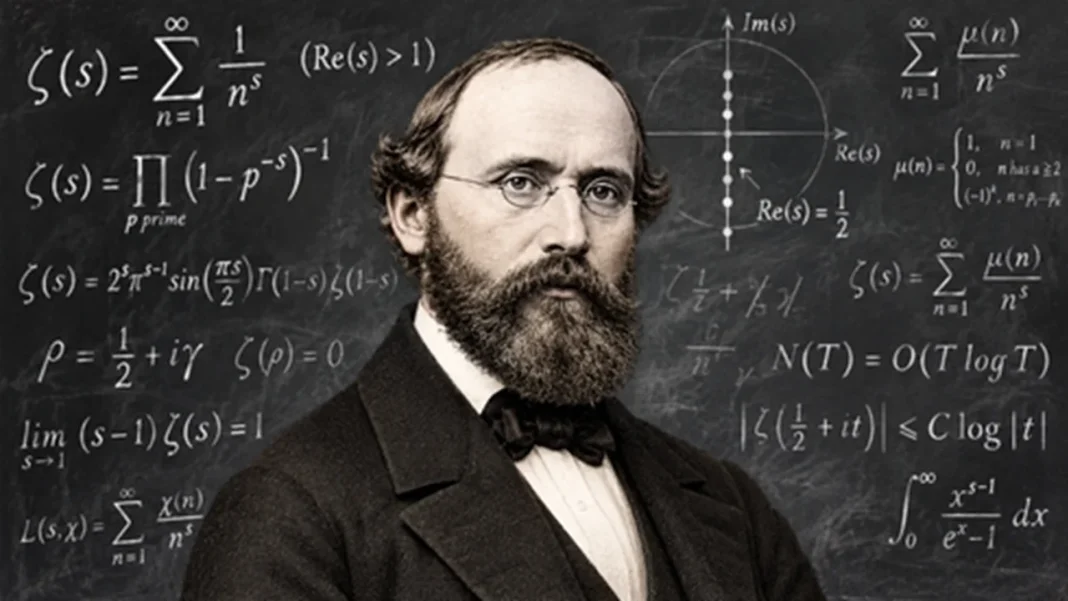
In 1859, Bernhard Riemann connected that question to a function now named after him. The hypothesis says that every non-trivial zero, a particular kind of input for which the function equals zero, lies on the same vertical line. The Clay Mathematics Institute’s explanation gives the line’s exact position: every such zero has real part ½.
- What calculations show: The first 10 trillion non-trivial zeros checked lie on that line.
- What a proof must show: Every non-trivial zero lies there, including those beyond the reach of any finite calculation. A single exception would overturn the hypothesis.
Which Checks Has the Proposed Proof Passed?
Sutherland’s verification log records more than a successful attempt to run the files. He also examined which assumptions the main results depend on and tested the exported proof with a separate checker. His update was time-stamped 19:45 UTC on 20 November.
| Check | What Sutherland Reported |
| Compile the published source | All 175,187 modules compiled without errors. |
| Inspect the five main theorems | They relied only on three standard axioms used in Lean. |
| Test the exported proof independently | A separate checker called nanoda accepted it. |
| Run further comparisons | Two additional checks were still running at the time of the update. |
Those results give specialists something specific to examine. A checker tests the argument against the statement written in the files. A mathematician reviewing the claim can also inspect the definitions and ask whether that statement captures the classical problem in full. The verification log makes it possible to follow that work beyond the original announcement.
What Happens Before Anyone Receives the $1 Million Prize?
The Millennium Prize rules set out two milestones worth watching.
- A proposed solution must appear in a qualifying publication and gain general acceptance among mathematicians worldwide.
- At least two years must pass after that publication before the institute will consider the solution. The announcement date alone does not start the clock.
For readers following the story, the most informative update will be a specialist’s account of exactly what the formal proof establishes. Until then, read the announcement alongside the dated verification log. One explains the discovery Alpöge believes he made with Claude. The other shows which parts an independent researcher has already tested.
Frequently Asked Questions
Did Claude solve the problem on its own?
Alpöge describes a collaboration. He chose a mathematical approach and credits Claude with developing parts of the argument, including a specific suggestion late in the work.
Why did Alpöge release only four pages of explanation?
The note introduces the claim and describes how the work developed. Alpöge released the detailed argument as Lean files and said he intended to write a simpler account.
Is checking Lean code the same as testing more zeros?
Checking more zeros tests additional examples. Lean checks whether each step of an argument follows from its assumptions, so a formal proof can cover infinitely many cases.
Does the claim extend beyond the original hypothesis?
Alpöge also claims a result for the generalised Riemann hypothesis involving Dirichlet L-functions. His announcement treats a further extension as a possibility for future work.
When could the Clay Mathematics Institute consider an award?
The earliest point comes two years after publication in a qualifying outlet. The proposed solution must also have gained general acceptance in the global mathematics community.
Explore More Claude AI Breakthroughs, Features and Latest Updates
1. Is Claude Pro Affordable in India?
Check out Claude AI subscription pricing, Pro plan costs and available features for Indian users.
2. Which Claude Model Offers Better Value?
Compare Claude Fable 5.2 and Opus 5.5 features, pricing and key differences.
3. What Changed With Claude Fable 5?
Uncover the July 2026 subscription update and its implications for Claude users.
4. Can Claude Voice Control Your Apps?
Explore Claude’s voice mode, Opus and Sonnet capabilities, and app control features.
5. Why Is AI Model Distillation Controversial?