

A Constitution book usually sits on a shelf, untouched, like a “for experts only” item. This week, that distance narrowed. Prime Minister Narendra Modi commended the release of the Constitution in Santhali language, a move framed as a push to boost democratic participation, a development that has drawn attention in India Current News. The Santhali edition, presented in Ol Chiki script, turns a national document into something many Santhali households can actually read, line by line, without a translator hovering nearby.
Background of the Santhali Language and Ol Chiki Script
Santhali carries the weight of daily life across parts of Jharkhand, Odisha, West Bengal, and Bihar. It is spoken at markets, on bus rides, at village meetings, and in classrooms where children still switch between home speech and official language. Ol Chiki, the script linked closely with Santhali identity, has its own history of struggle and pride. People who grew up seeing Ol Chiki on community posters know the feeling: it looks familiar, it sounds right in the head.
A Constitution translation in Santhali is not a decorative gesture. It deals with a basic problem India keeps running into. Laws exist, schemes exist, rights exist, but the language barrier stays stubborn. Paperwork talks in a tongue many citizens do not use at home. And that gap quietly decides who asks questions and who stays silent.
President Droupadi Murmu’s Leadership in the Constitution Release
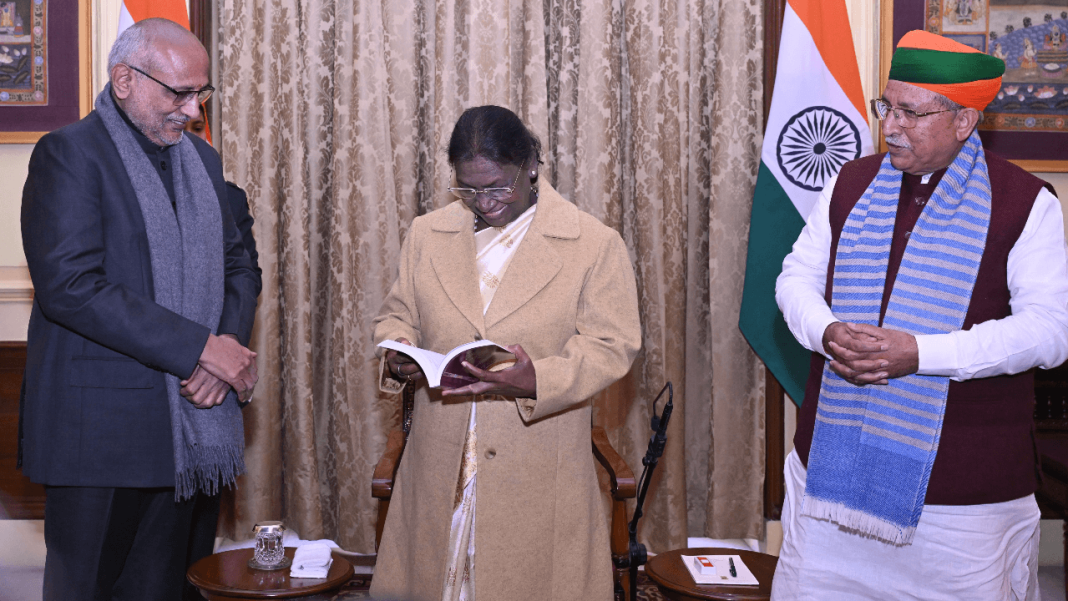
The release took place at Rashtrapati Bhavan, with President Droupadi Murmu leading the ceremony. Delhi’s winter air has that sharp, dry bite, and inside the hall the mood stayed formal but not stiff. A Constitution copy in Ol Chiki was presented as an official edition, not a side-note. The symbolism mattered, yet the practical angle mattered more.
Officials around the event pointed to access. A citizen reading constitutional rights in a familiar script has a different confidence. It changes how a person approaches a local office, a police station, a school meeting, or a panchayat discussion. It is a small shift, but these are the shifts that stack up over years.
Prime Minister Narendra Modi’s Commendation and National Message
Prime Minister Modi publicly praised the effort, calling it commendable and linking it to stronger democratic participation. The statement leaned on a simple idea: democracy works better when people can read the rules. Not summaries. Not hearsay. The actual words.
The Prime Minister also spoke about pride in Santhali culture and the contribution of Santhali communities to national progress. That line lands well in tribal regions where people often feel noticed mainly during elections. Recognition after elections feels rarer. But recognition also needs follow-through, otherwise it sounds like a speech line and nothing else.
Why the Santhali Translation of the Constitution Strengthens Democracy
Democratic participation starts long before polling day. It begins when people understand what the State can ask, what the State cannot ask, and what citizens can demand without fear. A Constitution edition in Santhali supports that process in a direct way.
A real-world example makes it clear. A community member hearing “fundamental rights” in a public talk may nod politely, but later struggle to explain it at home. Put the same idea in Ol Chiki on a printed page, and the discussion turns concrete. People can point to a line, read it twice, argue over meaning, and settle doubts. It becomes less mysterious.
Impact on Tribal Communities and Regional Participation
In tribal regions, participation often gets blocked by practical hurdles. Travel time to offices, unfamiliar forms, and language that feels cold and distant. Add a Constitution translation in Santhali, and one hurdle weakens.
This could matter in ways that rarely make headlines:
- clearer discussions in gram sabhas and community meetings
- better understanding of grievance routes and complaint formats
- stronger confidence among young first-time voters and student groups
But the bigger impact is psychological. A citizen seeing their script in a national constitutional document reads it as respect. That respect, even if late, shapes civic mood. People engage more when they feel the system speaks their language, literally.
Government Initiatives Supporting Multilingual Constitutional Access
India already holds a long tradition of multilingual governance, yet constitutional access has stayed uneven. Government bodies have supported translations and language promotion in different forms across decades. The Santhali edition fits into that broader direction, but it stands out because it targets a community that often remains on the edge of official communication.
A simple distribution picture helps clarify the need:
| Access Point | What Usually Happens | What Needs To Happen |
| Schools and colleges | Civics taught through summaries | Students read key parts directly in Santhali |
| Local offices | Forms available in limited languages | Reference copies available for public reading |
| Digital access | Links shared, pages hard to find | Searchable Santhali PDF and mobile-friendly access |
Community and Cultural Response to the Santhali Edition
Early reactions in Santhali circles tend to carry two feelings at once: pride and a quiet “about time.” Cultural groups have long pushed for serious recognition of Ol Chiki in education and administration. A Constitution edition strengthens their argument with official weight.
Teachers in tribal belts often talk about a familiar scene: students speak Santhali at home, then face civic concepts only in Hindi or English at school. The result is a gap in confidence. The Santhali edition gives educators a tool that feels natural. But tools need distribution. If copies stay limited, the excitement will fade.
Challenges and Opportunities for Wider Implementation
Translation alone cannot fix access. Distribution is the first headache. Printing enough copies, placing them in libraries, schools, panchayat offices, and community centres. Then digital access. A searchable online version in Ol Chiki would help young readers who live on smartphones.
Another challenge is guidance. A Constitution text is dense, even in a familiar language. Supporting booklets, simplified explanations, and teacher training will be needed. Officials at local offices also need orientation, otherwise the Santhali edition stays symbolic.
Yet the opportunity is clear. This step can set a pattern. Other indigenous language communities will notice. And they will ask, politely or loudly.
FAQs
1) Why does a Constitution issue in Santhali language matter for democratic participation?
It reduces language barriers, so citizens can read rights and duties directly, not through second-hand explanation.
2) What is the role of Ol Chiki script in the Santhali Constitution edition?
Ol Chiki is widely linked with Santhali reading and identity, so the text becomes accessible in a familiar script.
3) How can schools use the Santhali translation of the Constitution effectively?
Teachers can use it for civics reading, discussions, and local examples, making constitutional ideas easier to grasp.
4) Which regions may see direct impact after the Constitution is available in Santhali?
Santhali-speaking belts across Jharkhand, Odisha, West Bengal, and Bihar may see better civic awareness and engagement.
5) What practical steps are needed after the launch to make the edition useful?
Wide distribution, a digital version, supporting guides, and training for educators and local officials will be essential.