

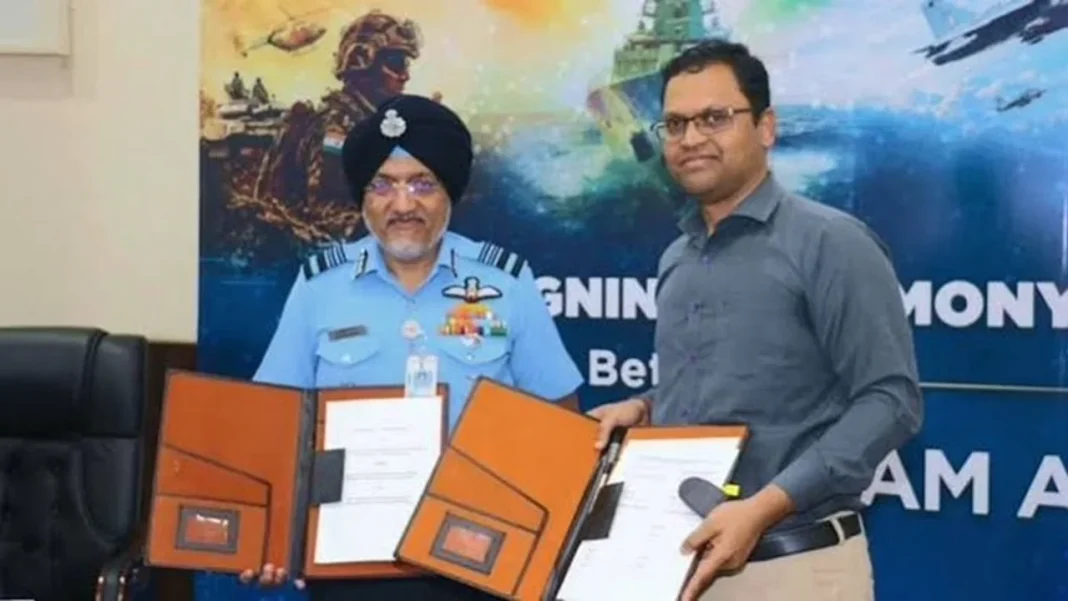

Sarvam has announced an agreement with Headquarters Integrated Defence Staff (HQ IDS) to develop AI applications for the Army, Navy and Air Force. The framework covers operational requirements, training and decision support across the Services and joint organisations.
The company published its announcement on October 27, 2026. In an October 28 clarification, Sarvam specified that it signed the MoU with HQ IDS, an organisation under the Ministry of Defence, rather than directly with the ministry.
Key Highlights
- The five-year MoU establishes a framework for multiple AI projects.
- HQ IDS will facilitate engagement across the Services.
- Sarvam’s Chanakya division will carry out the work.
- The announcement retains human oversight of operational decisions.
What The Sarvam AI Defence Agreement Covers
The five-year term describes the collaboration period. The announcement does not provide a delivery schedule for individual applications or confirm a completed rollout across the armed forces. Financial terms and project-level details remain undisclosed.
Sarvam’s statement assigns different responsibilities within the framework:
| Organisation Or Division | Announced Responsibility |
| HQ IDS | Facilitate engagement across participating Services and joint organisations |
| Sarvam | Design, develop and deploy applications, then provide technical support |
| Chanakya | Execute the work using Sarvam’s AI technology stack |
The arrangement covers several projects rather than one finished product. Sarvam says participating organisations will draw on common foundation models and infrastructure, allowing lessons from one Service’s projects to inform another.
HQ IDS announced the collaboration on X on October 26, identifying research, knowledge management, and training among its areas of work. Sarvam’s company announcement followed the next day.
Indian-Made Models And The Role Of Chanakya
Sarvam names its 105B foundation model among the technologies Chanakya will use. The model’s public documentation describes a mixture-of-experts architecture with 10.3 billion active parameters. Only part of the model participates in processing each token, rather than the entire parameter set operating together.
Those specifications describe the underlying model. They do not establish the accuracy or readiness of a defence application built around it.
Sarvam’s March 6 technical release says it trained its 30B and 105B reasoning models entirely in India using computing resources provided under the IndiaAI Mission. It also released downloadable model weights, giving developers a route to run the models outside a public consumer chatbot.
Chanakya’s previously announced deployment approach includes:
- On-premise operation: Running systems within an organisation’s infrastructure.
- Air-gapped environments: Operating without an internet connection where security requirements demand isolation.
There is already a related training example. On August 18, 2026, the Defence Services Staff College in Wellington launched DRONA 2.0, a generative AI platform incorporating Sarvam 105B alongside other open-source models. Its focus includes defence education, research and strategic studies. That institutional application provides context for the broader agreement without proving readiness for operational use.
Human Oversight, Sovereign Infrastructure And Open Questions
Sarvam identifies decision support, target acquisition and data fusion among the intended areas of work. Its statement says the AI layer will use sovereign infrastructure and retain human oversight of operational decisions.
The public description does not explain the approval process for individual applications. It therefore supports a narrower conclusion than claims that AI will independently direct military operations.
For readers assessing future announcements, two details deserve attention:
- Deployment evidence: Which application has moved beyond development, who uses it and what task it performs.
- Oversight arrangements: What decisions require human approval and how users can review the system’s output.
These are questions for subsequent disclosures, not capabilities the MoU itself demonstrates. A training tool searching an academic repository and an operational decision-support system would require different evidence of performance.
The Sarvam AI defence agreement establishes a route for shared development across the Services. Its practical results will become clearer through named projects and confirmed deployments.
Follow Sarvam’s updated announcement and official HQ IDS communications for project-specific developments, rather than treating the agreement’s duration as a deployment deadline.
FAQs
Did Sarvam sign the agreement directly with the Ministry of Defence?
Sarvam clarified on October 28 that HQ IDS signed the MoU. HQ IDS operates under the Ministry of Defence, but the two are not interchangeable signatories.
How long does the Sarvam AI defence agreement last?
Reporting describes a five-year MoU. That period covers the collaboration framework; the public announcement does not assign a separate delivery deadline to each proposed AI application.
Does Sarvam 105B already power a defence training application?
DRONA 2.0 at the Defence Services Staff College incorporates Sarvam 105B alongside other open-source models. Its training and research role differs from the broader projects envisaged.
More Defence And Aviation Updates You Can’t Miss!
1. Why Celebrate Indian Air Force Day?
Explore the history behind Indian Air Force Day and why India marks October 8.
2. What Are India’s 160 Anti-Airfield Weapons?
Uncover details of India’s 160 anti-airfield weapons deal and its significance for the IAF.
3. How Will UDAN’s 21 Agreements Help?
Check out the 21 UDAN 2026 agreements involving states, Union Territories and airports.
4. How Could GSAT-7B Strengthen Army Communications?
Find out how India’s GSAT-7B Army satellite is expected to support military operations by 2028.
5. What Happens During Veer Guardian 2026?