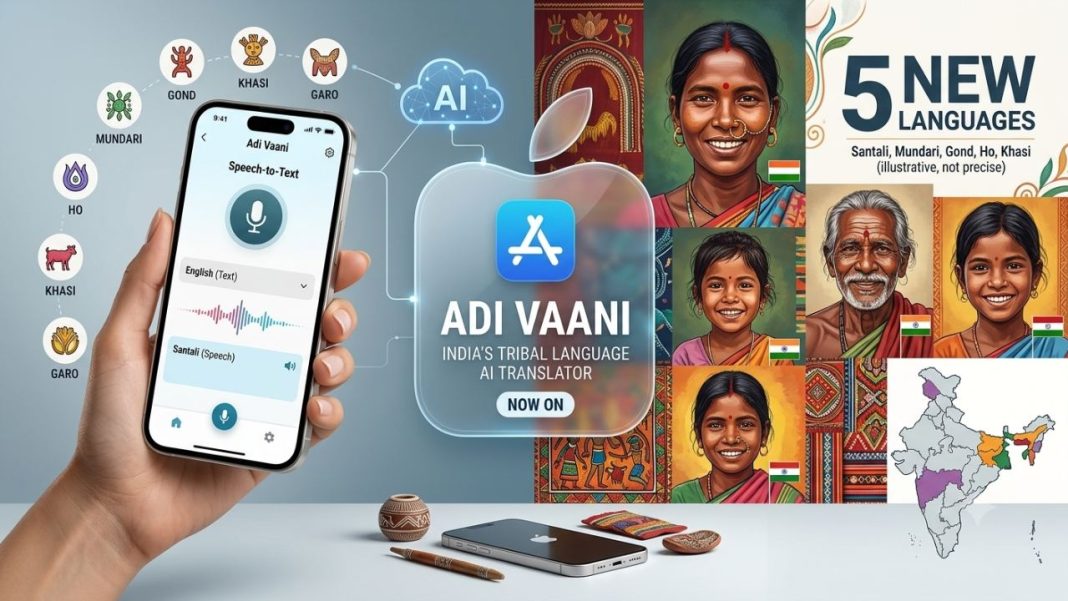

India’s AI push into low-resource languages has moved beyond Android. The Ministry of Tribal Affairs launched an upgraded Adi Vaani platform in Mysuru on August 24, 2026, bringing the tribal-language translator to iPhones and adding five more languages. The update came during the National Conclave on Tribal Languages and Museums, where officials, linguists, researchers and tribal representatives were discussing ways to protect languages that are poorly documented or mainly passed down orally. The Ministry’s official August 24 announcement confirmed the expansion.
Adi Vaani began as India’s first AI-powered translator focused on tribal languages. Its bigger test now is whether people actually use it in homes, schools and public services.
What Changed In The Latest Adi Vaani Upgrade?
The August 24 rollout gave Adi Vaani an iOS application, five additional languages, a new logo and further platform features. Apple’s Adi Vaani App Store listing identifies the Ministry of Tribal Affairs as the developer and describes translation tools covering text, speech and images.
The government release confirms five languages were added, but does not identify all five by name. In March 2026, the Ministry told Lok Sabha that Gondi, Mundari, Bhili and Santali were supported, while Kui and Garo were under development. Its Lok Sabha response on Adi Vaani’s language roadmap also listed Katkari, Koya, Kokborok, Betta Kuruba, Thodou Kuki, Tangkhul and Chodri for a later phase. The August announcement should not be treated as confirmation that any particular five from that list are now live unless the Ministry names them.
Key developments around the launch include:
- Adi Vaani is now available on iOS alongside its existing web and mobile access.
- Five new languages were added to the upgraded platform.
- The Ministry launched “Jago”, its AI conversational assistant for tribal welfare information.
- The Ministry and Central Institute of Indian Languages signed an MoU on language documentation and corpus development.
- Karnataka released tribal-language learning material, including a Jenukuruba Class 1 primer.
- More than 150 participants joined the opening day of the Mysuru conclave.
The Ministry’s official X account also posted from the conclave on August 24. Its official X update from Mysuru highlighted the national gathering around tribal languages and heritage.
How Does Adi Vaani Translate Tribal Languages?
Adi Vaani is not limited to typed translation. It was designed for text-to-text, text-to-speech, speech-to-text and speech-to-speech use. It also includes optical character recognition, which can pull text from images or documents for translation.
That toolkit is useful for languages with little digital text. A spoken story can become searchable material. A printed primer can be digitised. A health advisory can be translated for a community that may not use Hindi or English comfortably.
The project is led by IIT Delhi with BITS Pilani, IIIT Hyderabad, IIIT Naya Raipur and Tribal Research Institutes. Government material says the work adapts AI models such as IndicTrans2 and Meta’s No Language Left Behind for low-resource languages, while community experts help validate translations. More details appear in the government’s original Adi Vaani launch note.
Can An AI App Actually Stop A Language From Disappearing?
No app can preserve a language on its own. A language survives when people speak it at home, teach it to children, use it in schools, and create stories, songs and everyday conversations in it.
Still, Adi Vaani addresses a large digital gap. Government data cited at its 2025 launch said India has 461 tribal languages spoken by Scheduled Tribes and 71 distinct tribal mother tongues. It also classified 81 languages as vulnerable and 42 as critically endangered.
Digitisation can create dictionaries, speech datasets, primers, recordings and searchable archives before vocabulary or oral traditions are lost. Translation can also give a language practical uses in classrooms, healthcare, welfare delivery and communication with officials.
There is a catch. Poor translations, weak dialect coverage or language data collected without community participation can reduce trust. The Mysuru conclave discussed data protection, commercialisation, corpus building and community-led revitalisation. Language AI is also about who controls the data and how communities benefit from it.
What Comes Next For Adi Vaani And India’s Tribal Language Push?
The next phase will be judged less by the number of languages on a menu and more by active use. Downloads, repeat users, translation quality, offline access, school adoption and participation by native speakers will show whether Adi Vaani becomes an everyday tool.
The Mysuru event widened the effort beyond one app. The CIIL partnership is intended to strengthen documentation and corpus development, while sessions covered multilingual education, dictionaries, teacher resources and community-led preservation. A proposed Mysuru Declaration was also on the conclave agenda.
For endangered languages, that wider approach may be more valuable than AI alone. Technology can record a voice and translate a sentence. Keeping a language alive still depends on people choosing to speak it.
FAQs
What Is Adi Vaani?
Adi Vaani is an AI translation platform built specifically for India’s tribal and endangered languages.
Which Five New Languages Were Added To Adi Vaani?
The upgraded platform added five languages, though the August government release did not name them.
Is Adi Vaani Available On iPhone?
Yes, the Ministry of Tribal Affairs now offers Adi Vaani through Apple’s App Store officially.
Can Adi Vaani Help Preserve Endangered Tribal Languages?
It can help by documenting speech, creating digital resources, and supporting everyday use across generations.
Who Developed Adi Vaani?
IIT Delhi leads the consortium with IIIT Hyderabad, IIIT Naya Raipur, BITS Pilani, and TRIs.