
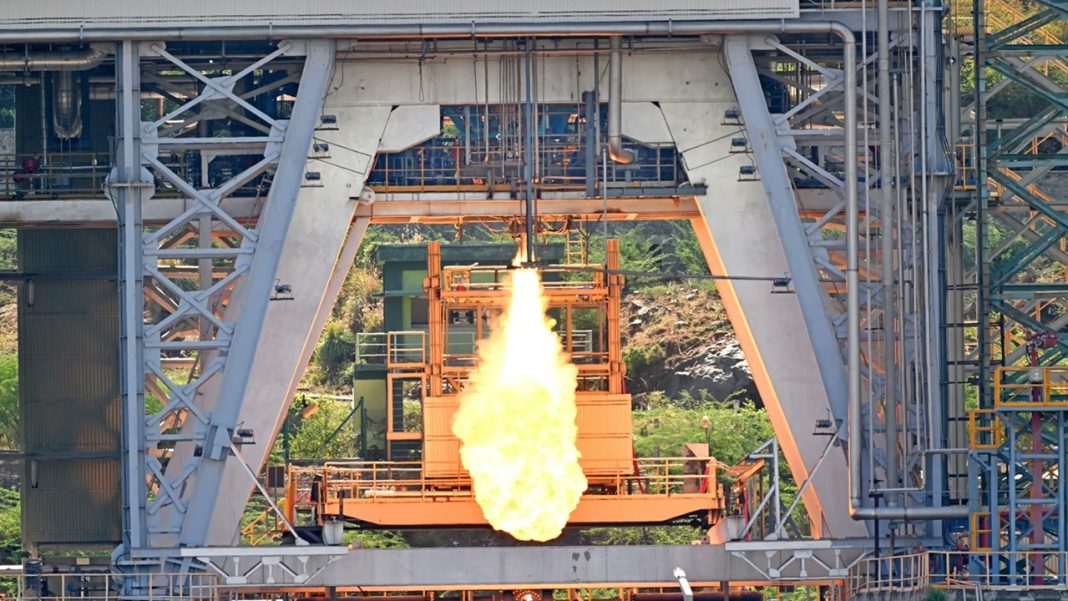

ISRO has crossed a major propulsion checkpoint after running its Semi-Cryogenic Engine Power Head Test Article at the full 200-tonne thrust level for the first time. The test took place at the ISRO Propulsion Research Complex in Mahendragiri, Tamil Nadu, on September 5, 2026. It brings India closer to a planned LVM3 upgrade aimed at carrying heavier satellites while replacing the current L110 liquid core stage.
According to ISRO’s official September 5 test release, the firing lasted 35 seconds, with the power head operating at 100% thrust for five seconds. The test article includes all major engine systems except the thrust chamber. ISRO also validated the switch from a low-pressure start tank to a medium-pressure run tank, needed before longer trials.
Key Highlights
- The PHTA reached 200 tonnes, or 100% of planned thrust, for the first time.
- It was the ninth hot test in the semi-cryogenic power-head programme.
- Earlier firings reached 94 tonnes, 120 tonnes and 175 tonnes.
- The future SC120 stage will use the 2,000 kN-class SE2000 engine and replace LVM3’s L110 core.
- ISRO says SC120 with an uprated cryogenic stage could lift GTO capability from 4 tonnes to 5 tonnes.
What Exactly Did ISRO Test At Mahendragiri?
The September 5 firing was not a launch-ready SE2000 engine firing. ISRO tested the Power Head Test Article, or PHTA, which contains the feed system, turbopumps, pre-burner, start system and control hardware but excludes the thrust chamber. The power head must first prove stable operation before the complete integrated engine faces longer qualification runs.
The programme has climbed steadily through its test points. ISRO first reported successful hot testing in its March 2025 semi-cryogenic engine update. By June 24, 2026, the PHTA had reached 175 tonnes, or 88% thrust. The latest run finally took it to the planned 200-tonne level, with ISRO reporting that engine parameters followed predictions.
The engine uses liquid oxygen and purified kerosene, called isrosene by ISRO. Compared with the present L110 stage’s earth-storable propellants, the semi-cryogenic combination is intended to deliver higher performance while using non-toxic propellants.
How Much More Could The Upgraded LVM3 Carry?
The key figure is the planned payload gain to Geosynchronous Transfer Orbit. ISRO has stated that combining the SC120 semi-cryogenic stage with an uprated cryogenic upper stage could increase LVM3’s GTO capability from about 4 tonnes to 5 tonnes.
That is roughly a 25% increase over the older 4-tonne benchmark. ISRO’s LVM3-M6 mission page cites a 4,200 kg GTO capability. A 5-tonne target would widen the range of communication spacecraft and commercial payloads India could launch without splitting missions or using a foreign launcher.
LVM3 has already pushed past earlier operational milestones. CMS-03, weighing about 4,410 kg, became the heaviest communication satellite launched to GTO from Indian soil in November 2025. LVM3-M6 later carried BlueBird Block-2, another major commercial heavy-payload mission.
Why Are SC120 And C32 Being Developed Together?
ISRO is also upgrading the CE20-powered cryogenic upper stage. In July 2026, the agency completed a flight-acceptance test of the CE20 engine at up to 22 tonnes of thrust for the C32 stage being integrated for LVM3-M7.
This makes the LVM3 upgrade a two-stage propulsion improvement rather than a single engine swap. SC120 provides a stronger core-stage push, while C32 improves performance later in the climb. Together, they are intended to increase injected payload mass and give the rocket more flexibility for heavier missions.
There is a commercial angle too. India has used LVM3 for OneWeb launches, BlueBird Block-2 and domestic missions including Chandrayaan-2 and Chandrayaan-3. A higher payload ceiling could give NewSpace India Limited more room when bidding for large satellite launches.
What Comes After The 200-Tonne Test?
The next challenge is endurance and full-engine validation. The September test held the power head at full thrust for only five seconds. The validated tank switch-over was specifically intended to support longer PHTA firings. Integrated-engine and stage-level tests must still follow before SC120 can fly.
Could This Turn LVM3 Into A Much Heavier Launcher?
Yes, but within a defined range. The planned change does not turn LVM3 into a super-heavy launcher. Its clearest published target is around 5 tonnes to GTO with SC120 and the uprated cryogenic stage. That is still a sizeable gain for heavier communications spacecraft and commercial missions.
The September 5 result removes one important propulsion hurdle: the power head has demonstrated operation at its full planned thrust. ISRO must now prove longer-duration performance, complete the integrated SE2000 engine, qualify SC120 and then fly the upgraded configuration.
Frequently Asked Questions
What is the SE2000 engine?
SE2000 is ISRO’s 2,000 kN semi-cryogenic engine designed to power the future SC120 stage.
What fuel will the semi-cryogenic engine use?
It uses liquid oxygen and purified kerosene, offering higher performance than LVM3’s current liquid core.
Will SC120 replace the entire LVM3 rocket?
No, SC120 will replace the existing L110 core stage while the remaining stages stay onboard.
How much payload could upgraded LVM3 carry to GTO?
ISRO projects about five tonnes to GTO when SC120 flies with the uprated cryogenic stage.
Is the semi-cryogenic engine ready for flight now?
Not yet; longer power-head, integrated-engine and stage qualification tests remain necessary before an operational flight.