
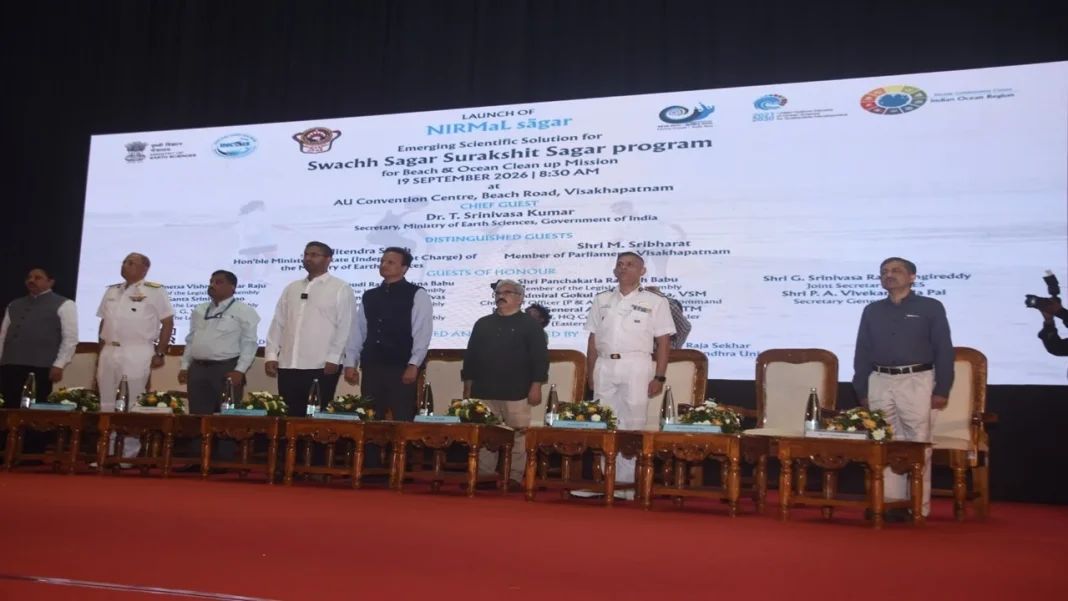

India has started a new marine-litter pilot in Visakhapatnam that tries to do more than clean beaches after waste washes ashore. Launched on September 19, 2026, NIRMaL Sāgar will use ocean modelling, satellite remote sensing and AI/ML tools to trace plastic waste, locate hotspots and forecast where litter may gather along the coast.
The pilot is being led by the Indian National Centre for Ocean Information Services, or INCOIS, under the Ministry of Earth Sciences, with Andhra University and Vignana Bharati. The immediate test area is Visakhapatnam, but the larger idea is a data-led system that can guide prevention, removal and recycling. Details are available in the official Government of India launch release.
What Is NIRMaL Sāgar And Why Was Visakhapatnam Chosen?
NIRMaL Sāgar stands for the National Initiative for Remediation of Marine Litter. The pilot was inaugurated at Andhra University Auditorium near RK Beach on the concluding day of Swachh Sagar Surakshit Sagar 5.0. Ministry of Earth Sciences Secretary Dr T. Srinivasa Kumar opened the programme, while Union Minister Dr Jitendra Singh joined virtually.
Researchers will study where marine plastic litter comes from, how currents carry it and where it is likely to accumulate. That gives the project a wider job than a regular shoreline cleanup.
Visakhapatnam also presents the sort of problem researchers want to examine: urban drainage, fishing activity and a long, busy coastline. Visakhapatnam MP M. Sribharat specifically sought technical and logistical help to stop plastic travelling through open drains into the sea.
How Will AI, Satellites And Ocean Models Track Marine Litter?
The technology is perhaps the most closely watched part of the pilot. Ocean models can simulate how floating waste travels with currents. Satellite observations cover wider stretches of coast, while AI and machine-learning systems can process large datasets and flag likely accumulation areas.
Key points from the launch include:
- Hotspot mapping will identify coastal stretches needing repeated intervention.
- Forecasting tools will estimate where floating litter could collect next.
- Source studies will examine how plastic reaches the sea from land and coastal activity.
- Removal plans will connect recovered plastic with recycling and circular-economy options where feasible.
- Scientific data is expected to help local planning, community programmes and future policy decisions.
That changes the cleanup equation. Instead of sending crews out only after rubbish appears on a beach, authorities could eventually use forecasts to choose where interception or recovery work should happen first.
Why Marine Plastic Tracking Is Becoming A Bigger Issue
The problem behind the pilot is huge. According to the UN Environment Programme’s marine pollution data, an estimated 19 million to 23 million tonnes of plastic waste enter aquatic ecosystems every year. Once in the water, debris can travel away from where it was discarded, making the original source harder to identify.
NIRMaL Sāgar is also aligned with the Swachh Sagar Surakshit Sagar mission and the UN Sustainable Development Goals. UN Goal 14 specifically covers marine pollution, including marine debris from land-based activities.
There was plenty happening beyond the research launch. More than 1,300 people, including Navy and Coast Guard personnel, fishermen, scientists, students and members of the public, participated. A human chain followed on RK Beach Road, volunteers cleaned the beach, and an underwater cleanup had been conducted off Visakhapatnam a day earlier.
The Ministry of Earth Sciences also documented NIRMaL Sāgar through an official Instagram post from the ministry, putting the initiative before a wider public audience.
Could The Visakhapatnam Pilot Change Future Coastal Cleanups?
Potentially, yes, although the pilot still needs to show that its forecasts are reliable enough for routine operations. The bigger shift would be away from occasional cleanup drives towards a system that traces sources, predicts movement, and directs teams before litter spreads further.
If Visakhapatnam produces reliable maps and repeatable methods, similar tools could later be adapted for other Indian coastal cities. Each location, though, has different currents, drains, fishing patterns and waste streams.
Recycling will be another test. Collecting plastic from the sea is one job. Sorting dirty or degraded marine waste and finding usable recycling routes is considerably tougher.
For now, NIRMaL Sāgar is a working pilot rather than a finished national model. Its impact will depend on the quality of its data, whether local agencies use those forecasts, and how much waste can actually be intercepted before it reaches open water.
FAQs
What Is NIRMaL Sāgar?
It is an Indian pilot using science and digital tools to track and remove marine litter.
Where Was NIRMaL Sāgar Launched?
The pilot was launched in Visakhapatnam at Andhra University near RK Beach on September 19, 2026.
Which Agency Is Leading The Project?
INCOIS leads the pilot with Andhra University and Vignana Bharati under India’s Earth Sciences Ministry.
How Will The Pilot Track Plastic Waste?
It combines ocean models, satellite observations and AI tools to map movement and accumulation zones.
Can NIRMaL Sāgar Be Expanded To Other Cities?
Expansion is possible if Visakhapatnam produces reliable methods adaptable to different Indian coastal conditions nationwide.
India’s Maritime Power and Global Trade Shifts
Could Sagar Manthan Transform Deep-Sea Research?
Explore how India’s indigenous vessel could advance deep-sea missions.
What Makes INS Aridhaman Significant?
Discover the features and strategic role of India’s nuclear submarine.
Could Red Sea Disruptions Raise Costs?
Find out how oil blockades could affect India’s fuel and freight expenses.
What Are India’s New Warship Classes?
Browse the roles and features of Project 18A, 15C, and 17B.
What Could India-UK Trade Pact Change?
Check out the key changes expected from the July 15 rollout.