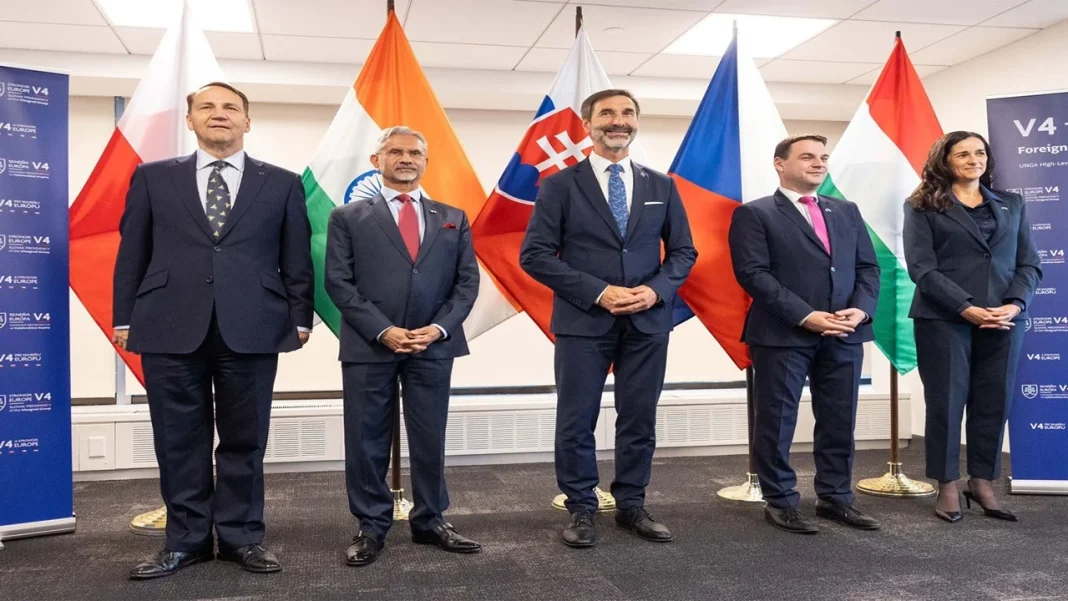

India’s campaign for permanent membership of the United Nations Security Council has received fresh collective support from four Central European countries. Poland, Hungary, Slovakia and the Czech Republic backed India during the first V4+India foreign ministers’ meeting in New York on September 21, 2026, held alongside the 81st UN General Assembly.
The endorsement was voiced publicly by Slovak Foreign Minister Juraj Blanár, who said the four Visegrád Group countries agreed that India should be represented as a permanent Security Council member. The statement adds a new group-level endorsement to India’s long-running UN reform campaign.
Which Four European Countries Have Backed India?
The four countries are Poland, Hungary, Slovakia and the Czech Republic. Together, they form the Visegrád Group, commonly called the V4, a Central European cooperation format whose founding cooperation dates to 1991, as recorded in an official Visegrád Group declaration.
This was the first V4+India foreign ministers’ meeting at this level. India’s External Affairs Minister S. Jaishankar joined representatives of all four countries, with Slovakia holding the V4 presidency. An official Akashvani report on the meeting said discussions covered political ties, trade, investment, technology, resilient supply chains, defence, connectivity, education and mobility.
Key points from the meeting included:
- All four V4 countries expressed support for India’s permanent membership of the Security Council.
- India and the V4 agreed to continue regular foreign-minister-level engagement.
- Both sides discussed an annual business forum to deepen commercial links.
- Ukraine, developments in the Gulf and wider multilateral cooperation were also discussed.
What Did The V4 Say About India’s UNSC Bid?
Blanár said the V4 countries were in agreement that India, as part of the Global South and an important Indo-Pacific power, should have a permanent place at the Security Council table. Jaishankar shared the remark through his official X account on September 21.
The latest collective position also follows earlier individual support. An official Slovak Foreign Ministry statement from July 2026 said Bratislava supports India’s ambition to become a permanent Security Council member. At UN reform talks in 2026, Slovakia also said it continued to support Brazil, Germany, India and Japan, known collectively as the G4, as candidates for new permanent seats.
India, Brazil, Germany and Japan have coordinated through the G4, arguing that Security Council reform should include expansion in both permanent and non-permanent categories.
Why Does A Permanent Seat Still Require Wider UN Agreement?
Support from the V4 does not itself create a new permanent seat. The UN Security Council’s official membership page shows that the Council currently has 15 members: five permanent members — China, France, Russia, the United Kingdom and the United States — plus 10 elected members serving two-year terms.
Changing that structure requires an amendment to the UN Charter. Article 108 of the UN Charter states that an amendment must receive support from two-thirds of the General Assembly and then be ratified by two-thirds of UN members, including all five current permanent Security Council members.
That requirement keeps reform tied to a wider negotiation over the number of new seats, regional representation and veto rights. UN talks in 2026 continued to examine different reform models, including proposals from the G4 and African countries. At the 80th-session reform talks, Slovakia said it continued to support the G4 candidates and permanent-category expansion.
India has served eight elected terms on the Security Council, most recently in 2021-2022, according to the UN’s official record of elected members. Permanent membership, however, would require changes to the Council’s structure rather than another election for a rotating seat.
What Else Came Out Of The First V4+India Meeting?
The meeting went beyond the Security Council question. India and the four Central European countries discussed stronger economic links, technology and innovation, defence cooperation, space, research, education, connectivity and people-to-people exchanges.
Jaishankar described the new format as a historic first meeting and said the two sides wanted more regular engagement. The planned annual foreign ministers’ interaction and proposed business forum could give the V4+India format a recurring place in India’s Central Europe diplomacy. No timetable for Security Council expansion emerged from the meeting.
Frequently Asked Questions
Which four European countries backed India’s permanent UNSC bid?
Poland, Hungary, Slovakia and the Czech Republic backed India collectively through the Visegrád Group format.
When was the V4 support for India announced?
The support was voiced after the first V4+India foreign ministers’ meeting on September 21, 2026.
How many permanent members does the Security Council currently have?
UN Security Council has five permanent members: China, France, Russia, Britain and the United States.
Can V4 support give India a permanent seat immediately?
No. UN Charter reform requires General Assembly approval and ratification including all five permanent members.
Which countries are members of the G4 group?
The G4 consists of India, Brazil, Germany and Japan, which coordinate on Security Council reform.
Stay Updated: Key Developments Shaping India Today
What Could India’s Climate Talks Bring?
Check out the policies and priorities under discussion at the conference.
Could Uzbekistan’s Visa Rules Boost Travel?
Find out how visa-free entry could affect tourism and business trips.
What Could BRICS Climate Talks Decide?
Uncover the sustainability issues and decisions emerging from the meetings.
How Will UWA’s Mumbai Campus Operate?
Browse how the new foreign university campus will function in India.
What Will India-Russia AI Hub Do?
Explore the new AI centre and its focus under four technology agreements.