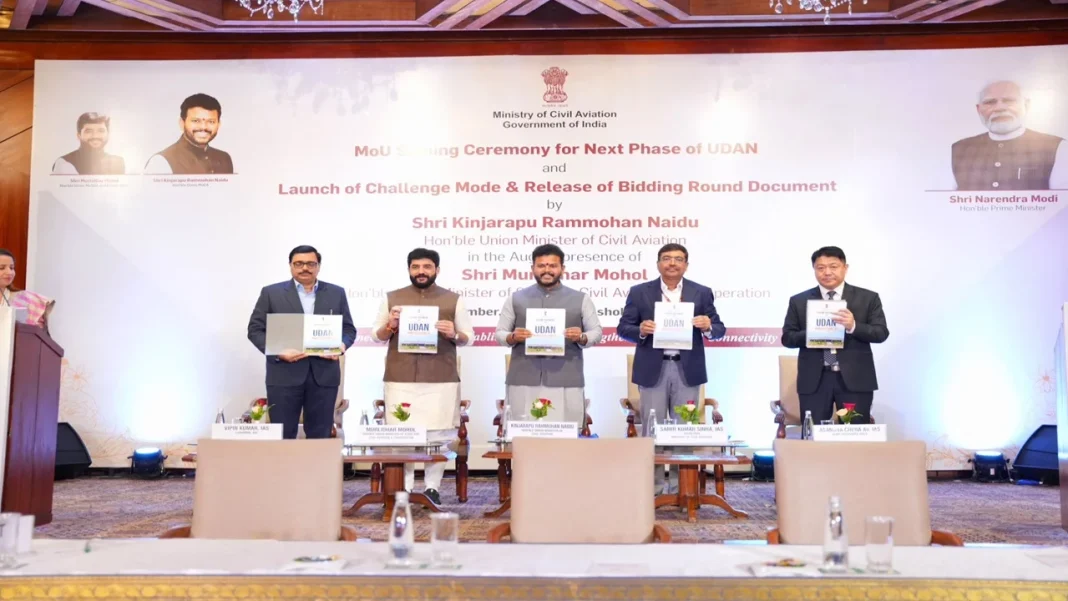

India’s regional aviation push has entered a new stage after the Ministry of Civil Aviation signed 21 Memoranda of Understanding with participating States and Union Territories on 22 September 2026. The agreements bring state governments, the Centre and the Airports Authority of India into a common framework for identifying and developing aviation infrastructure in places that still lack regular air links.
The move is important because the next phase of UDAN gives states a larger role in proposing airstrips and helipads. It does not mean every nominated city will automatically receive an airport, but it creates a clearer route for smaller locations to be considered for development and new airline services.
Key Highlights
- Twenty-one MoUs were signed for the next phase of the UDAN regional connectivity scheme.
- States and UTs can nominate airstrips and helipads through the new Challenge Mode portal.
- Modified UDAN targets 120 new destinations, 100 airports and 200 modern helipads over ten years.
- The government has set a ₹28,840 crore outlay for the scheme from FY2026-27 to FY2035-36.
What Changed Under The Next Phase Of UDAN?
According to the Press Information Bureau release on the UDAN agreements, the 21 MoUs create a structured system for the Centre, participating states and the Airports Authority of India to identify, develop and operationalise aviation assets. Civil Aviation Minister Ram Mohan Naidu also launched the Challenge Mode Portal for Aerodrome Development and released documents for the next UDAN route-bidding round.
Under Challenge Mode, a state can put forward an airstrip or helipad that it believes has strong connectivity potential. The location can then be assessed for development, while airlines will separately bid for identified routes. This gives states more room to flag local priorities before route awards are made.
Naidu also said West Bengal is scheduled to sign on 28 September, with other pending agreements expected within two to three weeks.
The Ministry of Civil Aviation also posted about the launch on its official X account, highlighting the MoUs, Challenge Mode and new route-bidding round.
| Modified UDAN Target | Plan |
| New destinations | 120 |
| Airports from unserved airstrips | 100 |
| Modern helipads | 200 |
| Additional UDAN passengers | 4 crore over 10 years |
| Total scheme outlay | ₹28,840 crore |
Could More Underserved Cities Actually Get Airports?
Yes, more smaller cities can enter the development pipeline, but selection will depend on more than a state recommendation. The new framework allows states to nominate locations, while factors such as land, clearances, road access, demand, airline interest and project feasibility will still influence whether a site becomes operational.
The government has proposed ₹12,159 crore for developing 100 airports from existing unserved airstrips. Another ₹3,661 crore is planned for 200 modern helipads, mainly for hilly, remote, island and aspirational regions. The Cabinet-approved Modified UDAN framework also includes ₹2,577 crore in operations and maintenance support for regional aerodromes.
Officials are also trying to shorten construction timelines. Under the Challenge Mode approach, selected airport projects are targeted for completion in about 18 months, compared with an earlier average of roughly two to three years. Faster development, however, will still depend on states completing land and local approvals on time.
What Has UDAN Achieved And What Could Decide The Next Phase?
According to government figures released on 22 September, UDAN has operationalised 687 routes across 95 aerodromes. More than 3.66 lakh flights have carried around 1.71 crore passengers since the scheme began in 2016.
The new phase also changes airline support. Viability Gap Funding can now continue for five years instead of three, with support reducing from the third year. The government has earmarked ₹10,043 crore for VGF over ten years, giving thinner regional routes more time to build passenger demand.
Recent examples such as Tezu in Arunachal Pradesh and Purnea in Bihar were cited by the ministry while discussing regional connectivity. Earlier, the government also highlighted Darbhanga and Kishangarh while describing how regional air links can support movement of local products, tourists and travellers.
For underserved cities, the next test will be whether state nominations turn into commercially workable routes. Airports need airlines, reliable passenger demand and local infrastructure around them. The MoUs open the door, but route bidding and execution will decide how many new locations finally appear on India’s active aviation map.
FAQs About The Next Phase Of UDAN
1. What Is Modified UDAN?
Modified UDAN is India’s expanded regional aviation scheme supporting airports, helipads, routes and affordable connectivity.
2. How Many Agreements Were Signed?
The Centre signed 21 MoUs with participating States and Union Territories on 22 September 2026.
3. How Many New Airports Are Planned?
The scheme proposes developing 100 airports from unserved airstrips during the next ten years nationwide.
4. What Is The Challenge Mode Portal?
It allows States and UTs to nominate airstrips and helipads for aviation development projects directly.
5. Will Every Nominated City Receive An Airport?
No. Development will depend on feasibility, approvals, infrastructure readiness, airline bids and passenger demand locally.
Travel Updates You Should Know Before Flying
Why Did Amritsar Airport Tighten Security?
Check out what the transfer-point lapse means for passengers.
Where Are Delhi-NCR’s Four Namo Cities?
Find the new locations and their potential property impact.
Why Did UK Aviation Tech Fail?
Uncover how the glitch disrupted flights between India and the UK.
What Forced This IndiGo Flight Back?
See why the Goa-Delhi flight made an emergency landing.
Can Amritsar Reach 27 Global Destinations?
Explore Air India Easy Connect’s routes through a Delhi stop.