
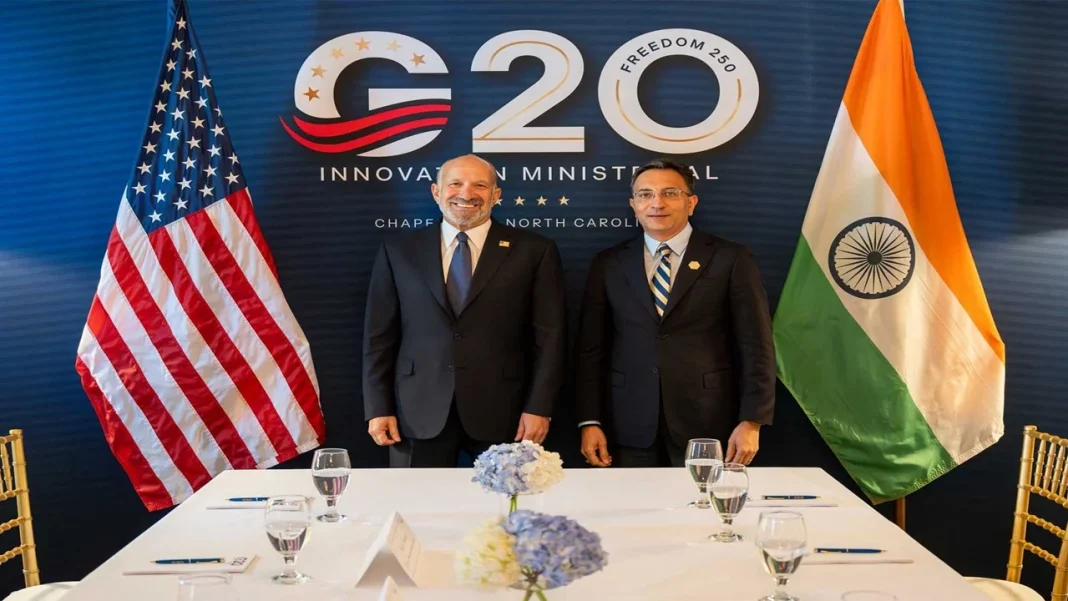

India has formally endorsed the US-led Call to Action for 6G Leadership and Security, joining governments working on how sixth-generation mobile networks should be secured, connected and developed. The move followed Minister of State Jitin Prasada’s meeting with US Commerce Secretary Howard Lutnick during the G20 Innovation Ministerial in North Carolina on September 1-2, 2026. The US Department of Commerce confirmed India’s entry through its official X post.
For India, the timing is notable. Global 6G work is moving from broad research ideas towards technical requirements and standards. New Delhi wants Indian researchers, telecom companies and equipment makers to have a stronger voice before those rules are settled. The Department of Telecommunications will coordinate India’s follow-up.
What India Has Joined And What The Group Wants
The Call to Action was launched by the US National Telecommunications and Information Administration in July 2026. India’s endorsement places it alongside governments including the United States, United Kingdom, Japan, South Korea, France and Germany.
The framework is built around open, interoperable, secure and resilient networks, while also covering resource efficiency, trusted artificial intelligence and competitive supply chains. It does not create a commercial 6G network or assign spectrum.
The immediate roadmap is unusually specific:
- Within one month, participating governments will name 6G contacts and relevant agencies.
- Within three months, they will consult telecom companies and identify barriers to secure 6G leadership.
- Within six months, they will discuss resilient supply chains and national or regional 6G strategies.
- Within twelve months, participants plan to meet in person in 2027 and review progress.
The Ministry of Communications explains the commitments in its Press Information Bureau announcement. Communications Minister Jyotiraditya Scindia also announced India’s endorsement through his official X account.
Why India Wants An Early Seat At The 6G Table
India already has a domestic 6G programme. The Bharat 6G Vision, released in March 2023, targets Indian leadership in the design, development and deployment of 6G technology by 2030.
That plan has moved beyond a policy document. The government said in March 2026 that the Bharat 6G Alliance had grown to 85 institutions and India was targeting about 10% of global 6G patents, with around 4,000 patents already contributed.
An earlier government update on India’s 6G programme also recorded 111 approved 6G research proposals, two funded testbeds and 100 academic 5G labs intended to support a 6G-ready research ecosystem.
Joining the international initiative gives those domestic efforts a government-to-government channel. It can also bring Indian officials into closer discussions with countries debating security, spectrum, supply-chain resilience and future network architecture.
Could India Actually Help Shape Global 6G Rules?
Yes, but not because this coalition can write technical standards by itself.
The Call to Action explicitly says it should not duplicate work already taking place in industry-led standards forums. Instead, participating governments can coordinate policy positions, share research priorities and work with industry before proposals reach formal standards bodies. India also retains its independent position in those forums.
That distinction is crucial. The International Telecommunication Union’s IMT-2030 programme covers immersive communication, ubiquitous connectivity, integrated sensing, AI capabilities, sustainability and stronger security. ITU expects candidate radio-interface proposals from 2027, with final global 6G standards targeted around 2030.
For India, influence will depend on turning research, patents and industry proposals into contributions accepted inside bodies such as ITU and 3GPP. The new coalition may give India more opportunities to coordinate positions with other governments before those discussions advance.
What Happens Next As The 6G Race Speeds Up?
Commercial 6G is still years away, but standards work is already moving. ITU completed draft technical performance requirements for IMT-2030 in February 2026 and evaluation guidelines in June. Debates over security, interoperability, spectrum, AI-native networks and equipment supply chains are therefore beginning well before consumers see a 6G icon on their phones.
India’s entry does not guarantee that its preferred technologies will become global standards. It does place Indian agencies closer to discussions that can influence which technologies reach research programmes, testing, funding and international standards forums.
Frequently Asked Questions
What Is The Call To Action For 6G Leadership And Security?
It is a framework for coordinating secure, interoperable, resilient and open future 6G networks globally.
When Is 6G Expected To Arrive?
Standards work points toward 2030, although research, testing and early specifications are already underway worldwide.
Who Will Lead India’s Participation In The Initiative?
India’s Department of Telecommunications will coordinate follow-up with government agencies, industry, researchers and academic institutions.
Does The Initiative Create Binding 6G Standards?
No, technical standards will continue through established bodies including ITU and industry-led 3GPP processes globally.
What Does India Want From 6G Development?
India wants patent ownership, standards participation, research capacity and a larger role in telecom technology.
India’s Global Moves and Policy Shifts
Could India Help Shape Global 6G?
Check out India’s role in shaping rules for next-generation telecom.
What Could The 6G Agreement Change?
Find out what the 24-country initiative could mean for mobile networks.
Could New Green Card Checks Affect Indians?
Uncover how wider public charge checks may affect applicants.
Could US Tariffs Hit Indian Goods?
Browse the proposed 100% tariffs linked to Russian oil purchases.
What Policies Could India’s Climate Summit Discuss?
Dive into the key environment and climate policies under discussion.