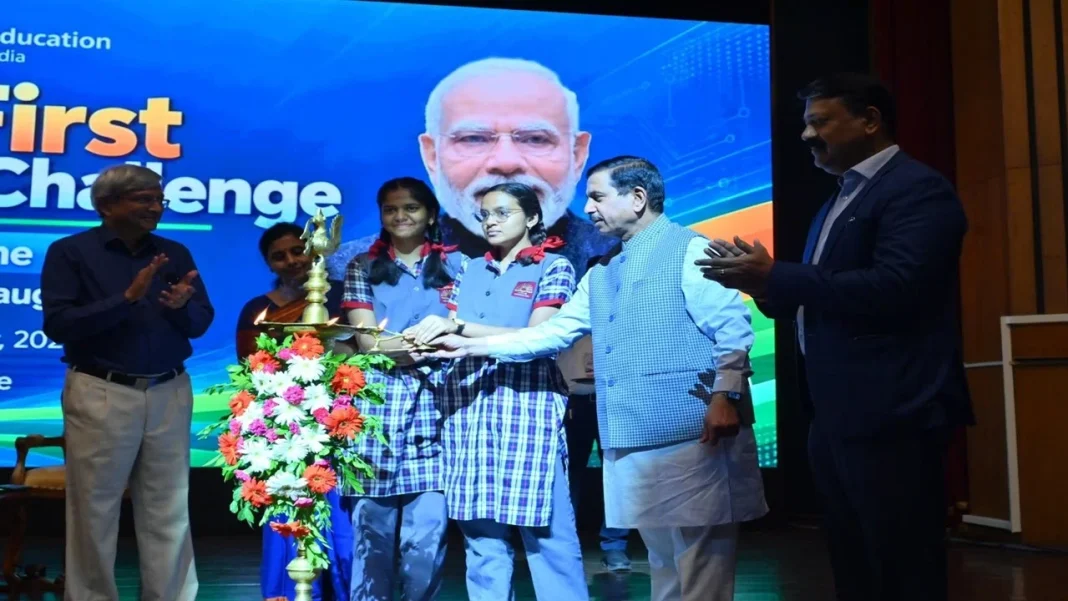

Student ideas are moving beyond classroom projects at the Seva First Innovation Challenge, launched at the Indian Institute of Science (IISc) Bengaluru on September 25, 2026. Union Education Minister Pralhad Joshi launched the challenge’s website and registration portal, opening a programme built around local problems and workable student-led solutions.
The initiative is being organised by the Union Ministry of Education, AICTE and UGC, with IISc Bengaluru serving as the nodal institute. Registration for the southern region runs from September 25 to October 24. The National Finale is scheduled in New Delhi from December 10 to 17, according to the Ministry of Education’s official announcement.
What Is The Seva First Innovation Challenge?
The challenge brings together school students, ITI learners, polytechnic students, college students, postgraduates and research scholars. Instead of placing everyone in one category, the programme uses Junior, Technical and Open participation levels.
Students from Classes 6 to 12 can enter at the Junior level. They can identify a problem around them and suggest either a simple working solution or an idea connected with services and governance.
ITI and polytechnic students will focus more closely on engineering, fabrication, electronics and process solutions. Undergraduate students, postgraduates and research scholars are expected to present prototypes or pilots with a credible route towards deployment.
For the IISc-led region, participation covers Karnataka, Tamil Nadu, Kerala, Andhra Pradesh, Telangana, Andaman and Nicobar Islands, Lakshadweep and Puducherry.
The Ministry of Education also announced the Bengaluru event through its official X post on the Seva First Innovation Challenge ahead of the launch.
Which Public-Service Problems Could Students Work On?
The competition uses five broad themes, leaving students room to work on issues they may already see in schools, towns, farms, healthcare facilities or public spaces.
- Clean and Sustainable Bharat: waste, sanitation, water, energy and environmental solutions.
- Prosperous Farmers, Prosperous Bharat: agriculture, storage, farm productivity and rural-support ideas.
- Healthy and Inclusive Bharat: healthcare access, inclusion, assistive solutions and community services.
- Educated and Skilled Bharat: learning, training, educational access and skill-development solutions.
- Secure Bharat: projects connected with safety, protection, resilience and security.
This approach allows a Class 8 student and a research scholar to start from the same basic question: what problem needs fixing? Their eventual projects, however, can differ sharply in technical depth and scale.
How Could A Student Idea Move From Campus To Public Use?
The more interesting part of Seva First comes after an idea has been submitted. Selected participants may receive access to academic and industry mentors, laboratories, fabrication facilities, testing assistance and incubation support.
The Ministry has also listed seed and pilot funding, field-testing opportunities and intellectual-property guidance among the support available to participants. Promising solutions could then be connected with ministries, state governments, urban and rural local bodies, public-sector undertakings and industry for possible adoption.
That does not mean every winning project automatically becomes a public programme. A prototype would still need testing, suitable costs, reliable performance and an agency willing to take it further.
Why The IISc Role Stands Out
IISc is not only providing a venue for the Bengaluru launch. The Ministry has named the institute as the nodal institution for the challenge, putting an established research campus inside the programme’s evaluation and innovation-support structure.
What Happens Next For Seva First Applicants?
Students in the southern region now have until October 24, 2026, to register through the official Seva First Innovation Challenge portal. The programme then heads towards its National Finale in New Delhi between December 10 and 17.
For applicants, a narrow problem may be a stronger starting point than a complicated invention. A proposal can identify who faces the issue, explain what currently goes wrong, show what the proposed solution changes and describe how it could be tested.
The larger question will come later. If selected student projects reach pilots with departments, public institutions or local bodies, Seva First could create a visible bridge between campus innovation and public-service delivery. The programme already provides that route on paper. The next stage will show which ideas can travel beyond the competition.
FAQs
Who Can Join The Seva First Innovation Challenge?
School, ITI, polytechnic, undergraduate, postgraduate and research students can participate through the programme’s designated levels.
When Does Registration Close For The Southern Region?
Registration for the southern-region challenge remains open until October 24, 2026, according to the Ministry.
Where Will The Seva First National Finale Be Held?
The National Finale is scheduled in New Delhi from December 10 through December 17, 2026.
What Are The Five Themes In The Challenge?
Themes cover sustainability, farming, health and inclusion, education and skills, plus security-related public solutions nationwide.
Can Selected Student Projects Reach Government Agencies?
Yes, promising solutions may reach ministries, local bodies, PSUs and industry for possible adoption later.
Explore India’s Biggest Education & Innovation Moves
What Will Students Study At Quantum-AI University?
Check out the courses and learning opportunities planned at India’s new Quantum-AI university.
Could The India-UAE AI Deal Help Students?
Find how the agreement could create opportunities for students, startups, and researchers.
How Will UWA’s Mumbai Campus Operate?
Uncover how the University of Western Australia’s first Mumbai campus will function.
Can India Build Chips At Scale?
Dive into SEMICON India 2026 and its push toward large-scale semiconductor manufacturing.
Who Can Get Free Exam Coaching?
Browse the new government initiative and who could benefit from its coaching support.