
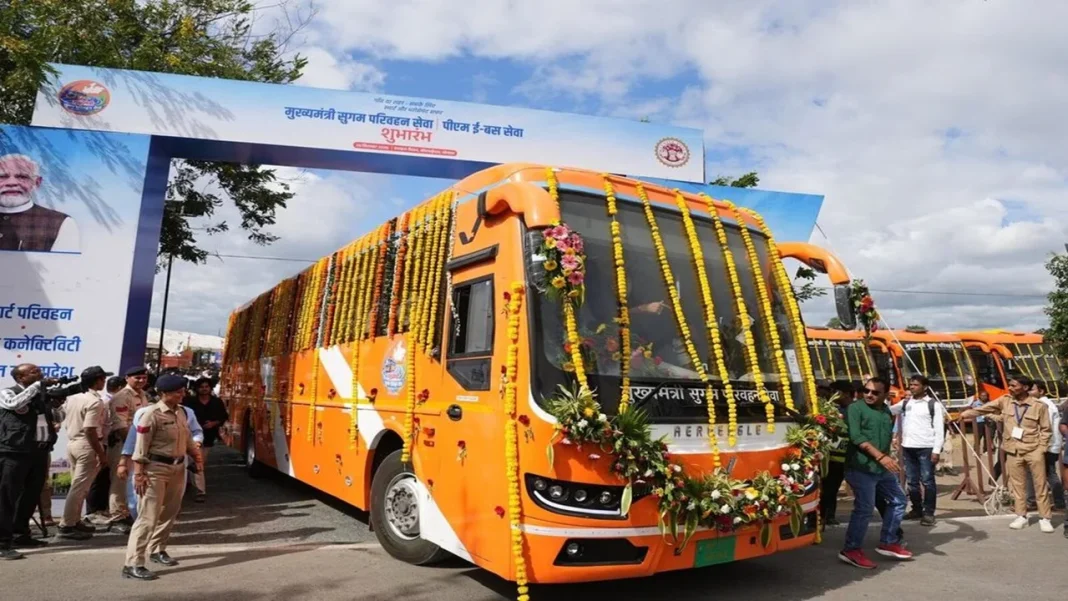

Madhya Pradesh has brought organised public bus transport back after a 21-year gap, opening a new chapter for everyday travel across the state. On September 25, 2026, Chief Minister Mohan Yadav and Union Road Transport and Highways Minister Nitin Gadkari launched the Mukhyamantri Sugam Parivahan Seva in Bhopal, flagging off 351 intercity and intracity buses. The first phase covers Bhopal, Indore, Jabalpur, Rewa, Dewas, Katni and Bhind, but the bigger story lies beyond these centers. The government says the network is meant to extend reliable bus links towards villages, smaller towns and gram panchayats.
Why Madhya Pradesh Has Revived Organised Bus Transport Now
The return is significant because the Madhya Pradesh State Road Transport Corporation was shut in 2005 after years of financial stress. Since then, passenger movement has largely depended on private operators, city-specific systems and smaller route networks. The new model does not simply recreate the old corporation. Instead, buses are planned under a public-private partnership framework with government oversight and technology-based monitoring, as detailed in the New Indian Express report on the transport revival.
According to News on AIR’s launch report, the state wants 1,500 buses operating during the first year and aims to expand the fleet to 15,000 by 2031. The government has also said bus connectivity should eventually reach 75% of gram panchayats. That rural target could determine whether the program becomes a statewide mobility network rather than another city-focused project.
The initial rollout includes several passenger-focused features:
- CCTV cameras, panic buttons and live vehicle-location tracking inside the new buses.
- Intelligent Transport Management Systems to monitor movement, schedules and operational performance in real time.
- Passenger information systems and grievance channels for route, timing and service-related complaints.
- Driver training focused on electric and CNG vehicles, safety practices and updated operating standards.
- Command-and-control centres to monitor punctuality and service conditions across participating routes.
Could Smaller Cities And Villages Gain The Most?
For residents outside major cities, the strongest impact could come from dependable links to district headquarters, colleges, hospitals, railway stations, markets and employment centres. Scheduled services can reduce the uncertainty of low-frequency or fragmented transport, particularly where commuters must change vehicles several times.
The government’s plan to connect villages and cities also resembles earlier hub-and-spoke transport efforts. NITI Aayog’s transport best-practices compilation described hub cities linked with smaller urban centres through organised routes, terminals and digital monitoring. If the revived service follows that approach, places beyond Bhopal and Indore could receive more predictable connections without requiring direct routes between every town.
Cost will matter too. Reports around the launch say intercity fares have been fixed at ₹2 per kilometre. Affordable fares could be especially important for rural and semi-urban passengers travelling regularly for work, education or healthcare.
Electric Buses, Cleaner Mobility And A Bigger Statewide Network
The launch also overlaps with India’s electric-bus push. Under PM-eBus Sewa, the Centre supports air-conditioned electric buses and related depot and charging infrastructure in participating cities. The PIB overview of PM-eBus Sewa says the national programme is intended to help cities introduce organised public transport while moving towards e-mobility.
The Madhya Pradesh EV Policy 2025 also gives priority to electric buses and calls for a growing electric share in city and intercity fleets. That makes the new network both a connectivity project and a platform for cleaner fleet expansion as charging infrastructure improves.
At the Bhopal launch, officials discussed adding thousands more buses in phases, while terminals, stops and digital systems are expected to support the network. An official X post from Chief Minister Mohan Yadav showed the launch of both Mukhyamantri Sugam Parivahan Seva and PM e-Bus Seva, underscoring how the two programmes are being presented together.
What Will Decide Whether The Bus Revival Succeeds?
Expansion alone will not guarantee better transport. The test will be frequency, punctuality, route planning, vehicle maintenance, last-mile links and whether less profitable rural routes receive dependable service. PPP systems can bring flexibility, but contracts and performance monitoring will need to prevent service quality from varying sharply between busy corridors and smaller destinations.
Passengers will judge the system by simple details: whether buses arrive when promised, digital tracking works, stops are usable and complaints receive responses. If those basics remain consistent while the network expands, Madhya Pradesh could build a more integrated bus system linking major cities with smaller communities.
For a state returning to organised public bus transport after more than two decades, the first 351 buses are only the starting point. The larger change will be measured by how far reliable service reaches beyond the biggest cities.
FAQs
When did Madhya Pradesh restart organised public bus transport?
Madhya Pradesh formally launched the service on September 25, 2026, after a twenty-one-year statewide gap.
How many buses were launched in the first phase?
A total of 351 intercity and intracity buses launched across seven Madhya Pradesh cities initially.
Which cities received buses during the initial rollout?
Bhopal, Indore, Jabalpur, Rewa, Dewas, Katni and Bhind were included in the opening phase statewide.
Will the scheme improve rural connectivity as well?
The government plans bus connections reaching 75% of gram panchayats across Madhya Pradesh over time.
What safety technology is included in the new buses?
Buses include CCTV cameras, panic buttons, live tracking and technology-enabled monitoring for safer passenger journeys.
What’s Happening Across Madhya Pradesh?
Why Are Baiga Children Still Hospitalised?
Find out why 57 villages remain under door-to-door health surveillance.
Is Chitrakoot Facing Another Monsoon Emergency?
Uncover how rising Mandakini River waters are affecting the region.
Why Do These Temples Celebrate Earlier?
Explore why two Madhya Pradesh temples observe Independence Day differently.
Which States Will This Train Connect?
Check out the new Amrit Bharat Express route and stations.
What’s Changing Across Madhya Pradesh Now?
Browse more stories covering major developments across the state.