

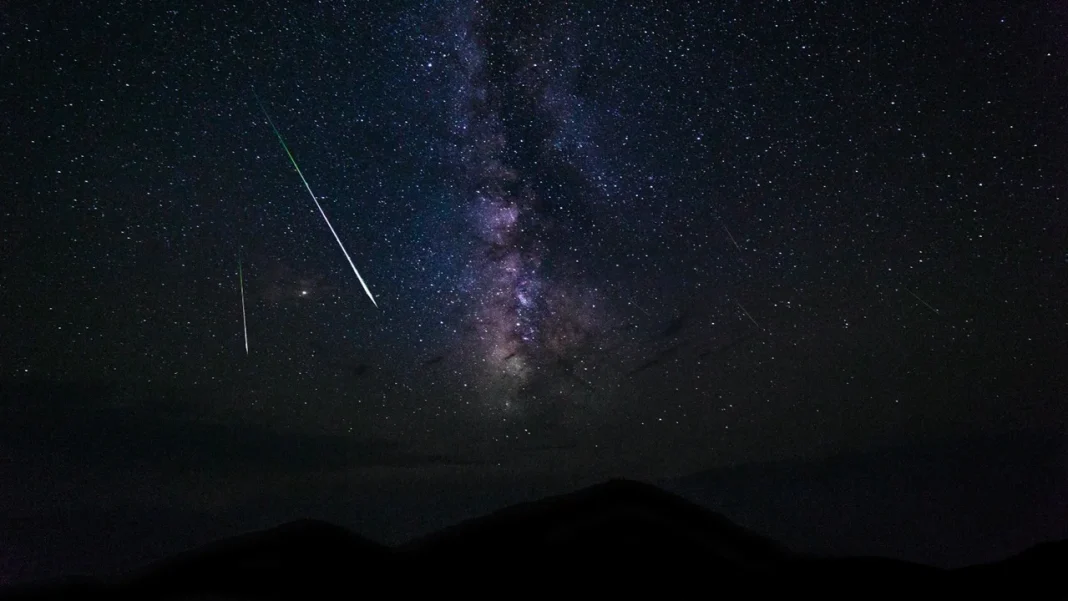

Missed the shooting stars before sunrise on October 22? There is still another chance. The Orionid meteor shower peaked overnight on October 21–22, 2026, but remains active until November 7, according to NASA. People across India can still look early on October 23, though moonlight will hide many faint streaks.
Key Highlights
- The Orionids peaked overnight on October 21–22, not throughout October 22.
- Shooting stars may remain visible on October 22–23 and subsequent nights.
- NASA lists the shower’s active period as October 2 to November 7, 2026.
- Peak rates of 10–20 meteors per hour assume dark, favourable skies.
- A waxing gibbous Moon limits what observers can actually see.
Is The Orionid Meteor Shower Still Visible After October 22?
Yes. A meteor shower’s peak is the expected period of greatest activity, not the moment the display switches off. Earth’s passage through dust shed by Halley’s Comet continues beyond October 22. The American Meteor Society’s 2026 calendar lists activity through November 7.
For Indian skywatchers who missed Thursday’s pre-dawn peak, Friday morning, October 23, is the next practical opportunity. Meteors may also appear on October 24 and later, though fewer should be expected as the shower recedes from maximum. A dark location offers a better chance than a floodlit rooftop.
Best Time To Watch Orionids In India On October 22–23
After midnight, Orion climbs higher, improving viewing conditions. For the night beginning Thursday, October 22, a useful target is roughly 3:30 AM until before dawn on Friday, October 23 (IST).
The Moon is the complication. Timeanddate’s lunar calculations for Chennai put moonset near 3:12 AM on October 23; Delhi’s calendar places it around 3:21 AM. Timings vary by city, and twilight shortens the viewing window.
For a better attempt:
- Go outside after moonset rather than immediately after dinner
- Allow around 30 minutes for your eyes to adjust to the darkness
- Put your phone away and avoid streetlights or floodlit terraces
- Give the sky at least 30–60 minutes rather than expecting constant meteors
Clouds may still prevent sightings.
How Many Shooting Stars Can You Expect After The Peak?
NASA’s Orionids fact sheet gives a typical rate of 10–20 meteors an hour under dark conditions near maximum. That does not mean 20 meteors per hour in Indian cities on October 23. Rates decline after the peak.
The Moon was roughly three-quarters illuminated around peak night and grows brighter as the October 26 full Moon approaches. NASA’s October 2026 skywatching update specifically advises looking after moonset and before dawn. The agency also mentioned the shower in its official October skywatching post on X.
Where Should You Look, And What Makes Orionids Different?
Orion rises late at night. Its three-star belt is a useful marker, but do not stare exclusively at the constellation. Orionids appear to radiate from a point near Orion, yet their streaks can cross almost any part of the sky.
Try this simple setup:
- Find a safe, open location with as little direct lighting as possible
- Lie back or use a reclining chair for a wider view overhead
- Watch a broad patch of sky away from the Moon
- Skip binoculars and telescopes; they restrict your field of view
These are particles from Halley’s Comet, not falling stars. NASA reports that Orionid particles hit the atmosphere at about 66 kilometres per second. Some leave glowing trails lasting several seconds.
The Takeaway: October 23 offers another opportunity, not a second peak. Plan for the darkest interval before dawn, keep expectations modest, and use NASA’s Orionids observing guide before heading out.
FAQs
Can I See The Orionid Meteor Shower On October 23, 2026?
Yes. The shower remains active after its October 21–22 peak. Look before dawn on October 23 from a dark location, but expect fewer visible meteors.
What Is The Best Time To Watch Orionids In India?
After midnight is usually preferable, especially once the Moon has set. On October 23, aim for roughly 3:30 AM until twilight, adjusting for local conditions.
Will Orionids Be Visible On October 24 And 25?
Some meteors may still appear because the shower continues into November. Activity will be below peak, while the increasingly bright Moon makes faint streaks harder to spot.
Do You Need A Telescope To Watch The Orionid Meteor Shower?
No. Meteor trails can appear across wide areas of sky, which makes unaided viewing preferable. Find darkness, get comfortable, and watch patiently for occasional streaks.
Why Are The Orionids Connected To Halley’s Comet?
Earth encounters dust left along Halley’s Comet’s orbit each October. Those particles burn brightly in the atmosphere, producing meteors that appear to originate near Orion.
More Celestial Wonders, Rare Eclipses And Skywatching Highlights!
1. When Did Perseids Peak Over India?
2. What Lit Up India’s July Skies?
3. Did Venus Disappear Behind The Moon?
4. Why Did Millions Watch Europe’s Eclipse?
5. How Long Did Europe’s Totality Last?