

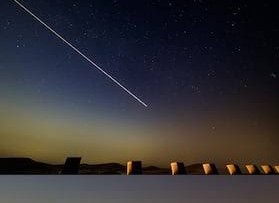

The Perseid meteor shower is reaching its annual high point on August 13, giving skywatchers in India another reason to look up after a packed week of celestial events. The shower is famous for fast, bright meteors and occasional fireballs, while 2026 brings one major advantage: almost no moonlight.
NASA’s Perseids guide says the shower can produce roughly 50 to 100 meteors an hour under excellent conditions, although actual counts vary with location, cloud cover and light pollution. The International Meteor Organization, or IMO, lists a 2026 zenithal hourly rate of 100 but also notes modelling that suggests background activity may be lower than the familiar headline figure this year. That makes “up to 100” an ideal-sky benchmark, not a promise for every observer.
Why The 2026 Perseid Peak Is Getting So Much Attention
The timing could hardly be better for dark skies. A New Moon arrived on August 12, removing the bright lunar glare that often hides fainter meteors. NASA’s August 2026 skywatching guide places the Perseid peak across August 12 and 13 and recommends looking northeast once Perseus clears the horizon.
The shower also followed the August 12 total solar eclipse, visible in totality from parts of Greenland, Iceland, northern Spain and northern Russia. India did not get the eclipse, but the same New Moon that produced it created excellent meteor-watching conditions overnight. Later this week, Venus reaches a prominent evening position from August 14 to 16, while a partial lunar eclipse closes the month on August 27 and 28.
Perseids come from debris shed by comet 109P/Swift-Tuttle. Earth crosses that dusty stream every year, and particles hit the atmosphere at about 59 kilometres per second, producing streaks commonly called shooting stars. NASA also highlights the shower’s bright fireballs and lingering trails.
When Is The Best Time To Watch The Perseids From India?
For India, the key detail is the difference between the mathematical peak and the best dark-sky viewing period. The IMO 2026 Meteor Shower Calendar places the main maximum on August 13 between 02:00 and 04:00 UTC, equal to 7:30 a.m. to 9:30 a.m. IST. That is daylight across India. Its broader traditional maximum runs from 21:00 UTC on August 12 to 09:00 UTC on August 13, or roughly 2:30 a.m. to 2:30 p.m. IST.
So, the strongest usable window for Indian viewers was the pre-dawn period on August 13. For anyone reading later on August 13, there is still a worthwhile second chance tonight. Watch after midnight into the pre-dawn hours of August 14. Rates should be lower than at the main peak, but EarthSky notes that August 14 can still be good before activity drops quickly after maximum.
Keep these points handy:
- Best peak-night window in India: Roughly 2:30 a.m. until dawn on August 13.
- Best remaining window: After midnight through pre-dawn on August 14, weather permitting.
- Where to look: Start northeast, then scan a wide section of sky rather than Perseus alone.
- Where to go: Choose a rural or edge-of-city site with a dark northern and northeastern horizon.
- What to carry: Skip telescopes and binoculars because naked-eye viewing gives a much wider field.
How To See More Meteors Without Special Equipment
The Perseids reward patience more than expensive gear. Reach a dark location before the main viewing period, switch off bright phone screens and give your eyes around 20 to 30 minutes to adjust. NASA recommends a dark, open spot and says viewers should stay out late as the radiant climbs higher.
Clouds may be the bigger challenge in India during August because monsoon weather can block even a moonless sky. A clear rural horizon can therefore be more useful than travelling to a famous location under thick cloud. Check the local forecast before leaving and avoid street lamps, building lights and headlights.
Do not stare only at Perseus. The radiant tells you where Perseid tracks appear to originate, but meteors can flash anywhere overhead. A reclining chair or mat also makes a long watch easier.
NASA Marshall has been sharing the peak with viewers through its official Perseids watch-party post on X, giving people facing clouds another way to follow the event.
Perseid Meteor Shower 2026 FAQs
Can the Perseids really produce 100 meteors per hour?
Yes, under dark skies, but city lights, clouds and conditions can reduce visible counts sharply.
What time should people in India watch tonight?
After midnight until before dawn is best, with darker rural skies improving your viewing chances.
Which direction should viewers face for the Perseids?
Start toward the northeast near Perseus, then scan broadly because meteors can cross the sky.
Do I need a telescope to watch the meteor shower?
No, naked eyes work better because telescopes narrow your field and can miss fast-moving streaks.
How long will the Perseid meteor shower remain active?
NASA lists Perseid activity through August 24, although meteor rates fall noticeably after the peak.
Keep watching the skies with more stories on meteor showers and celestial events.
Total Solar Eclipse To Turn Day Into Darkness Next Week: Where Will The Best Views Be?