

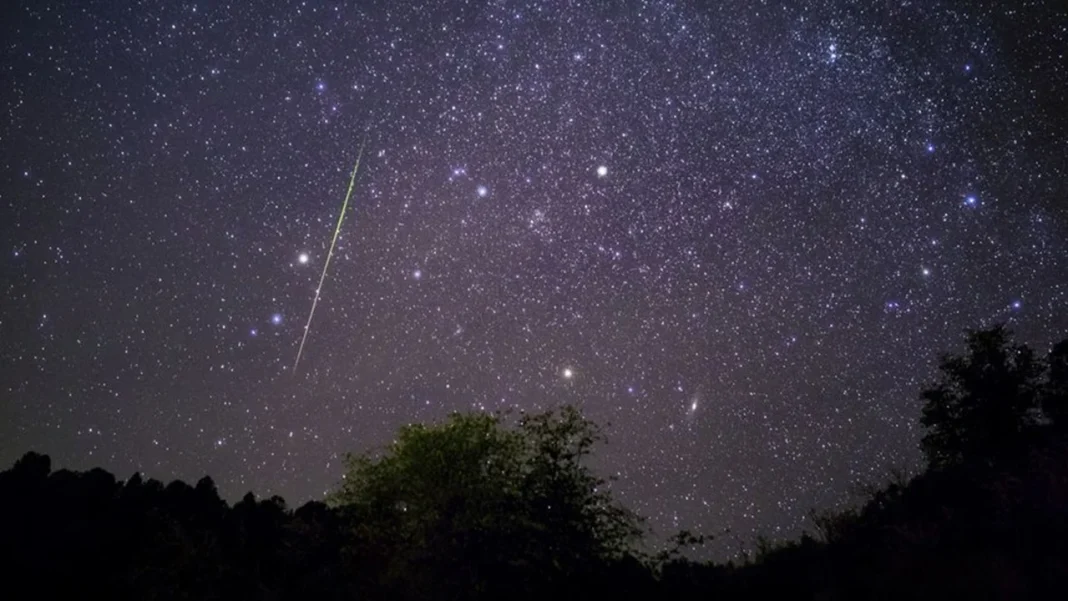

The Leonid meteor shower returns each November because Earth crosses a trail of comet dust. When those grains enter our atmosphere, they produce the brief streaks called shooting stars.
For India, the International Meteor Organization’s forecast put the regular 2026 maximum at 5:15 am IST on 18 November. If you missed it, there is still a reason to look up. The Leonids remain active through 30 November, although you should expect fewer meteors away from the peak. A clear hour before dawn offers a better chance than a glance from a brightly lit balcony.
Key Highlights
- The dust comes from comet 55P/Tempel-Tuttle, which takes roughly 33 years to orbit the Sun. Earth encounters its debris every year.
- Leonid particles enter the atmosphere at about 70 kilometres per second, making these among the fastest meteors visible from Earth.
- The streaks appear to spread from the constellation Leo, but you can see them across the sky with the naked eye.
Why the Leonids Return Every November
Two different journeys explain the timing. As Tempel-Tuttle approaches the Sun, warming ice releases gas and carries grains of dust into space. The grains continue travelling around the Sun along paths close to the comet’s orbit. Each November, Earth reaches the part of its own orbit that crosses this stream. The comet itself can be years away. Its next close approach to the Sun is expected in May 2031.
Most Leonid particles are only about a millimetre to a centimetre across. What makes one visible from the ground is its speed. As the grain ploughs into the upper atmosphere, it compresses and heats the air ahead of it. For an instant, a speck too small to see in space leaves a bright line you can spot without a telescope.
When to Watch the Leonid Meteor Shower From India
The International Meteor Organization’s 2026 calendar placed the regular peak at 23:45 Universal Time on 17 November. Adding five hours and thirty minutes puts it on the next morning in India. That date change explains why a calendar can say “17 November” while an Indian viewing guide points to the 18th.
| 2026 viewing detail | What it means in India |
| 6–30 November | The full activity period. An occasional Leonid can appear after peak morning. |
| 5:15 am IST, 18 November | The predicted regular maximum. Local dawn and cloud cover affect what an observer can see. |
| Around 15 meteors per hour | An estimate for ideal peak conditions. City lights, moonlight, and a restricted view reduce the visible count. |
NASA’s November skywatching guide recommended watching before dawn after moonset around the peak. For the remaining mornings, check local moonset and dawn times together. A dark interval between them is more useful than setting an alarm for the same time everywhere in India.
Why Some Leonid Showers Become Meteor Storms
The comet leaves denser trails on some passages than others. When Earth cuts through one of those concentrations, the count can rise sharply within a single night. An observation from 17 November 1966 captures just how quickly that can happen.
- At Kitt Peak National Observatory in Arizona, observers counted 33 Leonids during their first hour. Later that morning, the reported rate reached roughly 40 per second.
- For 2026, astronomers modelled encounters with several older, thinly spread dust trails. Their calculations suggested only weak activity from those encounters, giving observers little reason to expect a repeat of 1966.
How to Spot a Leonid Without a Telescope
Leo helps you identify a meteor after you see it. Mentally extend its path backwards. If the line leads towards Leo, the streak could be a Leonid. Watching only that constellation can mean missing longer trails elsewhere in your field of view.
- Choose an open patch of sky and put the nearest streetlight or bright window behind you. Give your eyes about 30 minutes to adjust.
- Leave binoculars aside. Lean back and watch a broad area of sky so a brief streak has a chance to catch your eye.
Frequently Asked Questions
Do I need to find Leo before I start watching?
No. You can see a Leonid far from Leo. Knowing the constellation’s position helps afterwards, when you trace the meteor’s path back across the sky.
Why is the comet absent during most Leonid showers?
Dust released on earlier trips continues to orbit the Sun. Earth crosses that material each November, even while Tempel-Tuttle is far from the point where their paths meet.
Does a forecast of 15 per hour mean one every four minutes?
No. An hourly rate describes activity under specified viewing conditions. Meteors arrive at uneven intervals, and faint ones can disappear in the glow above a city.
Does a forecast of 15 per hour mean one every four minutes?
No. An hourly rate describes activity under specified viewing conditions. Meteors arrive at uneven intervals, and faint ones can disappear in the glow above a city.
Is every shooting star in November a Leonid?
Several showers are active in November, including the Northern and Southern Taurids. A meteor whose path traces back towards Taurus may belong to one of those showers.
Explore More Meteor Showers, Space Discoveries and Celestial Events!
1. When Will Orionids Light Up India?
2. What’s the Best Time for Perseids?
Check out the Perseid meteor shower’s peak timing and best viewing hours in India.
3. Which Celestial Events Defined July 2026?
Explore July 2026’s major astronomical events, including meteor showers and skywatching highlights.
4. How Did SpaceX Catch Starship Successfully?
Uncover the story behind SpaceX’s 2026 Starship catch using robotic arms.
5. Could Space Warfare Begin by 2031?
Find out why experts have warned about possible space warfare by 2031 and its global implications.