

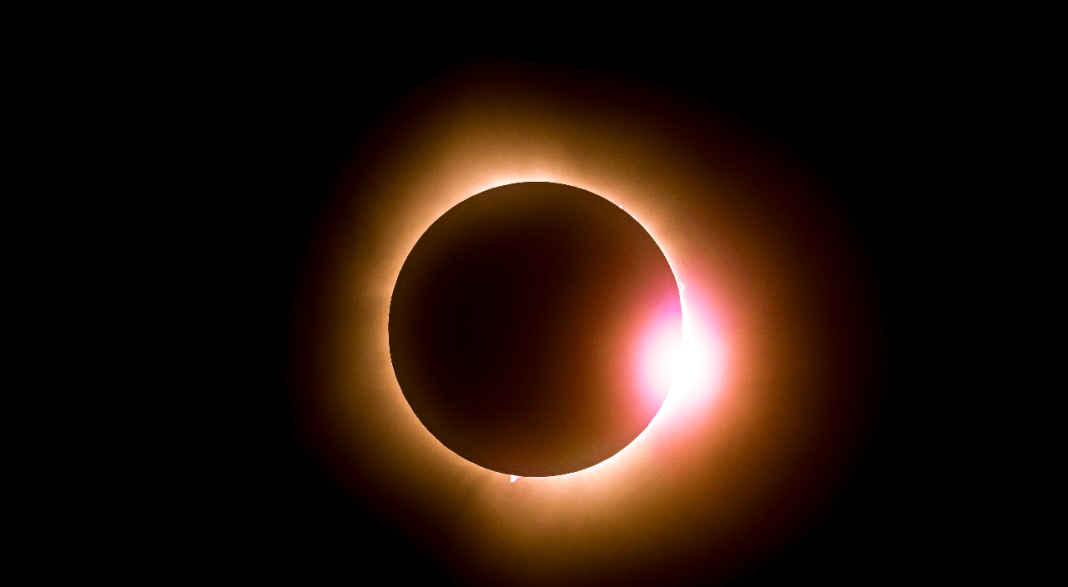

A rare total solar eclipse will sweep across the Northern Hemisphere on Wednesday, August 12, 2026, briefly turning daylight into darkness along a narrow path. Greenland, western Iceland, northern Spain, a tiny part of northeastern Portugal and a remote section of northern Russia sit inside the path of totality. Much of Europe, Canada and northwestern Africa will still see a partial eclipse.
NASA says most locations inside the totality band will get less than two minutes of darkness, although spots near the centre line can approach two and a half minutes. Spain stands out for accessible viewing, while Iceland and Greenland offer longer totality in some areas.
Where Will The August 12 Total Solar Eclipse Be Visible?
The Moon’s central shadow begins near northern Russia and travels across the Arctic, Greenland, Iceland and the North Atlantic before reaching the Iberian Peninsula. NASA’s official eclipse guide lists León, Reykjavík, Valencia and Zaragoza among locations inside the total-eclipse zone. London, Paris, Lisbon and Madrid remain outside totality but will see deep partial coverage.
Spain will experience the eclipse close to sunset. The Spanish National Geographic Institute’s eclipse portal says the band crosses the country west to east, passing near A Coruña, Oviedo, León, Bilbao, Zaragoza, Valencia and Palma. A clear western horizon will be critical because the Sun will sit very low.
The main viewing picture is:
- Spain: Broadest practical land area for totality, with many towns, roads and organised events.
- Iceland: Reykjavík and parts of the Westfjords fall inside totality; the westernmost Westfjords can reach about 2 minutes 13 seconds.
- Greenland: Excellent geometry and longer totality near the central line, but travel is far harder.
- Portugal: Only a small northeastern corner reaches totality; most of the country gets a deep partial eclipse.
- Northern Russia: Totality arrives earlier, though the accessible land area is extremely remote.
Which Countries Will Get The Best View Of Totality?
For most travellers, Spain offers the best balance of visibility, transport and viewing choices. The national eclipse portal notes that summer usually brings a good chance of clear skies across much of the country. The trade-off is altitude: totality happens shortly before sunset, so hills or buildings can block the Sun.
León is especially appealing because NASA places totality between about 8:28 p.m. and 8:30 p.m. local time. Zaragoza gets roughly one minute and 25 seconds of totality, while Valencia also enters the full shadow shortly before sunset.
Iceland offers a different scene. The Icelandic government’s eclipse information service says totality begins around 5:44 p.m. to 5:48 p.m., depending on location. Western Iceland, Reykjavík and the Westfjords are the key areas, with the longest land-based totality reaching about 2 minutes 13 seconds in the far west.
Best Viewing Picks At A Glance
Spain suits visitors who want easier transport and more fallback locations. Iceland offers dramatic scenery and a higher Sun. Greenland provides stronger eclipse geometry but demands more planning. For western European travellers, Spain is likely the simplest target.
Why This Eclipse Is Creating Such A Buzz Across Europe
The August 12 event is historic for Spain. The European Space Agency’s eclipse programme says it will be the first total solar eclipse visible from mainland Spain since 1905. ESA is organising public activities and a live broadcast, including an event in León.
NASA has announced live coverage beginning at 1:15 p.m. ET, or 17:15 UTC. The agency’s official X post about the August 12 eclipse invites viewers worldwide to follow the eclipse online, useful for anyone facing clouds or staying outside the totality band.
There is another skywatching bonus. The Perseid meteor shower peaks around the same night under a new Moon, while several planets will also be visible during August. That combination has turned August 12 into one of 2026’s biggest astronomy dates.
The eclipse also begins a striking Iberian run. Another total eclipse crosses southern Spain on August 2, 2027, followed by an annular eclipse visible from Spain in January 2028.
How To Watch The Eclipse Safely Without Damaging Your Eyes
Solar eclipse glasses are required throughout every partial phase. Ordinary sunglasses, exposed film, phone cameras and homemade dark filters are not safe substitutes. NASA says viewers may remove certified eclipse glasses only during complete totality, when the Sun’s bright surface is entirely hidden.
Anyone outside the totality path must keep proper solar protection on for the entire event. Cameras, binoculars and telescopes also need suitable solar filters attached at the front of the optics.
In Spain, viewers should arrive early and check the western horizon before choosing a spot. In Iceland or Greenland, weather updates may decide the final location.
FAQs
When is the 2026 total solar eclipse?
The total solar eclipse takes place on Wednesday, August 12, 2026, across parts of Europe.
Will the eclipse be visible from the United States?
Parts of the northern United States will see a partial eclipse, but nowhere receives totality.
Where is the best place in Spain to watch?
León, Zaragoza, Valencia and northern Spanish regions inside totality offer strong viewing opportunities for visitors.
How long will total darkness last?
Most locations get under two minutes; maximum totality reaches roughly two minutes and eighteen seconds.
Can eclipse glasses come off during totality?
Yes, but only during complete totality; replace them immediately when the bright Sun begins returning.