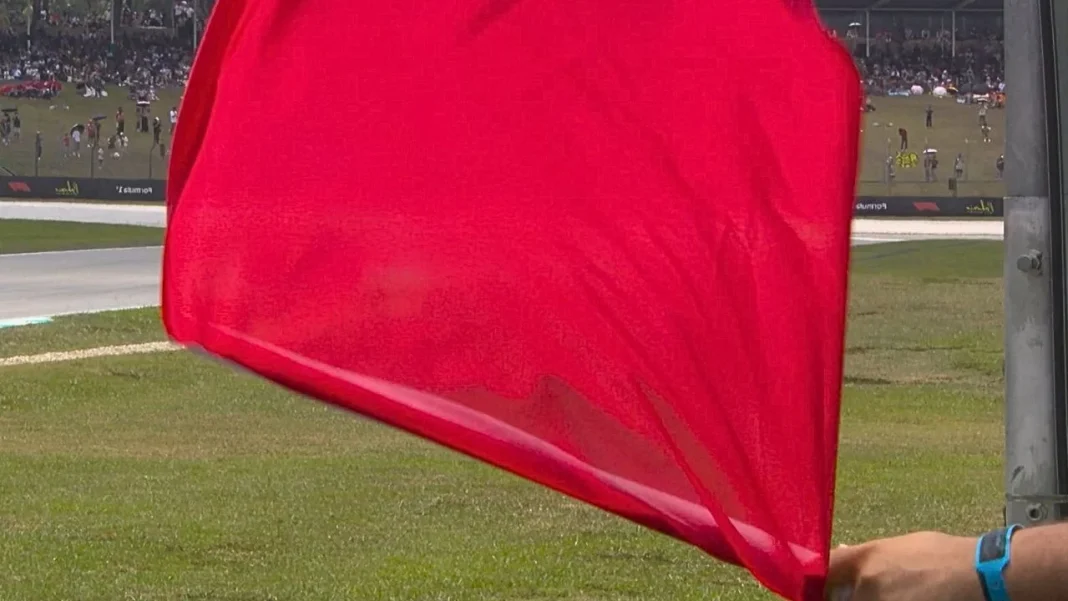

A red flag in Formula 1 means a session has been stopped because race control believes continuing is unsafe. It can follow a major crash, barrier damage, debris, heavy rain or another hazard that cannot be handled while cars keep circulating. Formula 1’s own flag guide lists serious incidents and poor weather among the main reasons for stopping a session.
The rule is especially topical on 4 October 2026. Severe thunderstorms delayed the Bahrain Grand Prix in Malaysia at Sepang, while FP3 a day earlier was briefly red-flagged after debris came off Ollie Bearman’s Haas.
Key Highlights
- A red flag stops an F1 race, qualifying session or practice rather than merely slowing the field.
- During a race suspension, overtaking is forbidden and drivers normally return slowly to the pit lane.
- The 2026 rules permit specified work during the stoppage, including tyre changes and genuine accident repairs.
- If a suspended race cannot restart, reduced points may apply depending on the distance completed.
What Does a Red Flag Mean in Formula 1?
Formula 1’s official guide to F1 flags explains that a red flag is shown when the Race Director decides a session or race must stop. Serious accidents and dangerous weather are common triggers, but damaged barriers, stranded cars or debris can also force a stoppage.
That separates it from a Safety Car or Virtual Safety Car. Under those neutralisations, cars remain on track at controlled speeds. Under a red flag, the session is suspended.
The latest example came in FP3 at Sepang on 3 October. Debris from Bearman’s Haas brought out the red flag shortly before halfway. No major crash was involved. Race control needed the circuit clear before running continued.
Rain creates a different challenge. Sepang’s race start on 4 October was delayed by 90 minutes after a heavy thunderstorm. FIA rules also allow the starting procedure to be suspended if conditions become unsuitable after formation laps behind the Safety Car.
What Happens When an F1 Race Is Red-Flagged?
The latest 2026 FIA Formula 1 Sporting Regulations lay out the suspension procedure. Once “RED FLAG – RACE SUSPENDED” is sent to teams, red flags appear around the circuit and orange lights illuminate on the start gantry.
The sequence is simple:
- Drivers slow down and cannot overtake.
- The pit-lane exit closes.
- Cars normally return to the pit lane and queue in the fast lane.
- Race control decides whether and how the race can resume.
Teams may perform only specified work once the cars stop. That includes changing wheels and tyres and repairing genuine accident damage. Fresh tyres during a stoppage can alter strategy because the driver avoids a normal racing pit stop.
For the restart, the FIA rebuilds the order from the last point where every car’s position could be reliably established.
Recent Red Flags Show How Quickly a Race Can Turn
The 2026 Italian Grand Prix offered a clear race-day example. Charles Leclerc crashed at Parabolica on Lap 2, damaging the barriers and forcing officials to stop the race. Leclerc was unhurt, repairs followed and the field later took a standing restart.
Qualifying can become even more chaotic. At Baku in 2025, Formula 1 recorded six red flags, the most in a single qualifying session. Qualifying lasted 1 hour 58 minutes, longer than the previous year’s Azerbaijan Grand Prix.
| Example | Cause | Result |
| Sepang FP3, 2026 | Debris from Bearman’s Haas | Brief stoppage |
| Italian GP, 2026 | Leclerc crash, barrier damage | Standing restart |
| Azerbaijan Qualifying, 2025 | Multiple crashes | Record six red flags |
If a race cannot resume, championship points can also change. Under the 2026 framework, reduced points apply below 75% of scheduled race distance when minimum racing-lap requirements are met. Full points are available from 75%.
Red Flag Rules Fans Should Watch During the Next F1 Stoppage
A red flag is not simply a longer Safety Car. It can reshape tyre strategy, remove gaps between drivers and give marshals a clear circuit for recovery or repairs.
Watch three things when one appears: the restart order, tyre changes or repairs, and the remaining race time. In 2026, F1 retains a two-hour limit for actual racing and a three-hour maximum race duration when suspension time is added.
FAQs
Why is a red flag shown in Formula 1?
Race control uses it when continuing becomes unsafe, including after major crashes, heavy rain, debris, damaged barriers or hazards requiring track access.
Can F1 drivers change tyres during a red flag?
Yes. The 2026 rules allow wheel and tyre changes during a suspension, alongside certain permitted repairs and adjustments that may influence the remaining race strategy.
Is a red flag the same as a Safety Car?
No. A Safety Car keeps cars circulating at reduced speed, while a red flag suspends the session and normally sends the field back to pit lane.
What happens to positions after an F1 red flag?
Officials restore the order from the last point where every car’s position could be reliably established, then arrange the field before the restart procedure begins.
Can an F1 race finish under a red flag?
Yes. If conditions stop a restart, results can be taken from the prescribed earlier point, with championship points awarded using the FIA’s distance-based rules.
India’s Asian Games Medal Journey Continues
How Did Kushare End India’s Wait?
Check out Sarvesh Kushare’s historic Asian Games high-jump medal.
How High Could India’s Tally Go?
Find the latest updates on India’s growing medal count.
Can India Add More Medals Today?
Uncover the latest Asian Games medal tally and prospects.
Has Soft Tennis Become India’s New Sport?
Explore Jay Meena’s historic medal-winning achievement for India.
Can Shooting Boost India’s Medal Tally?
See how three shooting medals strengthened India’s Asian Games campaign.