

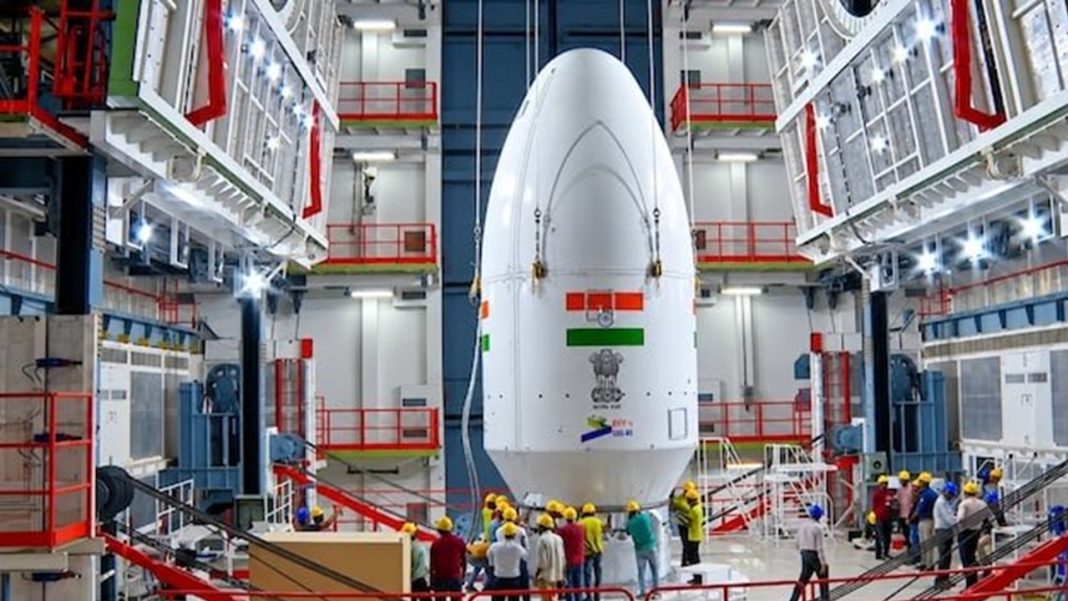

ISRO has rejected claims that India’s space reforms will privatise the agency, but confirmed a major shift: mature launch vehicles, routine satellites and other established systems can increasingly be produced by industry or public-sector companies. The September 6 clarification followed a letter from nine employee associations seeking clarity on in-house manufacturing, operations, recruitment and job roles. ISRO says it will remain India’s principal institution for advanced research, strategic missions and exploration, while industry scales mature technologies.
Why Did ISRO Employees Raise Concerns Over The Private-Sector Push?
Employee associations from major ISRO centres sent a joint representation dated September 4. Their concern was not simply private participation. India opened the sector in 2020, and industry involvement has expanded steadily since then.
The larger question was whether launch-vehicle production, satellite realisation, integration, testing and some operational work could move outside ISRO on a much bigger scale. Employees sought written clarity on policy, future recruitment and whether reduced in-house work could affect careers or technical capability.
The letter followed the GSLV-F17/EOS-05 mission. India is also preparing for Gaganyaan, lunar missions and the planned Bharatiya Antariksh Station, so staff groups argued that deep engineering capability must remain inside ISRO.
Key Highlights
- ISRO says it will neither be privatised nor lose its importance.
- Mature rockets and routine satellites may increasingly be produced by industry or PSUs.
- ISRO plans to focus more scientific manpower on frontier research and strategic missions.
- Around 440 space-tech start-ups were registered in India by August 2026.
- India is targeting a space economy of roughly $44 billion by 2033.
Will Rocket And Satellite Manufacturing Actually Move Outside ISRO?
Partly, yes. ISRO’s official clarification on space-sector reforms says mature and routinely manufactured systems can increasingly be scaled through industry. That includes established launch vehicles, routine satellites and other systems suitable for repeat production.
The distinction is between developing technology and repeatedly manufacturing it. ISRO says technology transfer does not mean leaving a field. Industry can manufacture at scale while ISRO works on next-generation launch systems, propulsion, advanced payloads, human spaceflight, planetary missions and strategic capabilities.
That model is already visible. ISRO transferred Small Satellite Launch Vehicle technology to Hindustan Aeronautics Limited in September 2025. SSLV was designed for quick-turnaround launches and can carry satellites up to 500 kg to low Earth orbit.
NewSpace India Limited has also contracted the HAL-L&T consortium to build five PSLV-XL vehicles with ISRO technical support. In August 2026, the government said planned technology transfers for PSLV and LVM3 were being taken forward.
In its official X post on September 6, ISRO described the transition as an “ISRO-led national space ecosystem,” rather than privatisation.
How Big Is India’s Private Space Expansion Now?
Private participation now reaches far beyond experimental start-ups. An August Parliament reply said around 440 space-technology start-ups were registered in India. Another government update on technology transfers said 118 technology-transfer agreements had been executed through NSIL.
Companies are active in launch vehicles, Earth observation, communications, propulsion, satellite manufacturing, ground systems and applications. The Indian Space Policy 2023 framework permits non-government entities to undertake end-to-end space activities, including launches and satellite operations, subject to authorisation.
The commercial target is ambitious. Government projections place India’s space economy at about $44 billion by 2033, from about $8.4 billion in 2023. Reaching that scale needs more manufacturing capacity, investment and commercial launches than ISRO alone can provide.
For now, manufacturing looks set to become more distributed, not abandoned by ISRO. Routine production is likely to move further towards companies and PSUs, while the agency retains frontier research, strategic programmes and mission-critical technology.
What Happens Next For ISRO, Industry And Its Workforce?
The policy direction is clearer, but employees still want details on staffing, recruitment, outsourced operations and how much hands-on manufacturing ISRO centres will retain.
ISRO’s reassurance addresses the privatisation fear, yet the transition will change who builds some rockets and satellites. The test will be whether industry can scale production without weakening ISRO’s engineering base, safety culture or strategic independence.
For India, the goal is to run both tracks together: a strong public space agency developing new technology, and an industry able to produce and sell mature systems at commercial scale.
FAQs
Will ISRO be privatised?
No. ISRO says it will remain India’s principal agency for advanced research and strategic missions.
Will private companies manufacture ISRO rockets?
Yes. Mature launch vehicles can increasingly be manufactured by industry or public-sector companies under agreements.
Has SSLV manufacturing already moved to industry?
Yes. SSLV technology was transferred to HAL in 2025 for manufacturing, integration and launch capability.
Will ISRO stop making satellites completely?
No. Routine satellite production may shift outward, while ISRO continues advanced payloads and critical technologies.
Why is India expanding private participation in space?
India wants more investment, manufacturing scale, commercial capacity and a larger share of space business.