
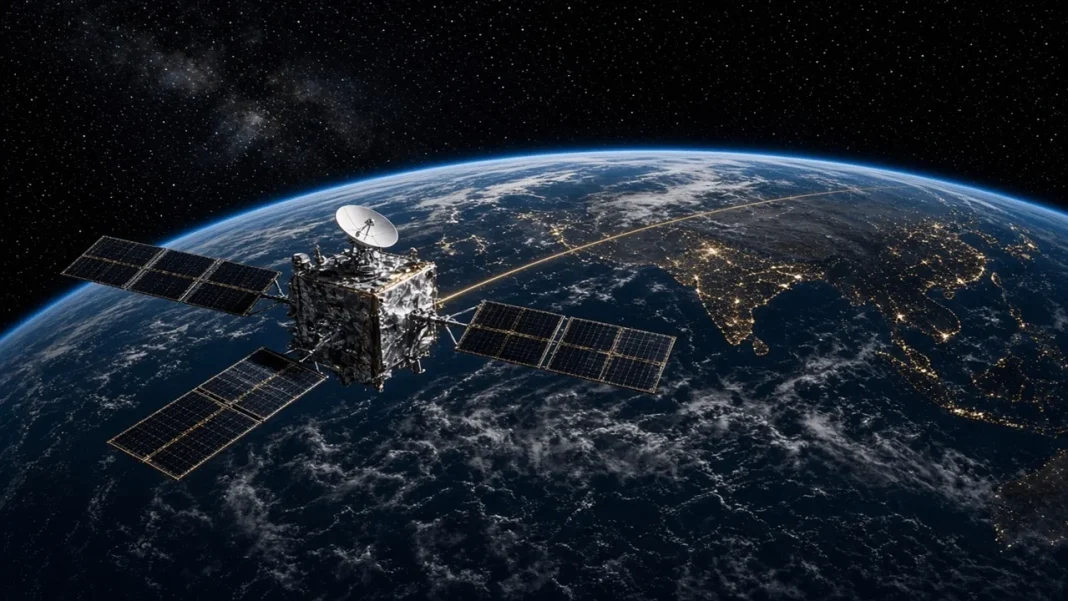

India has already placed spacecraft around the Moon and Mars. Its next planetary target is far less welcoming. Venus is hidden beneath thick clouds, its surface is hot enough to melt lead, and pressure near the ground is crushing. Yet this hostile world is also one of Earth’s closest planetary relatives.
That contrast is why ISRO’s Venus Orbiter Mission, or VOM, has become a major science priority. The Union Cabinet approved it in September 2024, and ISRO currently lists launch for 2028. The spacecraft is designed to stay around Venus and study how its surface, atmosphere and space environment interact. The approval and broad science goals are detailed in the Press Information Bureau’s official Venus mission announcement.
Key Highlights
- ISRO plans to launch VOM in 2028, with LVM3 identified as the candidate rocket.
- The project cost is about ₹1,236 crore, with a planned five-year science phase.
- Instruments will examine volcanism, subsurface layers, clouds, atmospheric chemistry, lightning, the ionosphere and solar-wind interaction.
- The mission will also test aerobraking around another planet.
Why Venus Comes After India’s Moon And Mars Missions
The sequence is not simply about travelling farther. Chandrayaan built experience in lunar science, while the Mars Orbiter Mission showed that India could operate a spacecraft across interplanetary distances. Venus presents another question: how did a planet similar in size to Earth end up with such a radically different climate?
Today, Venus has a carbon-dioxide-rich atmosphere that traps enormous heat. The European Space Agency’s Venus exploration overview puts surface conditions at roughly 465°C, with pressure about 90 times that at Earth’s surface. Studying how Venus changed could help scientists reconstruct the evolution of rocky planets and the conditions that separate a temperate world from a greenhouse one.
The timing is notable too. NASA’s DAVINCI team was testing hardware against Venus-like heat in September 2026, while ESA is developing Envision for a planned 2031 launch. India is entering a renewed international push to investigate Earth’s neighbouring planet.
What India’s Venus Orbiter Mission Hopes To Discover
ISRO’s science plan reaches from below the surface to the upper atmosphere. Its recommended suite includes 16 Indian payloads, two India-international collaborative payloads and one international payload. Radar, cameras, spectrometers and particle instruments will tackle different pieces of the Venus puzzle.
One radar experiment is intended to search for active volcanism and tectonic activity. Another will probe subsurface structure and estimate the thickness of lava flows. The atmosphere is equally important. Instruments are expected to track cloud motion, aerosols, gases and thermal behaviour. ISRO’s published VOM payload list sets out these science targets in detail.
Scientists also want to examine Venus’s “super-rotation”, where its atmosphere circles the planet much faster than the surface rotates. Higher up, VOM will study the ionosphere and solar-wind interaction. Because Venus lacks an Earth-like global magnetic field, its upper atmosphere faces particles from the Sun directly. Those measurements may show how atmospheric material escapes into space.
How ISRO Plans To Reach And Study Venus
ISRO’s published configuration identifies LVM3 as the candidate launch vehicle. After reaching Venus, the spacecraft is planned to enter a highly elliptical orbit. It would then use aerobraking for about six to eight months, repeatedly passing through the upper atmosphere to shrink its orbit while saving fuel.
The target science orbit is about 200 by 600 kilometres and highly inclined. ISRO proposes five years of science operations after the final orbit is established. The complete flight concept appears in ISRO’s official Venus mission configuration.
Preparation has already widened beyond the core mission team. At ISRO’s October 2025 national science meet, about 150 scientists, engineers, faculty members and doctoral students participated. ISRO has also invited Indian researchers to analyse archival Venus data before VOM flies, building a science community before the spacecraft even leaves Earth.
Why The Venus Mission Could Become A Major Scientific Step For India
A successful VOM would do more than add Venus to India’s destination list. It brings deep-space navigation, radar science, long-duration planetary operations and aerobraking into one programme, capabilities that could support later missions.
It may also fly during one of the busiest periods for Venus research in decades. Indian, American and European missions are targeting different layers of the planet, giving scientists a chance to compare observations across spacecraft rather than rely on one mission alone.
FAQs
When Will ISRO Launch India’s First Venus Mission?
ISRO currently places the Venus Orbiter Mission in 2028. Earlier mission material named March 2028, though launch schedules can still change during later spacecraft development.
What Will ISRO Study On Venus?
The orbiter will investigate Venus’s surface, subsurface, atmosphere, clouds, aerosols, ionosphere, possible volcanic activity and the way solar particles interact with the planet over time.
Will India Land On Venus During This Mission?
No. The approved Venus Orbiter Mission is an orbiter, not a lander, so its instruments will study the planet remotely while circling Venus from space.
Why Is Venus Important For Earth Science?
Venus resembles Earth in size but followed a very different climate path. Comparing both planets may reveal how rocky worlds change and lose habitability over time.
How Long Will The Venus Mission Operate?
ISRO’s published configuration proposes about five years of science operations after Venus arrival, orbital insertion and the planned aerobraking phase have been successfully completed there.
India’s Space Future Is Taking Shape
Why Is NVS-03 Important For NavIC?
Check out how the upcoming satellite could strengthen India’s navigation system.
What Could ISRO And ESA Explore?
Find out what the extended space partnership could bring by 2032.
What Will EOS-05 Do In Orbit?
Uncover the role of India’s new Earth-observation satellite.
When Will NVS-03 Finally Launch?
Browse the latest October launch timeline and what comes next for NavIC.
How Will NETRA Protect Indian Satellites?
See how the new space-tracking radar could strengthen satellite protection.