

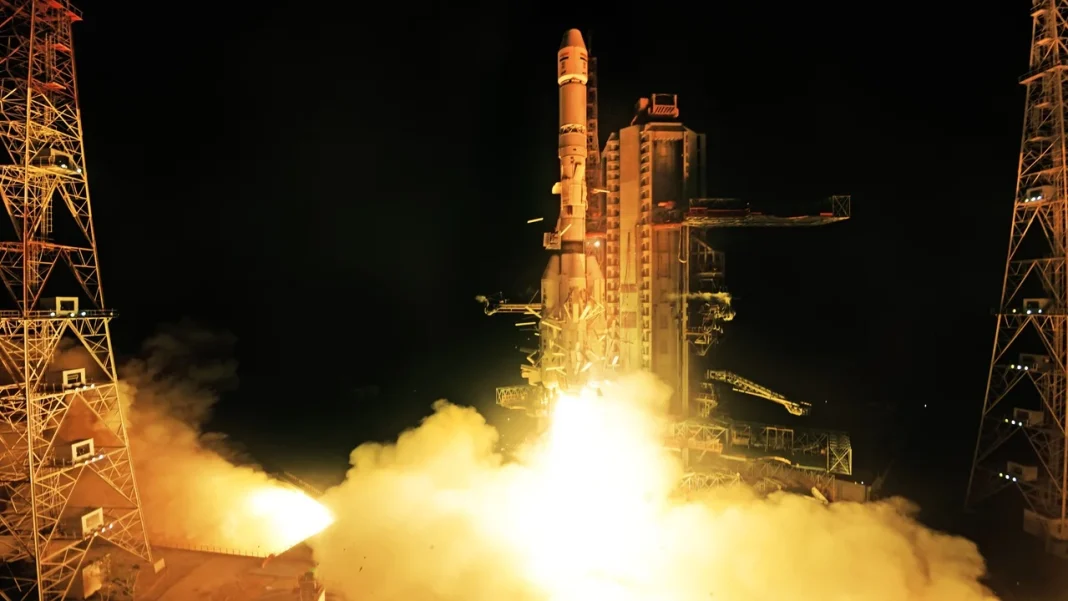

India’s next navigation mission may be only weeks away. ISRO is reportedly targeting October 15–20, 2026, for NVS-03 aboard a GSLV Mk II from Sriharikota. A Times of India report said the launch campaign began on September 14 and first-stage stacking is complete. ISRO, however, has not announced the final date on its public launch mission page.
NVS-03 arrives at a difficult point for Navigation with Indian Constellation, or NavIC. A July 29 government reply on NavIC’s operational status said only IRNSS-1B, IRNSS-1I and NVS-01 were providing Position, Navigation and Timing services. Four operational satellites are needed for basic standalone positioning, so NavIC cannot currently provide it independently, although timing remains functional.
Key Highlights
- NVS-03 is reportedly targeted for launch between October 15 and 20, 2026.
- It is the third spacecraft in the five-satellite second-generation NVS series.
- NavIC has three satellites providing full PNT services, below the four-satellite minimum.
- NVS-04 and NVS-05 are in advanced stages of realisation, according to the government.
Why The NVS-03 Launch Is So Important For NavIC
The immediate job is simple on paper: put another working navigation satellite into service. If NVS-03 reaches its intended orbit, clears testing and joins service while the existing three remain operational, NavIC could again cross the minimum four-satellite threshold. That outcome depends on NVS-03 being successfully commissioned rather than merely reaching space.
ISRO designed NavIC to serve India and an area extending about 1,500 km beyond the country’s boundary. Its civilian Standard Positioning Service is designed for position accuracy better than 20 metres over the primary service area, according to ISRO’s satellite navigation information. A February 2026 government update on satellite-based services said NavIC was used for real-time tracking on over 10,400 locomotives, fitted on more than 40,000 fishing vessels, and supported by over 60 mobile handset models.
That makes NVS-03 more than a routine launch. It is a recovery mission for a national navigation system that has lost redundancy as older spacecraft reached the end of service.
What Changed After NVS-02 Failed To Reach Its Final Orbit
The pressure on NVS-03 increased after NVS-02 ran into trouble. GSLV-F15 launched NVS-02 on January 29, 2025, marking the 100th launch from Sriharikota. The rocket placed the spacecraft into its transfer orbit, but the satellite could not raise itself to the planned circular orbit.
ISRO later said the drive signal did not reach the pyro valve on the oxidiser line used by the orbit-raising engine. An apex committee traced the most likely cause to disengagement of connector contacts in both main and redundant paths. The agency’s official NVS-02 investigation update said corrective actions were adopted for later spacecraft.
That setback is why NVS-03’s post-launch orbit-raising phase will draw almost as much attention as liftoff. Getting off the pad is only the first part of restoring another working NavIC spacecraft.
What NVS-03 Adds To The Second-Generation NavIC Fleet
NVS-03 is part of a five-spacecraft series covering NVS-01 through NVS-05. The new generation is intended to replace or augment the ageing first-generation constellation and keep services available over the coming years. ISRO outlines the second-generation programme on its NVS satellite information page.
One major change is the addition of the L1 civilian signal. ISRO says forthcoming NavIC satellites broadcast Standard Positioning Service signals in L1, L5 and S bands. The agency says L1 is interoperable with other navigation systems, opening a wider path for compatible civilian receivers.
NVS-01, launched in May 2023, was also the first NavIC satellite to fly an indigenous atomic clock. Precise clocks are central to satellite navigation because positioning depends on measuring tiny differences in signal travel time.
What Comes Next For ISRO And NavIC
NVS-03 will not finish the rebuild. The government said in July that NVS-04 and NVS-05 were already in advanced stages of realisation. Their deployment would add resilience rather than leaving NavIC dependent on the minimum number of working spacecraft.
The mission will also follow ISRO’s successful GSLV-F17/EOS-05 mission on September 4, 2026. That flight placed India’s first geosynchronous imaging satellite into its intended orbit, shortly before the reported NVS-03 window. If the October target holds, the two GSLV missions would be separated by roughly six weeks.
For NavIC, the next steps are clear: launch NVS-03, complete orbit raising, test its navigation payload and clock performance, then commission it. After that, attention moves to NVS-04 and NVS-05 and rebuilding enough spare capacity to keep the service stable when individual satellites retire or fail.
FAQs On NVS-03 And NavIC
When Will NVS-03 Launch?
NVS-03 is reportedly targeted for October 15–20, 2026, but ISRO has not announced a date.
How Many NavIC Satellites Currently Provide PNT Services?
NavIC currently has three PNT-capable satellites, while at least four are required for standalone positioning.
What Is NVS-03?
NVS-03 belongs to the five-satellite NVS series built to replace and strengthen ageing NavIC spacecraft.
What New Signal Does The NVS Series Add?
Second-generation NVS satellites add L1 signals, alongside L5 and S-band services, for wider receiver compatibility.
What Comes After NVS-03?
NVS-04 and NVS-05 were in advanced realisation stages, according to the July 2026 government update.
India’s Space Ambitions Are Reaching New Heights
How Will NETRA Protect Indian Satellites?
Check out how Project NETRA could strengthen India’s space surveillance.
Can ISRO Build A Space Station?
Find out what India’s 2035 space station goal requires from ISRO.
Will Private Firms Reshape ISRO’s Future?
Uncover what private-sector expansion could mean for rocket and satellite manufacturing.
Could New Engines Boost LVM3 Capacity?
Explore how the semi-cryogenic engine could increase LVM3’s satellite-carrying capability.
Can EOS-05 Transform Disaster Monitoring?
Dive into how rapid satellite revisits could improve real-time disaster monitoring.