

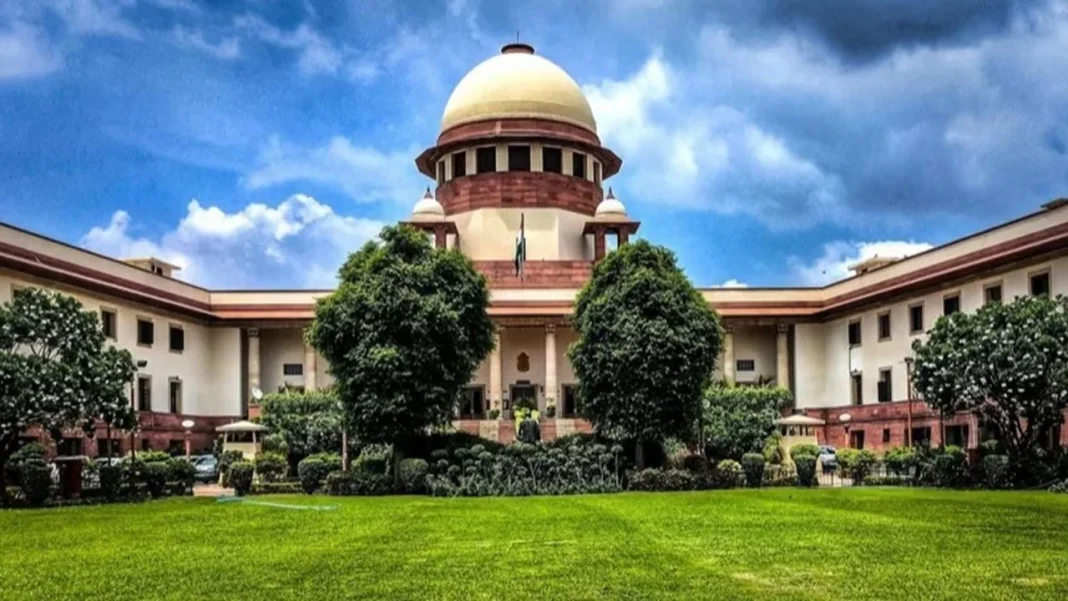

The Supreme Court has asked the Bihar government to explain how Panchayati Raj Minister Deepak Prakash has continued in office for more than six months overall without becoming an MLA or MLC. During Thursday’s hearing, Chief Justice of India Surya Kant called it a “pure question of law” and said the state must justify the minister’s continuation. The Constitution permits such an appointment temporarily. The dispute is whether a break between two stints can restart the six-month clock. The matter is listed for urgent hearing on August 4.
What Did The Supreme Court Ask The Bihar Government?
Deepak Prakash first became Bihar’s Panchayati Raj Minister on November 20, 2025, although he was not a member of either House of the state legislature. He served for four months and 26 days before the Nitish Kumar government ended on April 15, 2026. After remaining outside the cabinet for 22 days, he was sworn in again on May 7 under the Samrat Choudhary government. He still had not entered the Assembly or Legislative Council.
A petition filed by social activist Rakesh Kumar Singh argues that both periods must be counted together. On June 15, the Supreme Court issued notices to the Bihar government, Prakash and the Election Commission of India. The latest hearing placed the state’s explanation at the centre of the case. No final finding has been delivered.
The case currently turns on four points:
- Prakash has crossed six months in office when both ministerial stints are added.
- Neither individual stint lasted six continuous months.
- A 22-day gap separated the two appointments.
- The Court must decide whether reappointment legally resets the constitutional deadline.
Why Is Article 164(4) At The Heart Of The Case?
Article 164(4) of the Constitution says a minister who remains outside the state legislature for six consecutive months must cease to be a minister when that period expires. This allows a chief minister to bring a non-legislator into the cabinet during an exceptional or transitional situation. However, that person ordinarily has to win an Assembly bypoll or secure election to the Legislative Council within six months.
The Bihar dispute arises from the words “six consecutive months”. Prakash’s first appointment stopped before six months, followed by a short gap and another oath. The petitioner says the break cannot create a fresh constitutional window. Bihar may argue that the second appointment began a separate tenure, but the state’s detailed position will become clearer during the next hearing. The ruling could guide future cabinet formations after mid-term government changes.
Why Does The Earlier Supreme Court Ruling Carry Weight?
The petition relies heavily on the Supreme Court’s 2001 decision in S.R. Chaudhuri versus State of Punjab. That case involved an unelected minister who resigned after failing to enter the legislature within six months and was later appointed again during the same Assembly’s term. The Court ruled that repeated appointment without election would weaken Article 164(4) and parliamentary democracy. It described the six-month opportunity as a one-time slot for the individual during the life of that legislature.
Prakash’s case is not identical because his first ministry ended when the government fell, rather than after he personally completed six months. That distinction sharpens the current dispute. Still, the older judgment says a change of chief minister does not automatically permit the same unelected person to return repeatedly during the same Assembly term. The Bihar government will have to explain why that principle should not control this appointment.
What Could Happen After The August 4 Hearing?
The Supreme Court may first examine Bihar’s reply, the appointment dates, and whether the two periods should be treated cumulatively. If it accepts the petitioner’s argument, Prakash’s continuation could be declared invalid, and the ruling may tighten future use of the six-month exception. If the Court finds that the fall of one government ended the first constitutional period, it could recognise the second oath as a separate appointment. For now, both outcomes remain open.
Similar arrangements have appeared before. Uddhav Thackeray entered office as Maharashtra Chief Minister in 2019 before joining the Legislative Council. Tirath Singh Rawat resigned as Uttarakhand Chief Minister in 2021 near his six-month deadline, while H.D. Deve Gowda entered the Rajya Sabha after becoming Prime Minister. Those examples were settled through election or resignation. The Bihar case is different because it asks whether two incomplete stints can together cross the limit.
Frequently Asked Questions
1. Can an unelected person become a state minister?
Yes, but that person must enter the state legislature within six consecutive months of appointment.
2. Who is Deepak Prakash?
Deepak Prakash is Bihar’s Panchayati Raj Minister, currently serving without being an MLA or MLC.
3. Why did the Supreme Court question Bihar?
His combined ministerial tenure exceeded six months, although two appointments were separated by twenty-two days.
4. Has the Supreme Court removed Deepak Prakash?
No, the Court has sought Bihar’s explanation and has not delivered its final ruling yet.
5. When will the case be heard again?
The Supreme Court listed the constitutional dispute for an urgent hearing on August 4, 2026.