

India has already watched a privately built rocket cross into space. The next step is harder: reaching orbit and staying there. Skyroot Aerospace plans to attempt that jump with Vikram-1 during Mission Aagaman, whose launch window runs from July 12 to August 4, 2026, from the Satish Dhawan Space Centre in Sriharikota. The flight is scheduled no earlier than July 12 and remains dependent on final tests, weather, safety checks, and range clearance.
Once Vikram-1 lifts off, the headline will not simply be another private rocket launch. Success would make it the first privately developed Indian vehicle to place payloads into orbit. Skyroot’s official Mission Aagaman launch announcement describes a 450 km target orbit at a 60-degree inclination. The flight will collect data on propulsion, guidance, stage separation, and overall vehicle performance.
Vikram-1 Is Built To Stay In Orbit, Not Touch Space And Fall Back
Vikram-S proved that an Indian private company could design, build, and fly a rocket beyond the atmosphere. Its November 18, 2022 flight was suborbital, however. The single-stage vehicle climbed to 88.8 km, reached Mach 5.07, then returned to Earth after a 301.4-second mission. The official Mission Prarambh record shows that it carried three customer payloads and tested carbon-composite structures, avionics, telemetry, and solid propulsion.
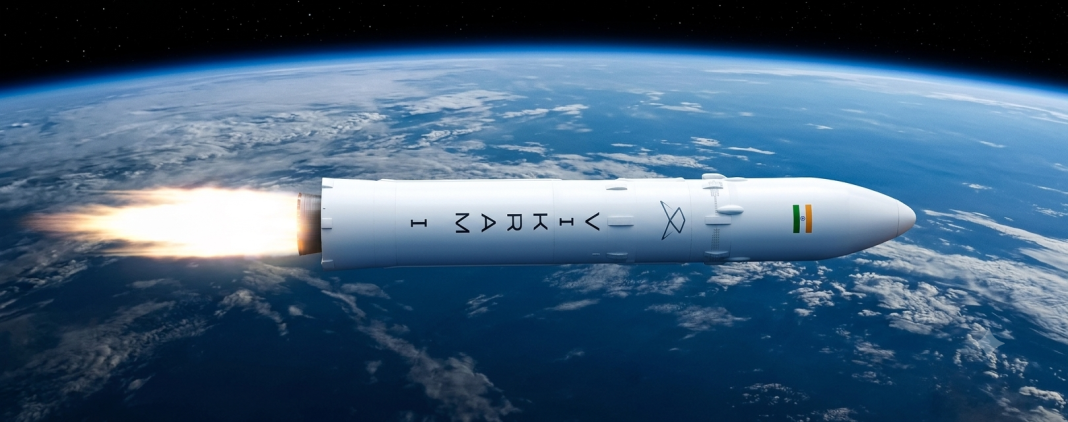
Vikram-1 has a different job. It must accelerate sideways fast enough to keep falling around Earth rather than dropping back into the sea. That requires several powered stages, precise steering, timed separation events, a payload fairing release, and accurate orbital insertion. Skyroot’s Vikram-1 specifications list capacity of up to 350 kg to low Earth orbit and 260 kg to sun-synchronous orbit.
Key differences include:
- Vikram-S was a single-stage suborbital demonstrator; Vikram-1 is a multi-stage orbital launch vehicle.
- Vikram-S tested core systems for minutes, while Vikram-1 must deliver working payloads at orbital velocity.
- Vikram-1 uses carbon-composite structures, solid boosters, and a 3D-printed liquid engine for final control.
- Vikram-S opened India’s private launch chapter; Vikram-1 aims to begin repeatable commercial satellite missions.
What Happens After Vikram-1 Leaves Sriharikota
At liftoff, the first-stage Kalam-1200 motor provides the heavy push needed to clear the atmosphere. ISRO reported a successful static firing in August 2025, describing the motor as 11 metres long, 1.7 metres wide, and loaded with 30 tonnes of propellant. That Kalam-1200 test was one of the largest hardware checks before flight.
As fuel is exhausted, spent stages separate so the remaining rocket does not carry dead weight. The fairing opens after atmospheric pressure and heating fall enough to expose the payloads safely. Guidance computers then command the upper stages toward the planned 450 km orbit. If speed, altitude, and direction line up closely enough, the payloads separate and begin circling Earth.
That is the defining moment. Crossing the commonly used boundary of space is not enough for an orbital mission. Vikram-1 must reach roughly orbital-class velocity, maintain control through every stage event, and release its customers into the intended path. Even if every payload works later, the first flight’s main prize is performance data that ground testing cannot fully reproduce.
Mission Aagaman Carries More Than Test Hardware
Mission Aagaman has attracted attention because its passenger list is unusual. Reports say Vikram-1 will carry domestic and international payloads, including commercial CubeSats, Skyroot’s SCOPE satellite, an 18-carat gold miniature rocket containing tiny tributes to C.V. Raman, Vikram Sarabhai, and A.P.J. Abdul Kalam, plus a diamond jewellery artwork called Cosmic Bloom. The reported payload lineup also includes Cosmoserve Space’s Mission Embrace.
Mission Embrace is expected to test a soft robotic capture mechanism designed for future space debris removal. That makes the flight more than a symbolic first. It gives young Indian space companies a rare chance to test equipment in orbit without waiting for a large foreign rideshare mission.
Why The First Flight Could Reshape India’s Launch Market
Small-satellite operators often face long queues, fixed destinations, or limited control when sharing large rockets. Vikram-1 is being positioned for dedicated and rideshare missions, allowing customers to choose a launch better matched to their payload and orbit. A successful demonstration would move Skyroot from ground tests and suborbital proof toward an operating launch business.
The timing adds weight. Skyroot became India’s first space-tech unicorn in May 2026 after raising $60 million, while India is targeting a $44 billion space economy by 2033. One clean orbital flight could help attract customers, suppliers, engineers, and investors. More importantly, it would show that private Indian teams can build launch vehicles while using national infrastructure and regulatory support alongside ISRO, rather than merely supplying components to government missions.
FAQs About Vikram-1 And Vikram-S
1. Has Vikram-1 already launched?
No. Its current launch window runs from July 12 through August 4, 2026, from Sriharikota.
2. Why Is Vikram-1 Called An Orbital Rocket?
It is designed to place satellites into Earth orbit instead of returning immediately after ascent.
3. How Much Can Vikram-1 Carry?
Skyroot lists capacity up to 350 kg for low Earth orbit missions with satellite payloads.
4. What Did Vikram-S Achieve In 2022?
Vikram-S crossed 88 km, tested systems, carried three payloads, and completed India’s first private launch.
5. What Would A Successful Flight Change?
It would prove a private Indian company can deliver payloads into orbit using homegrown technology.