

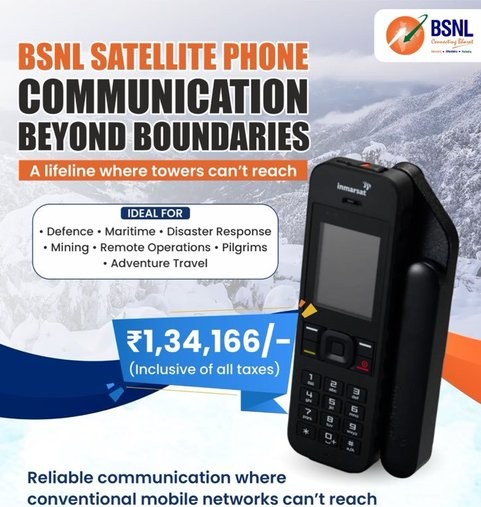

BSNL has put a very unusual phone back in the spotlight. It costs ₹1,34,166, does not need a normal mobile tower signal, and is not made for regular social media scrolling, camera use, or everyday calling. This is a satellite phone, built for places where normal mobile networks simply disappear.
The price was shared in BSNL’s recent satellite phone communication, with the handset cost listed at ₹1,34,166 including GST. The device is aimed at users who may need voice communication when mobile networks fail, especially in mountains, forests, deserts, coastal areas, and remote work sites. BSNL’s satellite phone service is part of its Global Satellite Phone Service, also called GSPS.
Why This BSNL Phone Is Getting So Much Attention
The headline price is enough to make people stop scrolling. A ₹1.34 lakh phone from BSNL sounds strange when many buyers compare it with premium smartphones. But this device is not competing with an iPhone or a Samsung flagship. It is built for communication when no mobile tower is nearby.
BSNL’s official Instagram post says the satellite phone service is meant for reliable voice communication when networks fail, with monthly plans starting from ₹4,130. That makes it a specialised safety device, not a mass-market mobile phone.
The phone may help teams working in defence, maritime operations, disaster response, mining, remote projects, pilgrimage support, and adventure travel. TelecomTalk also reported that BSNL asked interested users to contact the nearest BSNL office or call 9768866652 for details.
How Does The BSNL Satellite Phone Work Without a Normal Signal?
A normal mobile phone connects to a nearby tower. That tower sends the call or message through the telecom network. In remote hills, deep forests, border zones, or open sea, that tower may not exist. That is where a satellite phone works differently.
This BSNL satellite phone connects through satellite communication instead of depending only on a ground mobile tower. Under BSNL’s Global Satellite Phone Service, users can make voice calls and send SMS messages. The Ministry of Communications has said BSNL has provided GSPS voice and SMS services to the public and private enterprises since January 1, 2018.
The government has also said GSPS communication is encrypted and works under DoT guidelines. Users must complete customer verification and declare the purpose, place and period of use before using the service. That is why this phone cannot be treated like a normal prepaid handset bought from a mobile shop.
Where It Can Be Useful
- Disaster response teams during floods, landslides, cyclones or earthquakes
- Defence and border-side operations where mobile towers may not be reachable
- Ships, fishing teams, and maritime workers moving far from shore
- Mining, oil, power, and infrastructure teams in remote project zones
- Pilgrims, trekkers, and adventure groups travelling through weak-network routes
Can Anyone Buy This BSNL Satellite Phone?
This is the biggest catch. The answer is not as simple as “go and buy it.” Satellite phones in India need permission and proper documentation. They are not meant for casual use without authorisation.
The Ministry of Communications has stated that BSNL must follow the customer acquisition process prescribed for mobile connections and collect details such as place of use, period of use and purpose of use. The same government note also lists GSPS tariff plans, including postpaid and prepaid options for government and commercial users.
So, a business operating in a remote mining belt may have a valid case. A disaster relief agency may have a valid case. A regular buyer wanting a flashy phone for travel selfies does not fit the usual purpose.
There is also a legal angle. Unauthorised possession or use of satellite phones in India can lead to serious trouble. That is why BSNL’s satellite phone launch should be read as a specialised communication service, not a normal consumer gadget launch.
Why This Launch Fits India’s Satellite Connectivity Push
BSNL’s satellite phone news arrives while India’s satellite communication space is heating up. In 2024, the Department of Telecommunications said BSNL had launched India’s first satellite-to-device service, with Viasat as the technology partner. That service was linked to satellite connectivity for remote corners of India.
Viasat and BSNL had also demonstrated direct-to-device satellite messaging at the India Mobile Congress. In that trial, two-way and SOS messages were sent from a commercial Android smartphone enabled for non-terrestrial network connectivity to a geostationary L-band satellite nearly 36,000 km away.
That does not mean every phone in India will suddenly work from space. Direct-to-device technology, satellite phones, and satellite broadband are separate parts of the same wider story. Some need dedicated handsets. Some may later work on supported smartphones. Some will depend on licensing, spectrum, device support, and operator rollout.
FAQs
What Is The Price Of The BSNL Satellite Phone?
The BSNL satellite phone costs ₹1,34,166, including GST, as per recent official communication.
Does The BSNL Satellite Phone Need a Mobile Tower Signal?
No, it uses satellite communication for voice and SMS in areas without mobile coverage.
Can Normal Users Buy The BSNL Satellite Phone?
Users need proper authorisation, verification, and declared usage details before getting satellite phone access.
Who Should Use The BSNL Satellite Phone?
It suits defence, disaster response, maritime, mining, remote operations, pilgrims, and adventure travel users.
Does The BSNL Satellite Phone Support Internet Apps?
BSNL’s GSPS service is mainly for voice calls and SMS, not smartphone-style internet apps.