
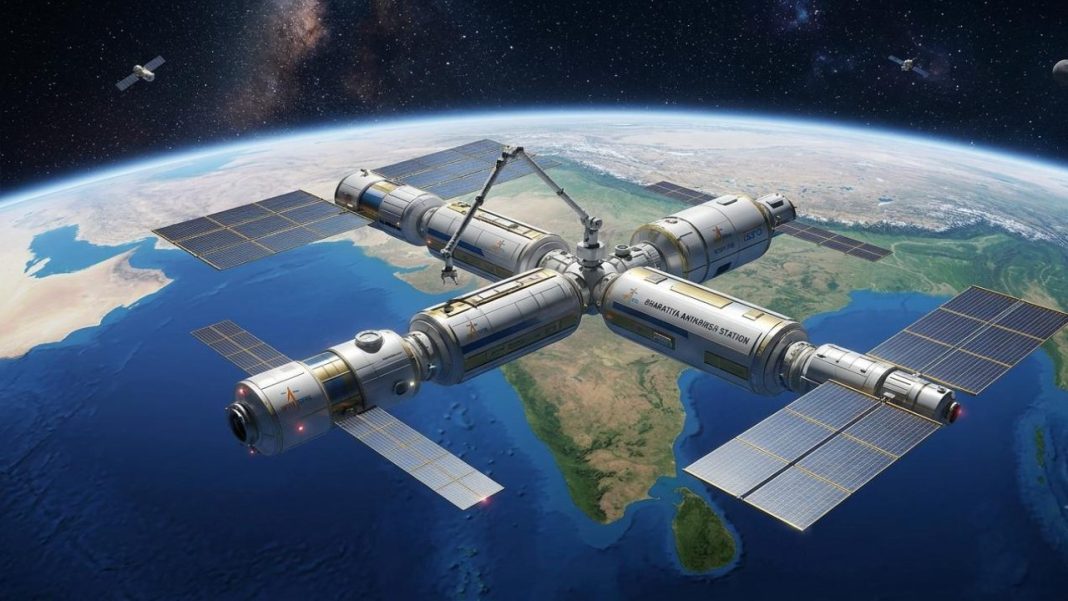

India’s space programme is moving from short missions toward something far more permanent: an Indian-built orbital station. The Bharatiya Antariksh Station, or BAS, is planned as a five-module research platform in Low Earth Orbit, with the complete station targeted for 2035.
The first big date arrives earlier. ISRO is aiming to launch BAS-01, the station’s first module, in 2028. A July 30, 2026 parliamentary reply said the baseline design review and system engineering for BAS-01 had been completed, 31 baseline design documents released, an expert review finished, and subsystem design work begun.
The station will build on technologies being developed through Gaganyaan, India’s human spaceflight programme, while docking, life-support and microgravity research projects are being prepared for longer stays in orbit.
What Is India Planning With The Bharatiya Antariksh Station?
BAS is intended to give India its own sustained human spaceflight platform rather than limit the programme to short orbital missions. The government says the final station will consist of five modules and support medium- to long-duration human missions, scientific experiments and technology demonstrations in microgravity.
The plan received a major push when the Union Cabinet expanded the Gaganyaan programme in September 2024 to include precursor missions and BAS-01. According to a March 25, 2026 Lok Sabha reply, the approved cost for developing and launching the first module is estimated at ₹1,763 crore for 2025-2028. The broader revised Gaganyaan programme carries an approved allocation of ₹20,193 crore.
Research planned around BAS includes life sciences, pharmaceuticals, material sciences and manufacturing technologies. ISRO also wants capabilities such as rendezvous and docking, robotics, in-orbit refuelling, crew quarters, intra-vehicular suits and experiment racks.
When Will The First BAS Module Go Into Orbit?
The current target is 2028. BAS-01 is described by the government as the first or base module of the future station. The complete five-module station is then expected to be operational by 2035.
Recent progress indicates that BAS has moved beyond a broad concept. ISRO has completed the baseline design review and system engineering for BAS-01, while subsystem design work is underway. Vikram Sarabhai Space Centre has also sought Indian industry participation for realising the first module’s structure.
Key dates in the present roadmap are:
- Q4 2026: First uncrewed Gaganyaan experimental mission with the Vyommitra half-humanoid.
- 2027: Two more uncrewed Gaganyaan missions and India’s first crewed Gaganyaan mission are targeted.
- 2028: Development and launch of BAS-01 is targeted.
- 2035: All five BAS modules are expected to form the operational Indian space station.
- 2040: India’s wider Space Vision targets an Indian crewed lunar landing.
These dates are connected. Each earlier flight is expected to validate systems later crews will rely on while travelling to, docking with, and living aboard BAS.
Why Gaganyaan And SpaDeX Matter Before BAS
A space station cannot work without reliable crew transport, docking, life support, communications and recovery systems. Gaganyaan is developing much of that base. As the August 5, 2026 Gaganyaan update reported, ground testing of all propulsion stages and structures for the Human Rated Launch Vehicle had been completed. Crew and Service Module propulsion systems had also been developed, tested, and qualified.
The first uncrewed experimental Gaganyaan flight is targeted for the fourth quarter of 2026, followed by additional uncrewed flights and the first crewed mission in 2027. These missions will test technologies before India begins human operations around an orbital station.
Docking is another critical piece. ISRO’s SpaDeX mission demonstrated rendezvous and docking technology, needed when separately launched spacecraft must connect in orbit. ISRO is also studying SpaDeX-2 and SpaDeX-3, with the latter intended as a precursor for docking involving pressurised modules relevant to BAS.
ISRO flagged this connection even before SpaDeX launched in its official SpaDeX post on X, describing docking as important for future lunar missions and for building Bharatiya Antariksh Station.
What Happens Between 2028 And The 2035 Space Station Target?
Launching BAS-01 will mark the beginning, not completion, of India’s space station. Additional modules will have to be developed, launched separately, and joined in orbit. Systems for power, environmental control, crew stays, refuelling, robotics, communications and experiments must also work together for much longer periods than a short Gaganyaan flight.
India also gained recent station experience through Group Captain Shubhanshu Shukla’s 18-day Axiom-4 mission aboard the ISS in 2025. He completed seven Indian microgravity experiments, and ISRO said the lessons would support Gaganyaan, BAS and future planetary missions.
Science preparation has already started. In January 2026, ISRO opened Indian Microgravity Experiments, or IMEx-2026, inviting researchers to propose experiments for human spaceflight platforms. The programme links Gaganyaan with the longer-term move toward sustained human presence through BAS.
Frequently Asked Questions
When will India launch the first Bharatiya Antariksh Station module?
ISRO plans to launch BAS-01, the first Bharatiya Antariksh Station module, into orbit during 2028.
How many modules will the Bharatiya Antariksh Station have?
The completed station is targeted to contain five modules and become fully operational by 2035.
What research will be carried out aboard BAS?
BAS will support microgravity research in life sciences, pharmaceuticals, materials, manufacturing, and human spaceflight technologies.
How is Gaganyaan connected to the Indian space station?
Gaganyaan will test crew transport, life-support, recovery, escape systems and other technologies required before BAS.
Why is SpaDeX important for Bharatiya Antariksh Station?
SpaDeX proved docking capability, while planned follow-up experiments will test operations closer to BAS needs.
More Technology & Space News
ISRO To Resume Launches With GISAT-1A After Seven-Month Pause: Why Has India’s Calendar Been Quiet?