
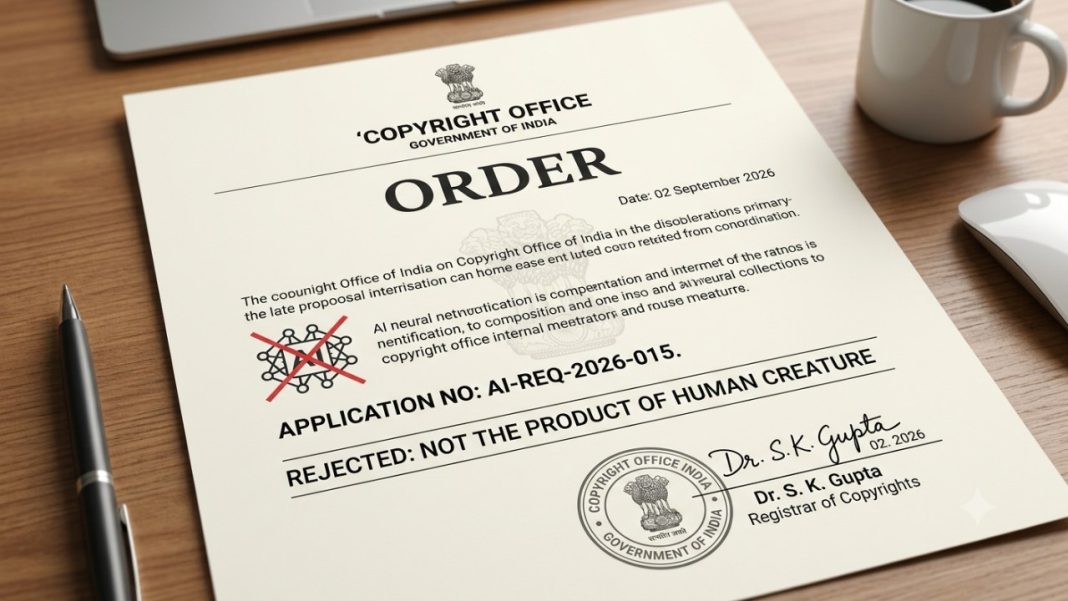

India has drawn a clear legal line around AI-generated content. On August 31, 2026, the Copyright Office rejected US computer scientist Stephen Thaler’s application to register “A Recent Entrance to Paradise” with his AI system DABUS named as author. The unexpected part was elsewhere: the artwork itself cleared the originality threshold.
Artificial intelligence cannot presently hold the legal status of an author or copyright owner simply because it generated an output. Yet computer-generated work may still qualify for protection when statutory conditions are met, and a legally recognised person can be identified as author. The ruling separates machine generation from legal authorship instead of declaring all AI-created work uncopyrightable.
What The Copyright Office Decided In The DABUS Case
Thaler filed the application in May 2022, naming DABUS, or Device for the Autonomous Bootstrapping of Unified Sentience, as author. He was listed as applicant and owner. The Delhi High Court had earlier directed the Copyright Office to decide the long-pending application, bringing AI authorship directly before the authority.
The order records that Thaler designed and configured DABUS, supplied photographs as visual inputs, curated linguistic material, and initiated the process of producing the artwork. He was offered a chance to amend the application and name himself as author, but declined.
Key findings were:
- “A Recent Entrance to Paradise” met the limited originality threshold under Section 13
- DABUS was neither a natural nor juristic person recognised by Indian law
- Thaler was the person who caused this particular work to be created
- The application failed because DABUS remained the author while Thaler claimed ownership
The order says extending authorship or legal personhood to autonomous AI is a policy choice for Parliament, not something the Registrar can introduce administratively.
Why DABUS Cannot Be An Author Under Indian Copyright Law
The central rule appears in Section 2(d)(vi) of the Copyright Act, 1957. For computer-generated literary, dramatic, musical or artistic work, the author is “the person who causes the work to be created.”
DABUS failed because the Registrar treated “person” as someone recognised by law. A human can qualify, while a company can be a juristic person where law permits. DABUS has no independent legal personality and cannot own or assign property rights.
Section 17 ordinarily makes the author the first copyright owner, while Sections 18 and 19 govern assignment. If the supposed author cannot hold or transfer rights, the chain from author to owner fails. Under current Indian law, AI therefore cannot legally own copyright by itself.
Could this change? Yes. Parliament could amend the law to create a special rule for autonomous systems or allocate rights differently. The Copyright Office cannot make that leap.
Can AI-Generated Work Still Receive Copyright In India?
Potentially, yes. The Copyright Office did not treat AI generation as automatic failure on originality. It found Thaler’s artwork had a particular visual arrangement and was not shown to reproduce an identified earlier work. That was sufficient for the limited Section 13 inquiry.
This does not mean every chatbot article, AI image, generated song or video automatically receives copyright. The Office confined its finding to this application because human involvement can differ sharply between projects.
For creators and businesses, records may carry more weight. Keeping prompts, source inputs, edits, rejected drafts, selection decisions and final revisions can help show who exercised creative control and caused the work to exist.
India’s policy debate is moving too. A DPIIT working paper on AI and copyright published in December 2025 said copyrightability and authorship of generative-AI outputs would be addressed separately from training-data questions.
What The DABUS Ruling Changes For Creators And AI Companies
The immediate takeaway is simple: under the present statute, an AI tool should not be listed as the copyright author in India. Applicants instead need a legally recognised person who fits the statutory test, backed by a credible record of that person’s role.
India is also moving broadly alongside the US. In March 2026, the US Supreme Court docket in Thaler v. Perlmutter recorded that Thaler’s petition was denied, leaving the lower-court human-authorship position intact.
The sharper question for Indian creators is now less about whether AI touched a work. It is who caused that output to exist, whether that person had sufficient creative responsibility, and whether the finished work meets originality requirements.
FAQs On AI Copyright In India
Can AI-generated artwork receive copyright in India?
Yes, potentially, if originality exists and a legally recognised person can properly claim statutory authorship.
Did India grant copyright to DABUS artwork?
No. The Office found the artwork original, but rejected registration because DABUS remained the named author.