

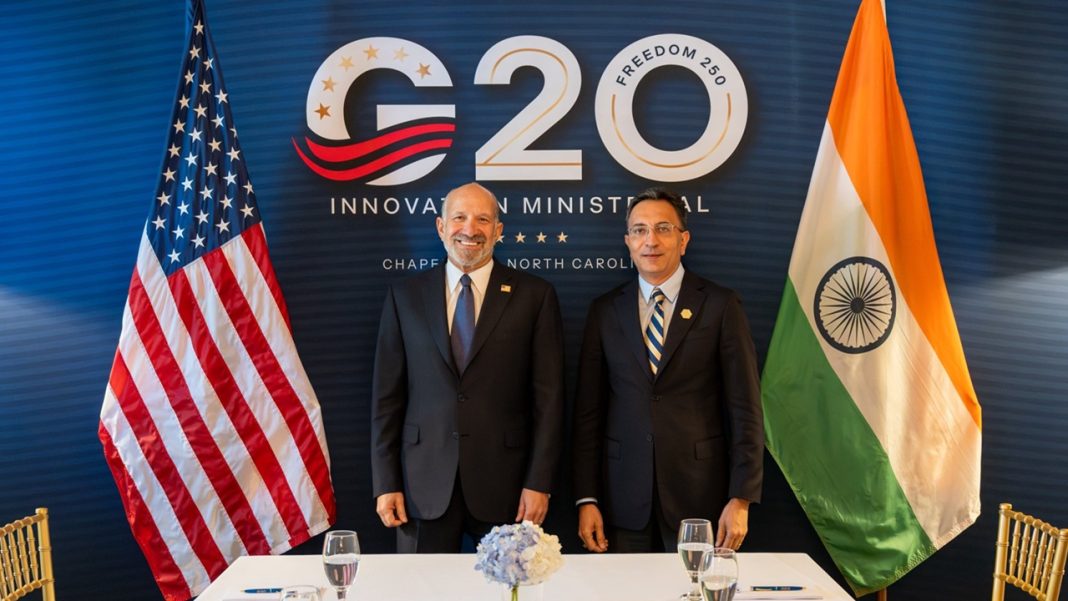

India has joined a US-led international effort to shape 6G before the technology reaches commercial networks. The announcement followed talks between Minister of State for Commerce and Industry Jitin Prasada and US Commerce Secretary Howard Lutnick around the G20 Innovation Ministerial. The US Department of Commerce said the partners want future networks to support shared security interests, competitiveness and 6G innovation.
6G standards are still being written. Decisions taken now can influence spectrum policy, equipment rules, AI use, network security and which technologies become widely adopted. India is entering before large commercial 6G rollouts, rather than after the technical direction is fixed.
What Exactly Has India Joined?
The initiative is called the Call to Action for 6G Leadership and Security. It was launched by the US National Telecommunications and Information Administration in July 2026 with 25 governments. India was not among the July signatories. India has now joined the United States and those 24 other participating countries, taking the wider group to 26 governments.
The European Commission’s digital policy update said participating governments agreed to promote 6G networks that are open, interoperable, secure, resilient and supported by trusted artificial intelligence.
The current priorities include:
- closer work on secure and resilient telecom supply chains;
- greater coordination on technical standards and interoperability;
- cooperation on spectrum, network security and policy;
- responsible use of trusted AI inside future telecom networks;
- continued international engagement over the next 12 months and beyond.
The official US Department of Commerce X post followed the Prasada-Lutnick meeting. It said India had joined the effort to strengthen competitiveness, security and innovation in next-generation networks.
Why India Wants A Seat Before 6G Standards Are Final
Telecom leadership is not decided only by who launches a network first. Countries and companies that contribute patents, standards, radio technologies, chip designs and network architecture can gain a stronger commercial position once deployment begins.
India has already created the Bharat 6G Alliance as a domestic platform connecting telecom operators, equipment makers, startups, universities and research organisations. According to the Department of Telecommunications update carried by PIB, the alliance had expanded to 90 members by 15 July 2026. Seven working groups are covering areas such as spectrum, devices, 6G technologies, applications, sustainability and international outreach.
The government has also set an ambition for India to secure a 10% share of global 6G patents. That target is difficult, but participation in international standard-setting gives Indian researchers and companies a clearer route to place their technical work into global discussions.
India’s New Delhi Declaration on 6G has already backed networks that are trusted, secure, reliable, interoperable, inclusive and sustainable. The new international initiative overlaps with several of those priorities, particularly security, interoperability and resilience.
Standards Could Become The Bigger Prize
A successful Indian contribution to a global standard could create licensing income, export opportunities and demand for locally developed telecom equipment. It could also help Indian companies avoid building products around specifications decided entirely elsewhere.
That does not mean every Indian proposal will become a global standard. International bodies still have to reconcile competing technical approaches, spectrum demands and commercial interests. Yet early participation gives India more opportunities to argue for technologies suited to large, price-sensitive markets.
How Could The Agreement Change The Way 6G Networks Are Built?
The biggest shift may be security-by-design. During the 5G era, governments often debated trusted vendors after networks were already being procured. The 6G initiative is trying to move security, supply-chain resilience and interoperability much earlier in the design process.
AI is another major difference. Future networks are expected to use AI for radio optimisation, traffic management, fault detection and automation. The Call to Action specifically refers to AI-supported communications systems. That could push participating countries toward common expectations for trustworthy AI inside telecom infrastructure.
Open interfaces may receive greater attention as well. If equipment from different vendors can work together more easily, operators could have more choice instead of depending heavily on one supplier. However, openness alone will not guarantee lower costs. Testing, integration and cybersecurity requirements can still make deployment expensive.
Spectrum will remain one of the hardest questions. 6G research is examining a broad range of frequencies, while governments must balance mobile broadband with satellite, defence, broadcasting and other users. International coordination before major spectrum decisions could reduce fragmentation between national markets.
What Comes Next For Bharat 6G?
India now has to turn diplomatic participation into technical contributions. That means stronger research funding, patent filings, semiconductor capability, testbeds and sustained involvement in international standards bodies.
The Department of Telecommunications has expanded standardisation work through institutions such as the Telecommunications Standards Development Society, India, while the Telecommunication Engineering Centre has signed research partnerships covering 6G, AI-enabled telecom, antennas, MIMO and non-terrestrial networks.
Commercial 6G is still years away, so the agreement will not suddenly change mobile speeds for Indian users. Its immediate effect is upstream: India gets another route into discussions that will influence how networks are specified, secured and supplied.
For telecom companies, startups and universities, that is where the opportunity sits. The countries that shape standards early may have a better chance of selling technology when operators eventually begin spending on 6G infrastructure.
FAQs
What is the global 6G initiative India joined?
It is a US-led cooperation framework focused on secure, open and interoperable future 6G networks.
How many countries are now part of the initiative?
India joins an original group of 25 governments, bringing participation to 26 governments in total.
When could 6G become commercially available?
Commercial timelines remain unsettled, with standards, spectrum decisions and testing still needing several years globally.
What is the Bharat 6G Alliance?
It is India’s industry-academia platform supporting 6G research, standards, patents, testbeds and domestic technology development.
Will this agreement improve mobile internet immediately?
No. Its near-term impact concerns research, standards and security policy rather than consumer network speeds.