

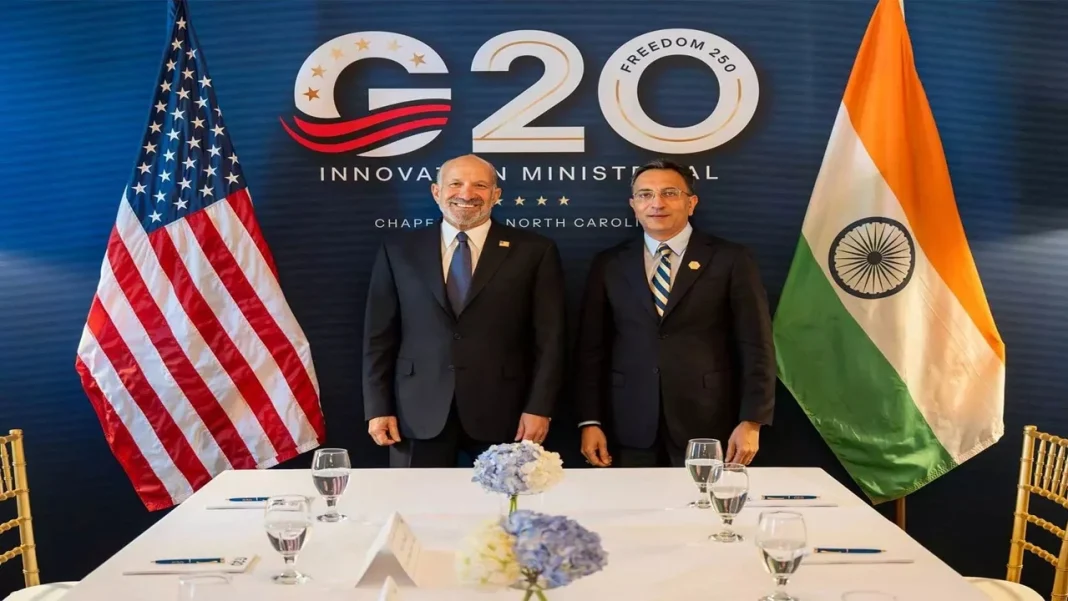

India has endorsed the Call to Action for 6G Leadership and Security, joining governments that want to influence how sixth-generation mobile networks are built before commercial 6G arrives in the 2030s. The announcement followed the G20 Innovation Ministerial in North Carolina. India’s Department of Telecommunications will coordinate follow-up work with government agencies, industry and academia. The move gives India another route to push its priorities on standards, spectrum, security and affordable connectivity. The official PIB announcement confirmed the development on September 9, 2026.
Key Highlights
- India has joined the Call to Action for 6G Leadership and Security with over 20 governments.
- The group backs open, interoperable, secure, resilient, and resource-efficient next-generation telecom networks.
- India wants to contribute about 10% of global 6G standards and patents.
- The Bharat 6G Alliance had grown to 90 members by 15 July 2026.
- Governments plan expert coordination, industry consultations, and work on secure 6G supply chains.
Why Has India Joined The Global 6G Push Now?
Many 6G rules are being written years before consumers see a 6G symbol on phones. The official framework says participating governments will identify expert contacts within one month, engage industry within three months, discuss secure supply chains within six months, and meet in 2027 to review progress.
For India, this is not a replacement for the Bharat 6G Mission. The government says participation will complement work already underway in international standardisation and spectrum forums while preserving India’s independent positions.
The partnership also puts India in closer policy discussions with countries including the United States, United Kingdom, Germany, Japan and the Republic of Korea. That may help New Delhi raise issues important to a large, price-sensitive telecom market before global rules harden.
Union Communications Minister Jyotiraditya Scindia also posted about the announcement on his official X account, saying the partnership would support secure 6G networks and national strategy coordination. The post is also reproduced in the government announcement.
Where Could India Influence Global 6G Rules?
India’s strongest bargaining point may come from combining scale with technical proposals. The government aims for roughly 10% of global 6G standards and patents. In March 2026, it said around 4,000 6G-related patents had already been contributed and India’s “ubiquitous connectivity” proposal had gained international acceptance.
That proposal fits the International Telecommunication Union’s IMT-2030 framework. ITU lists ubiquitous connectivity among six 6G usage scenarios, alongside immersive communication, massive communication, hyper-reliable low-latency communication, AI and communication, and integrated sensing and communication.
India could therefore push for standards that work not only in dense cities but also across villages, remote regions and transport corridors. Affordable equipment, lower energy use, interoperable systems and broad coverage are areas where Indian deployment experience could carry weight.
What Does India Already Have In Its 6G Toolkit?
India is entering these talks with a growing domestic ecosystem. The Bharat 6G Alliance update showed that the alliance had 90 members by mid-July 2026 and seven working groups covering technology, spectrum, devices, use cases, sustainability and other areas.
There is also hardware research. A government-backed 6G terahertz testbed involving SAMEER, IIT Madras, IIT Guwahati and IIT Patna demonstrated a 270 GHz wireless link at India Mobile Congress 2025. The government reported a data rate of 6,400 megabytes per second.
Meanwhile, ITU experts agreed in 2026 on draft minimum technical performance requirements for IMT-2030. The framework contains 20 technical requirements. The next phase is increasingly about turning research priorities into globally accepted technical rules.
India’s Global Push: Space, Defence, Technology & Travel
- How Could India’s 6G Initiative Transform Connectivity?
Check out how the global agreement could shape the future of next-generation mobile networks. - Could ISRO Join NASA’s Moon Base?
Find out how Bengaluru space talks could open new opportunities for India’s lunar ambitions. - What Will Veer Guardian 2026 Test?
Uncover the combat drills planned between Indian and Japanese fighter aircraft. - Can Visa-Free Uzbekistan Boost Indian Travel?
Explore how the 30-day visa-free regime could reshape tourism and business visits. - What Missions Could Shape India’s Space Future?
Reveal the key missions and technologies scientists and startups may discuss at the conclave.
Could India Become A 6G Standard-Setter Rather Than A Technology Buyer?
That will depend on whether Indian research becomes essential intellectual property, standards contributions and commercially usable equipment. Membership in an international government group can open doors, but it does not automatically deliver influence.
India will need sustained participation in ITU, 3GPP and other standards organisations, stronger links between laboratories and manufacturers, and enough spectrum planning to test technologies at scale. It will also need diverse, secure supply chains.
If India can combine patents, affordable network design and experience connecting a huge subscriber base, it could help write rules that suit emerging markets as well as advanced economies. That would mark a bigger shift than simply launching 6G early.
FAQs
What is the Call to Action for 6G Leadership and Security?
It is a government partnership promoting secure, open, interoperable and resilient future 6G telecom networks.
When is 6G expected to arrive commercially?
Commercial 6G networks are expected during the 2030s, after standards, spectrum and testing progress further.
What is India’s target for global 6G standards and patents?
India aims to contribute about 10% of global 6G standards and patents under national vision.
What is ubiquitous connectivity in 6G?
It targets wider network access across rural, remote and underserved locations through future mobile systems.
Which body is developing global IMT-2030 requirements?
The International Telecommunication Union is developing IMT-2030 requirements that guide global 6G technology evaluation processes.