
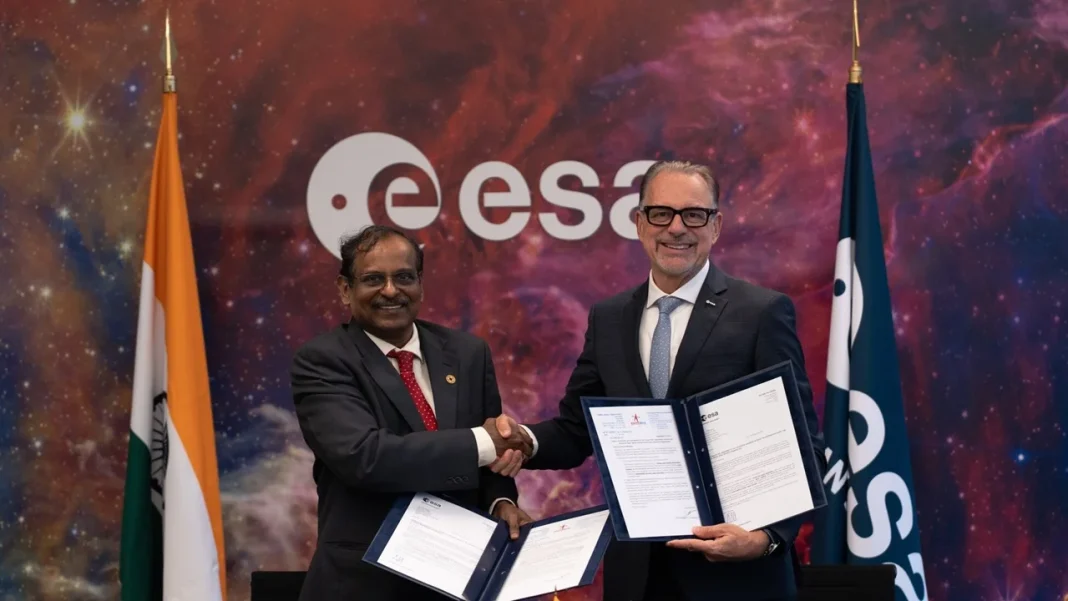

India and Europe have given their space partnership a longer runway. ISRO and the European Space Agency have extended their Cooperative Agreement until January 8, 2032, opening a fresh phase for human spaceflight, robotic exploration, space weather and safer use of Earth orbit. The letters were exchanged in Paris on September 10, 2026, during the International Space Summit, after more than two decades of formal cooperation.
The renewed framework arrives when both sides are preparing for busier years in low Earth orbit and beyond. India is building toward Gaganyaan and the Bharatiya Antariksh Station, while ESA is planning for a post-ISS future. That overlap could make the next five years more ambitious than routine data-sharing.
A Five-Year Extension With A Wider Space Agenda
According to ESA’s official announcement, the agreement, first in force from January 2002, has been extended for another five years and updated to include human and robotic exploration, space weather and sustainability of outer-space activities. Existing cooperation in Earth observation, satellite navigation, space science and mission operations will continue.
ISRO’s International Space Summit update confirmed that Chairman V. Narayanan met ESA Director General Josef Aschbacher at ESA headquarters in Paris and exchanged the documents on September 10. Both agencies have already moved from broad cooperation to hands-on activity.
In December 2024, India’s PSLV launched ESA’s Proba-3 spacecraft, a precision formation-flying mission. In 2025, the agencies also worked together on astronaut training, mission implementation and microgravity research connected with Axiom Mission 4, which flew Indian astronaut Shubhanshu Shukla and ESA project astronaut Sławosz Uznański-Wiśniewski.
Human Spaceflight Could Become The Biggest Shared Frontier
The clearest area for deeper cooperation is human space exploration. In May 2025, ISRO and ESA signed a Joint Statement of Intent on human space exploration focused first on low Earth orbit and later on the Moon. The agencies said they would examine interoperable rendezvous and docking systems, astronaut training, analogue missions, parabolic flights and research using common standards.
That creates several practical possibilities before 2032:
- Joint astronaut training and biomedical research for future crewed missions.
- Compatible docking technologies allowing Indian and European spacecraft to work together.
- European experiments on Indian orbital platforms, including possible POEM opportunities.
- Cooperation around the planned Bharatiya Antariksh Station and post-ISS research access.
- Early coordination on lunar payloads or robotic science missions, subject to separate agreements.
ESA has stated that future cooperation could include ESA astronaut flight opportunities to the planned Indian station and early scientific utilisation. These are possibilities rather than confirmed missions, but the renewed agreement keeps the path open.
The agencies already gained shared crewed-flight experience through Ax-4, where Indian and European astronauts trained and flew within the same international mission environment.
Space Weather, The Moon And Safer Orbits Move Up The List
The addition of space weather is timely. Solar storms can disrupt satellites, navigation, radio links and power systems, so India’s solar-observation expertise and Europe’s space-weather programmes give both sides room to compare data, improve forecasting models and strengthen mission planning. No specific joint space-weather mission has been announced.
Robotic exploration is another natural next step. The 2025 statement mentioned discussions around payload alignment and robotic scientific missions to the Moon. A future project could combine Indian launch or mission experience with European instruments, navigation, communications or science payloads, although any such mission would need a dedicated agreement.
Orbital sustainability may become just as important. More satellites mean more collision risk, debris tracking requirements and pressure for responsible end-of-life operations. Joint work could cover tracking data, operational standards, collision avoidance methods and technology for safer long-term use of crowded orbits.
ESA previously agreed to provide tracking support for Indian space missions through its global ground-station network, while ISRO could offer similar support for European spacecraft. Such cross-support can lower mission risk and reduce duplicate infrastructure.
What The 2032 Partnership Could Mean For India And Europe
For India, closer work with ESA can widen access to specialised facilities, research networks, astronaut-training experience and international mission operations. For Europe, ISRO brings proven launch capability, growing human-spaceflight plans, deep-space ambitions and a rapidly expanding space ecosystem.
The next phase will be judged by projects, not declarations. Proba-3’s PSLV launch and Ax-4-related research showed that the partnership can move from paperwork to flight hardware and crew activity. The extended agreement gives both agencies time to turn exploratory discussions into specific missions.
Nothing in the 2032 extension automatically confirms a joint lunar mission, ESA astronaut seat on an Indian spacecraft or shared space station module. Those steps would require separate technical, financial and political approvals. Still, the new scope places human exploration, lunar science, space weather and orbital safety directly inside the ISRO-ESA cooperation framework.
FAQs
When Does The Renewed ISRO-ESA Cooperation Agreement Expire?
The extended cooperative agreement remains valid until January 8, 2032, according to ESA’s official announcement.
What New Areas Were Added To ISRO-ESA Cooperation?
Human exploration, robotic missions, space weather and sustainability were added to the renewed cooperation framework.
Could ESA Astronauts Visit India’s Future Space Station?
ESA identified future astronaut flights to Bharatiya Antariksh Station as a possible cooperation opportunity later.
Have ISRO And ESA Already Worked On Human Spaceflight?
They collaborated on astronaut training, research experiments and mission activities connected with Axiom Mission 4.
Could ISRO And ESA Launch A Joint Moon Mission?
They are discussing lunar payloads and robotic science, but no joint mission is confirmed yet.
India’s Global Diplomacy & Space Missions: What’s Next?
Which Countries Backed India’s UN Bid?
Check out the four European countries supporting India’s Security Council bid.
What Does EOS-05 Mean For India?
Find out what ISRO’s new Earth-observation satellite will do.
When Will ISRO Launch NVS-03?
Uncover the planned October launch and what comes next for NavIC.
How Will NETRA Protect Satellites?
Explore how ISRO’s new radar will strengthen space tracking.
What Could India’s Space Push Achieve?
Dive into India’s latest satellite and space-security developments.