
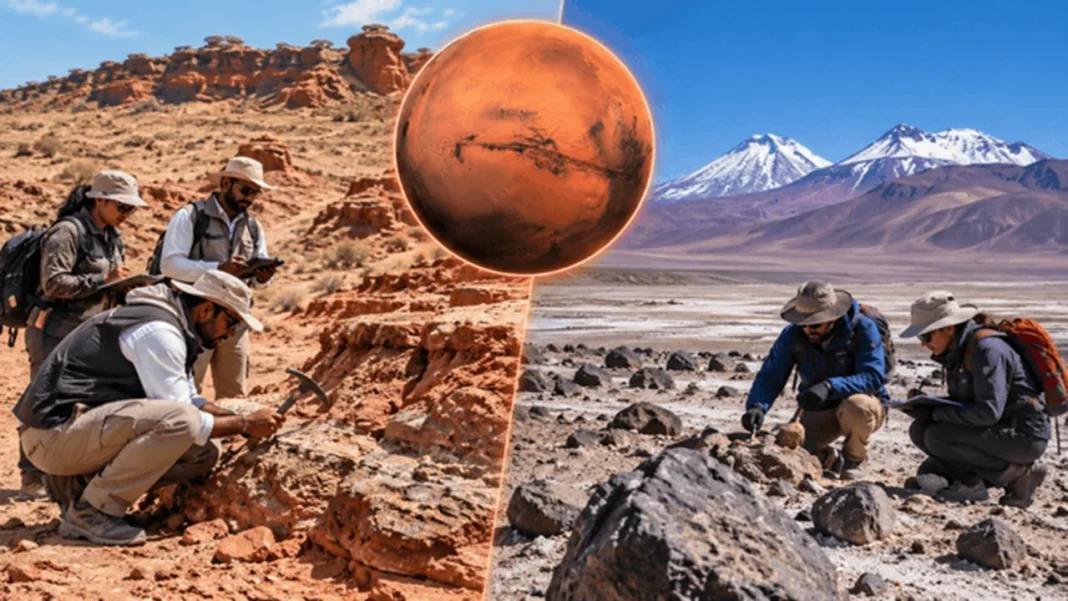

How did water change ancient Martian rocks? Some minerals may have formed during brief contact with moisture; others as water moved through cracks. Two Tamil Nadu sites let researchers examine both possibilities.
On October 16, 2026, India’s Ministry of Science and Technology announced research identifying melanterite at Neyveli and gypsum in the Tiruchirappalli Badlands. The two papers in the Journal of Geophysical Research: Planets examine Earth-based analogues, not material returned from Mars.
Key Highlights
- Researchers identified melanterite in Neyveli’s lignite deposits and gypsum in Tiruchirappalli’s Badlands.
- Melanterite formed from marcasite within 23 days under the conditions examined.
- Gypsum at Tiruchirappalli formed differently from gypsum in Chile’s Atacama Desert.
- The team compared laboratory measurements with mineral signals collected by a Mars orbiter.
- Similar minerals do not establish that life existed on Mars.
Which Places in Tamil Nadu Resemble Mars?
The October 16 government announcement names two locations. Their value comes from mineral chemistry and formation processes, not from simply looking like a red desert.
- Neyveli: Melanterite, a water-bearing iron sulphate, develops as marcasite in lignite-bearing rock that oxidises. It offers a model for temporary wet, acidic conditions.
- Tiruchirappalli Badlands: Gypsum occurs within semi-arid terrain. Its crystals preserve evidence of water moving through existing rocks.
- Atacama Desert, Chile: Researchers analysed gypsum here for comparison because extremely dry conditions produce a different route to forming the same mineral.
None is a miniature Mars. Each reveals a process that researchers otherwise interpret from afar.
At Neyveli, a Mineral Appeared Within 23 Days
The striking figure in the June 2 research paper is 23 days. After marcasite associated with Neyveli’s lignite was exposed to ordinary atmospheric conditions, it altered into melanterite. The paper describes this as the first reported occurrence of melanterite in Peninsular India.
Researchers checked the material using X-ray diffraction, electron microscopy, and spectroscopy. Its Raman signal at 976 cm⁻¹ helped establish its identity. They then compared its spectral pattern with readings from the Ceti Mensa region of Mars gathered by NASA’s Compact Reconnaissance Imaging Spectrometer for Mars (CRISM).
The comparable Martian spectrum does not prove the same mineral exists there. Neyveli shows how quickly iron sulphate can form with limited moisture and oxygen.
Why Tiruchirappalli’s Gypsum Tells a Different Story
An orbiter may identify gypsum without showing how it formed. The September 14 comparative study tested that problem against samples from India and Chile.
In the Atacama Desert, gypsum developed as groundwater evaporated. Around Tiruchirappalli, it filled fractures in Cretaceous mudstones of the Karai Formation as sulphate-rich fluids circulated during burial and uplift. Different geological histories. Yet the minerals produced similar spectral signatures.
The researchers compared these results with CRISM observations at Olympia Undae, Columbus Crater and Mawrth Vallis on Mars. Their analysis linked the Atacama pattern to Olympia Undae and the Tamil Nadu example to Columbus Crater, while Mawrth Vallis displayed features resembling both.
A mineral signal may indicate water, but surrounding geology helps reveal what the water actually did. Orbital data alone cannot settle that question.
Could These Findings Help Scientists Search for Life on Mars?
Gypsum can preserve potential biosignatures, including traces associated with microorganisms. That makes mineral deposits useful targets for investigation, but neither study reports discovering Martian life.
The University of Kerala research group, led by K. S. Sajinkumar, used a laser Raman spectrometer supported by the Department of Science and Technology’s FIST programme. The work points to three practical uses:
- Testing how water-bearing minerals respond to different environments before interpreting rover measurements.
- Distinguishing mineral formation routes that look alike in orbital spectra.
- Prioritising rocks worth examining more closely for preserved chemical or biological traces.
A separate NASA finding in September 2026 showed that rocks in Jezero Crater recorded several episodes of water activity. It reinforces the need to look beyond a single mineral reading.
The findings offer a laboratory guide, not a final answer about habitability. Follow India Focus Daily for further developments in planetary research.
Frequently Asked Questions
Which Mars-like minerals were found in Tamil Nadu?
Researchers identified melanterite at Neyveli and gypsum in the Tiruchirappalli Badlands. Both contain water within their mineral structures and help reconstruct different kinds of water-rock interaction.
Did scientists discover evidence of life on Mars?
No. The discoveries concern Earth-based minerals useful for studying Martian conditions. Some minerals can preserve potential biosignatures, but neither study established that Mars supported life.
Why is the 23-day finding at Neyveli important?
It demonstrates that melanterite can form relatively quickly when marcasite oxidises in moist conditions. That gives researchers a possible model for short-lived wet episodes on Mars.
What is a Mars analogue site?
It is an Earth location with geological or chemical features resembling particular Martian environments. Scientists study these sites to interpret remote measurements, rather than claiming identical planets.
Which research institution carried out the Tamil Nadu studies?
The research team was led from the University of Kerala by K. S. Sajinkumar, with collaborators from other institutions. Its findings appeared in two planetary-science papers.
India’s Fascinating Scientific Discoveries, Space Missions and Research Breakthroughs!
1. Could India’s Microgravity Lab Transform Spaceflight?
2. Which New Flower Did Arunachal Reveal?
3. Can Temple Wearables Track Brain Circulation?
4. What Could India’s Venus Mission Uncover?
5. Could El Niño Disrupt India’s Monsoon?