

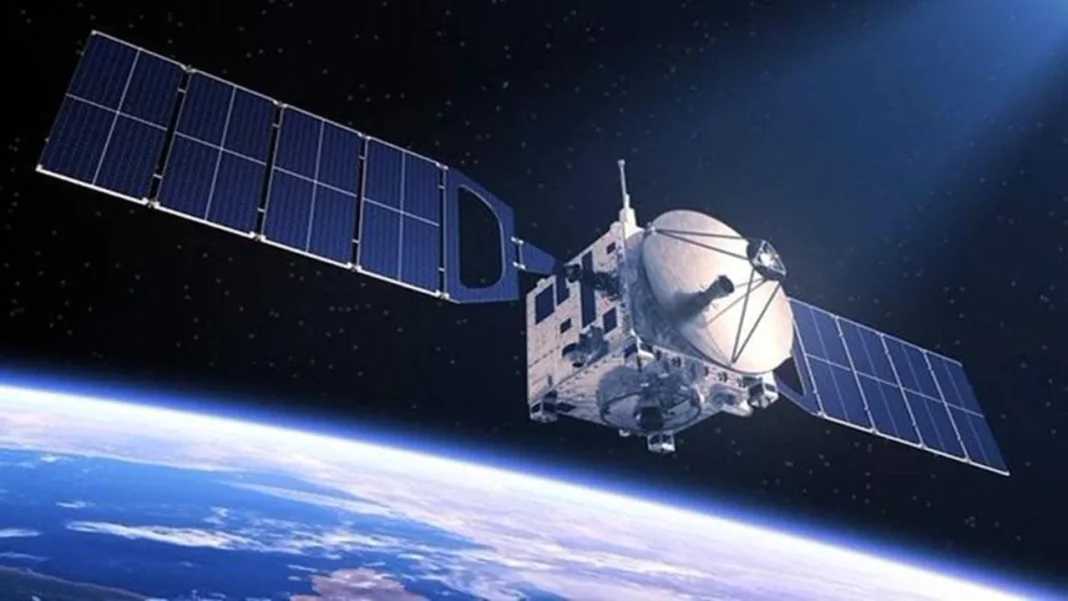

India’s Army is preparing to get a communications satellite of its own, but the wait has grown longer. GSAT-7B, ordered from NewSpace India Limited (NSIL) in March 2023, is now expected around mid-2028, officials told Hindustan Times on October 19, 2026. The proposed satellite will link deployed troops, command centres, airborne platforms and weapon systems across distances where ordinary radio links fall short.
The ₹2,963-crore project is designed for communications, not photographing targets.
Key Highlights
- GSAT-7B will be the Indian Army’s first dedicated communications satellite.
- The October 19 report puts the expected launch around mid-2028, not 2026.
- The 2023 contract with NSIL is worth ₹2,963 crore.
- The planned geostationary satellite will weigh about five tonnes.
- Beyond-line-of-sight links are central to its intended military role.
Why Does the Indian Army Need GSAT-7B?
A command post on one side of a mountain cannot always communicate directly by radio with a unit beyond the ridge. Ground networks can help, but they depend on relay infrastructure and equipment that may be disrupted during fighting. Satellite communication offers another route for messages and data.
The Army currently relies in part on the Air Force’s GSAT-7A. That satellite was launched by ISRO on December 19, 2018. A dedicated Army spacecraft would provide capacity planned around land-force requirements rather than shared arrangements.
GSAT-7B would add a long-range connection for dispersed formations, not replace radios or fibre networks. At remote borders, reaching headquarters without intermediate ground relays could prove valuable.
How Will GSAT-7B Work During Army Operations?
The spacecraft is planned for geostationary orbit, where a satellite appears to hold nearly the same position above Earth. Such satellites operate roughly 35,786 kilometres above the equator. Ground terminals within the coverage area can point towards it and exchange signals through its communications payload.
In practice, its expected contribution can be separated into three tasks:
- Connecting distant formations: A unit sends a message through a compatible terminal; the satellite relays it to another connected location.
- Linking mobile military assets: The defence ministry lists troops, weapon platforms and airborne platforms among the intended users.
- Supporting command decisions: Shared voice and data links may help headquarters receive updates and send orders when terrestrial routes are inadequate.
ISRO is developing the five-tonne-class spacecraft, while the NSIL arrangement also covers the ground segment. Ground terminals and military networks will be essential too.
Satellite coverage does not guarantee that every mountain valley will have a clear signal. Ground equipment, local obstructions, and possible interference remain operational constraints. GSAT-7B should not be described as immune to jamming or as an intelligence-imaging satellite.
What Has Changed Since India Approved the Project?
The project moved from procurement clearance to a signed contract, but schedules have shifted. The main public milestones are:
- March 22, 2022: The Defence Acquisition Council approved the procurement proposal as part of a wider package of indigenous equipment.
- March 29, 2023: The defence ministry contracted NSIL for ₹2,963 crore. Its announcement specified beyond-line-of-sight communications and Indian manufacturing participation.
- October 19, 2026: Hindustan Times reported an expected launch around mid-2028, six months later than the previously planned November 2027 date, citing technical reasons.
The ministry’s original announcement also projected about three lakh man-days of work over three and a half years. It said components would be sourced from Indian manufacturers, including smaller enterprises and start-ups. Those were project estimates, not a confirmed count of jobs already created.
ISRO launched the Navy’s GSAT-7R (CMS-03) in November 2025. On October 15, 2026, the defence ministry signed a separate ₹2,563-crore contract for the Air Force’s GSAT-7C. The missions are distinct.
When Will GSAT-7B Launch, and What Happens Next?
Mid-2028 is the latest reported target, not a confirmed launch appointment. Neither an exact date nor a completed in-orbit commissioning has been announced in the cited material. After launch, successful deployment, testing, and integration with Army terminals will determine when operational communications can begin.
Watch for ISRO’s mission schedule and subsequent readiness announcements instead of relying on outdated 2026 launch predictions.
FAQs
Has GSAT-7B Already Been Launched?
No. As of October 19, 2026, GSAT-7B remains a planned mission. Reports now point to mid-2028, but ISRO has not confirmed an exact launch date.
How Much Will the Army Satellite Cost?
The defence ministry’s March 29, 2023, announcement gave the GSAT-7B procurement contract a value of ₹2,963 crore, covering the planned communication capability through NSIL.
Is GSAT-7B the Same as GSAT-7A?
No. GSAT-7A was launched in 2018 and serves Air Force communication needs over India. GSAT-7B is a separate satellite being developed for the Indian Army.
Will GSAT-7B Photograph Enemy Positions?
Its publicly stated purpose is military communication, including beyond-line-of-sight links. The government’s project announcement does not describe GSAT-7B as a dedicated Earth-observation or imaging satellite.
Can Satellite Communications Replace All Military Radios?
No. Satellite links depend on terminals and accessible coverage, while local radio and terrestrial networks still perform important tasks. GSAT-7B is intended to complement those systems.
ISRO’s Space Missions, Rocket Breakthroughs and the Future of Space Exploration!
1. Is ISRO Changing Who Builds Rockets?
2. Could ISRO’s Engine Test Transform LVM3?
Uncover ISRO’s 200-tonne engine test for LVM3 and its potential impact on rocket payload capacity.
3. What’s Next for Gaganyaan and NavIC?
Check out ISRO’s mission calendar for Gaganyaan and NavIC and upcoming Indian space missions.
4. What Went Wrong With ChinaSat 4B?
5. Will NVS-03 Strengthen India’s NavIC Network?