
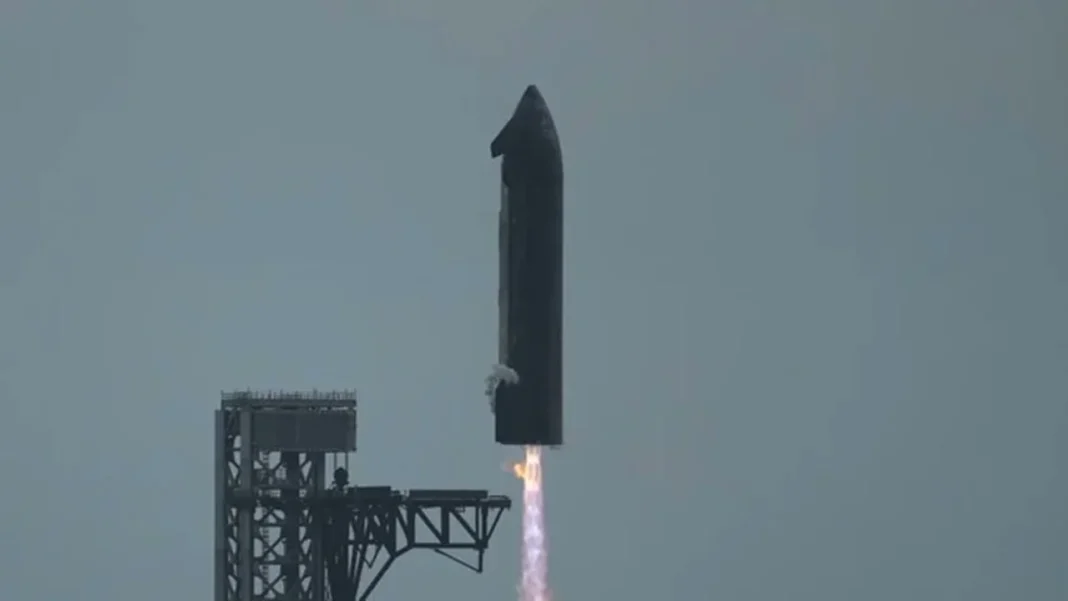

SpaceX caught its Starship spacecraft returning from orbit on November 14, 2026, using the giant mechanical arms of its launch tower in Texas. The spacecraft descended into the structure at Starbase after approximately 22.5 hours in space, completing the company’s first successful upper-stage catch. For viewers in India, the moment arrived early on November 15.
The SpaceX Starship catch marked a new achievement, separate from the booster captures seen previously. However, Flight 15 did not deliver the planned recovery of both stages: its Super Heavy booster was lost after launch.
Key Highlights
- Starship’s upper stage returned to its launch tower after an orbital mission.
- Flight 15 deployed 26 Starlink V3 satellites before returning.
- The successful spacecraft catch followed an unsuccessful booster recovery.
What Happened During The SpaceX Starship Catch?
The mission lifted off from Starbase on November 13. Its return stretched into the following afternoon in Texas, giving engineers a much longer flight to monitor than the earlier tests that ended with ocean splashdowns.
SpaceX’s Flight 15 mission plan scheduled several checks during orbit before the spacecraft committed to returning. Ahead of descent, teams responsible for the heat shield, flight controls and tower cleared the catch attempt. Space.com’s live coverage placed the capture at approximately 21:20 GMT, or 2:50 a.m. IST on November 15.
The arms were only the final part of the operation. SpaceX’s published sequence called for a deorbit burn, atmospheric entry and a landing burn, followed by a flip into an upright position. Engines reduced the descent speed before the tower supported the vehicle. Describing the event simply as robotic arms grabbing a falling rocket leaves out the controlled approach that made contact possible.
Watch the return through SpaceX’s official Flight 15 landing webcast on X, which covered preparations for reentry and the first attempted spacecraft catch.
Why This Was Different From The 2024 Booster Catch
The familiar tower footage can cause confusion because “Starship” names both the complete launch system and its upper-stage spacecraft.
On October 13, 2024, SpaceX caught Super Heavy, the lower stage that provides the initial push off Earth. The upper stage continued its flight and splashed down in the Indian Ocean. That mission never included a spacecraft catch.
| Milestone | October 2024, Flight 5 | November 2026, Flight 15 |
| Vehicle caught | Super Heavy booster | Starship upper stage |
| Upper-stage destination | Indian Ocean splashdown | Starbase launch tower |
| Recovery outcome | Booster caught | Spacecraft caught; booster lost |
Returning the upper stage adds difficulties beyond those of a booster’s shorter journey. Starship comes back from orbit at much higher speed and must survive atmospheric heating before reaching the tower.
Two distinctions help explain the achievement:
- Recovery: Bringing hardware back intact preserves it for inspection and possible reuse.
- Repeated reuse: Flying recovered hardware again requires another demonstration; a catch alone does not establish turnaround time or operating cost.
The tower photograph proves where the spacecraft finished. It does not reveal how much work engineers will need before another launch.
The Booster Failure And What Comes Next
SpaceX had intended to recover both stages at the launch site. Instead, the booster’s engines stopped firing too early during its return, and its guidance system diverted it away from the tower. The booster was subsequently destroyed over the Gulf of Mexico, with engineers investigating the cause, the Associated Press reported.
That loss limits the result: Flight 15 demonstrated upper-stage recovery, but not the complete two-stage recovery planned for this mission.
What The Catch Changes For Future Missions
The next evidence to watch is practical:
- Post-flight condition: Inspection results will show what survived and what needs replacement.
- Another flight: Reusing the recovered spacecraft would establish more than recovering it once.
For lunar missions, additional work remains. NASA’s October 2026 lander update describes tanker Starships transferring propellant to a depot in Earth orbit, which would then fuel the lunar lander. An uncrewed demonstration must precede a crewed lunar mission.
Repeated launches make hardware recovery relevant to that plan. Yet catching a spacecraft in Texas does not demonstrate orbital refuelling, lunar descent or astronaut safety.
NASA is targeting a return to the lunar surface in 2028, with provider selection dependent on readiness. The Starship catch advances one part of that effort without guaranteeing its schedule.
Frequently Asked Questions
When did the first Starship spacecraft catch happen?
The catch occurred on November 14, 2026, in Texas. In India, it was approximately 2:50 a.m. IST on November 15, following the spacecraft’s return from orbit.
What is Mechazilla?
Mechazilla is the nickname used for SpaceX’s launch-and-catch tower. Its large mechanical arms support returning vehicles after their engines slow them sufficiently for the final catch.
Did SpaceX recover both stages during Flight 15?
Only the upper-stage spacecraft was caught. Super Heavy failed to complete its return, leaving SpaceX short of the two-stage recovery it had planned for this flight.
Does the catch confirm cheaper space launches?
No launch-price reduction follows automatically from one recovery. Actual savings depend on refurbishment costs and how often the recovered vehicle flies again, which the catch alone cannot establish.
Does this mean Starship is ready to land astronauts on the Moon?
NASA still requires an uncrewed lander demonstration and certification before crewed missions. Orbital propellant transfer also forms part of SpaceX’s lunar plan, beyond this Earth-return achievement.
Explore More Space and Technology Stories!
1. Can Starlink Beat Jio in India?
2. Why Is Vietnam Turning to Starlink?
3. What’s Delaying Starlink’s Launch in India?
4. Could Space Become a Battlefield by 2031?
Explore expert warnings about potential space conflicts and the growing risks to satellites.
5. How Far Have NASA’s Voyagers Travelled?