

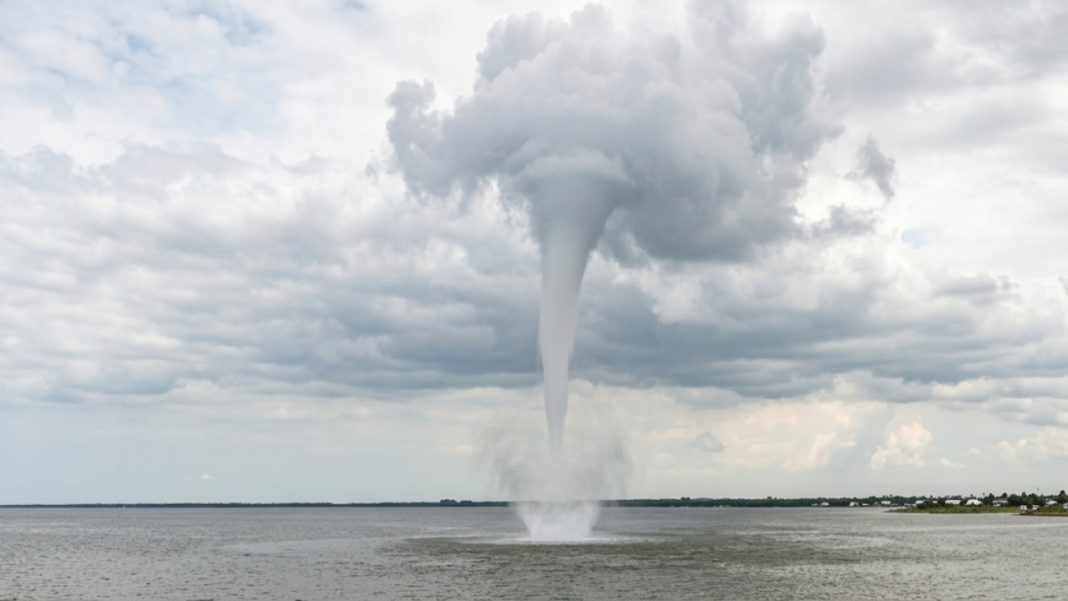

A strange funnel rising from the Brahmaputra startled residents in Assam’s Barpeta district after a rotating column appeared near Paharpur in the Baghbar area on August 24. Videos showed a narrow vortex linking the river surface with the cloud base, quickly drawing comparisons with a waterspout. The footage spread across social media within hours.
Reports have described the formation as waterspout-like, though a detailed meteorological assessment confirming its exact type has not yet been made public. For people watching from boats or the riverbank, that distinction is important. Some waterspouts fade quickly. Others can bring violent winds, spray, lightning and dangerous conditions with very little warning.
What Happened Over The Brahmaputra In Barpeta?
The rotating column was recorded over the Brahmaputra near Paharpur on Monday. India Today NE reported that the funnel appeared to rise from the river, while NDTV said the visible column connected the water surface to a cloud above. There were no immediate reports in these accounts of deaths or major damage from the latest event.
The visuals also triggered speculation locally that the formation might signal an earthquake or another disaster. There is no established scientific evidence linking waterspouts with impending earthquakes.
Barpeta is already used to river hazards of another kind. The district administration identifies flooding and erosion along the Brahmaputra and its tributaries as major recurring problems. A fast-forming vortex, however, is a very different and far less familiar threat.
This is not the first time Barpeta has seen dramatic rotating weather. In May 2022, a low-intensity tornado hit the district and damaged seven huts, according to a Hindustan Times report quoting local officials. More recently, a waterspout was filmed off Odisha’s Astaranga coast in Puri district in May 2026, where the Meteorological Department linked the event to unstable Bay of Bengal weather.
NDTV also shared the latest Barpeta footage through its official X account on August 25.
Was The Barpeta Vortex Really A Waterspout?
It certainly looked like one, but appearance alone cannot settle the classification. NOAA describes a waterspout as a whirling column of air and water mist. Meteorologists generally separate them into fair-weather waterspouts and tornadic waterspouts.
Fair-weather waterspouts usually develop over water beneath growing cumulus clouds. They often begin near the water surface and extend upward. Tornadic waterspouts, by contrast, are associated with thunderstorms and behave more like tornadoes, bringing the possibility of stronger winds, hail and frequent lightning.
The Barpeta video shows rotation and a visible connection with the river surface, features consistent with a waterspout. Still, wind observations, radar data and the storm environment would be needed before confidently calling it fair-weather or tornadic.
A useful clue is that waterspouts do not literally “suck” huge quantities of river water into the clouds. Much of the visible lower column is spray thrown upward by rotating winds, while condensation can make the funnel itself easier to see.
How Dangerous Can Waterspouts Become?
Many fair-weather waterspouts are short-lived and weaker than strong land tornadoes, but “weaker” does not mean harmless. NOAA warns that waterspouts can damage vessels and can become dangerous if they move ashore.
The main risks include:
- Strong rotating winds that can overturn or damage small boats.
- Flying spray and debris near the vortex.
- Sudden rough water around vessels and fishing craft.
- Lightning, hail and squally winds when thunderstorms are involved.
- Localised damage if the circulation reaches the riverbank or nearby settlements.
The region has already seen how quickly rotating storms can turn destructive. On March 31, 2024, a tornado struck Jalpaiguri district in neighbouring West Bengal. The India Meteorological Department later described it as a short-lived but intense tornado, with major damage reported around Mainaguri.
That event was not the same as the Barpeta vortex, but it is a reminder that funnel-shaped storms in eastern and northeastern India should not be treated as sightseeing opportunities.
What Should People Do If Another Funnel Appears?
Anyone on the Brahmaputra should move away rather than approach for a closer video. The US National Weather Service advises boaters to travel at a 90-degree angle to a waterspout’s apparent movement, creating distance from its path. People near shore should head indoors to a sturdy building if the vortex appears to be approaching land.
The latest Barpeta episode may prove to have been a brief waterspout, but the viral video cannot reveal wind speed or storm structure by itself. Until meteorological authorities publish a formal assessment, “waterspout-like vortex” remains the safer description.
FAQs
Can Waterspouts Form Over Rivers?
Yes, rotating columns can develop over inland waters when local atmospheric conditions support strong rotation.
Are Waterspouts Always Weaker Than Tornadoes?
No, tornadic waterspouts can carry tornado-like winds, dangerous lightning, hail and severe storm conditions nearby.
How Long Does A Waterspout Usually Last?
Many fair-weather waterspouts survive only several minutes, although individual vortices can sometimes persist longer offshore.
Can A Waterspout Move Onto Land?
Yes, a waterspout reaching land can cause localised wind damage and should be treated seriously.
Does A Waterspout Predict An Earthquake?
No scientific evidence shows waterspouts act as reliable warning signs for earthquakes or seismic activity.
More Environment & Weather News
Humid Weather Skincare Guide: 7 Moisturisers Indian Users Can Try During Monsoon Season
Heavy Rain Vs Heatwave: Why India Is Seeing Two Different Weather Risks This Week
Char Dham Yatra 2026 Open: Step-By-Step Registration Guide And Latest Weather Advisory