
Black holes can be called cosmic destroyers as they suck in light due to the influence of their gravitational force. But new research indicates that these enigmatic objects could be used to also form new worlds. The study of a dusty region around supermassive black holes has investigated the possibility of creating millions of planets and even star-weight objects.
The results provide a new insight into the universe and propose that black holes could form planets and stars under specific circumstances. The possibilities are, however, based on scientific modelling and do not necessarily reflect confirmed observations.
A New Role for Black Holes
Led by Bhupendra Mishra, this study was authored by five other scientists and was called Active Galactic Nucleus Tori: Potential Birthplace to Millions of Planets. It was published in 2026 in The Astrophysical Journal.
The team analyzed the dusty environments around active galactic nuclei (AGNs). These are luminous regions in the center of galaxies that are fuelled by a supermassive black hole that sucks matter into it.
The results indicate that these areas may offer a much greater potential for planet formation than had been thought before. The researchers’ model suggests that under proper conditions, tens of millions of planetary building blocks might have been created.
The Dusty Regions Where Worlds May Form
Planets typically are made from a cloud of gas and dust around a young star. The new research explores whether a similar process could take place around supermassive black holes.
Surrounding the black holes are disks and thick rings of gas and dust. Conditions near the central black hole can be very extreme, but the outer regions could be cold enough to allow the presence of dust grains, which can grow.
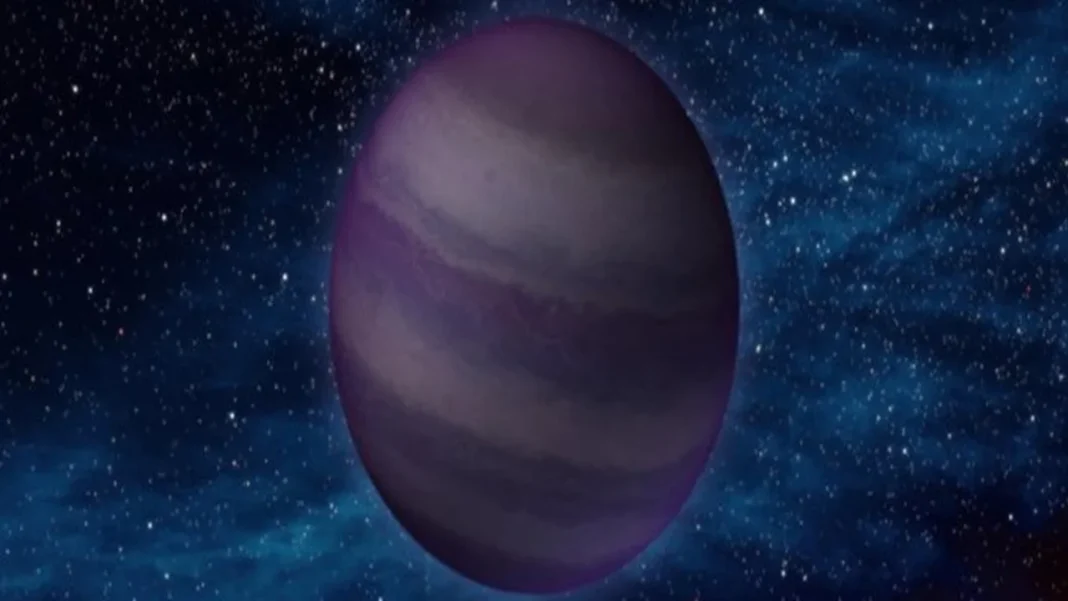
This dust is the raw material for the formation of planets. They may be the environments in which objects as large as planets or larger than Jupiter might reside, the research indicates.
From Tiny Grains to Massive Bodies
The process starts with the coalescence of small dust grains and their growth. The material is capable of aggregating under favorable conditions into compact clusters that are prone to gravitational collapse.
One important aspect of this process is termed streaming instability by scientists. After the planetary building blocks are made, they can grow by accreting small solid particles called pebbles. This is referred to as pebble accretion.
The scientists believe that under certain conditions, such objects can grow to be double their original mass in a thousand to ten million years.
A Possible Route to Star Formation
The study indicates that planet growth could continue beyond planets. Some of them are accumulating more gas and dust and can grow to be stellar objects.
This could provide a way to create stars in the vicinity of an active galactic nucleus. But it is not the black hole per se that forms these objects. Instead, the conditions in the surrounding material may be suitable for their growth.
Why Further Evidence Matters
The results might help to expand research on the location of planets in the cosmos. The process, however, is speculative to date, and planets in such environments have not yet been directly observed.
More study and observation will be required to determine if there are any outer worlds there. So for now, the study offers a tantalizing suggestion: areas where some of the universe’s most powerful objects sit could be able to create new worlds as well.
Explore Space Mysteries & Cosmic Discoveries!
1. How Did Annapurni Subramaniam Make History?
Discover how India’s pioneering scientist earned the prestigious COSPAR Medal.
2. What’s Planned For India’s 2028 Station?
Explore India’s ambitious space station project and its first module launch plans.
3. What Could ISRO Discover On Venus?
Uncover India’s first Venus mission and its exciting scientific goals.
4. Which July 2026 Sky Events Shine?
Check out spectacular celestial events visible across India in July 2026.
5. Where Could You Watch 2026’s Eclipse?
Find the best countries to witness the breathtaking 2026 total solar eclipse.