

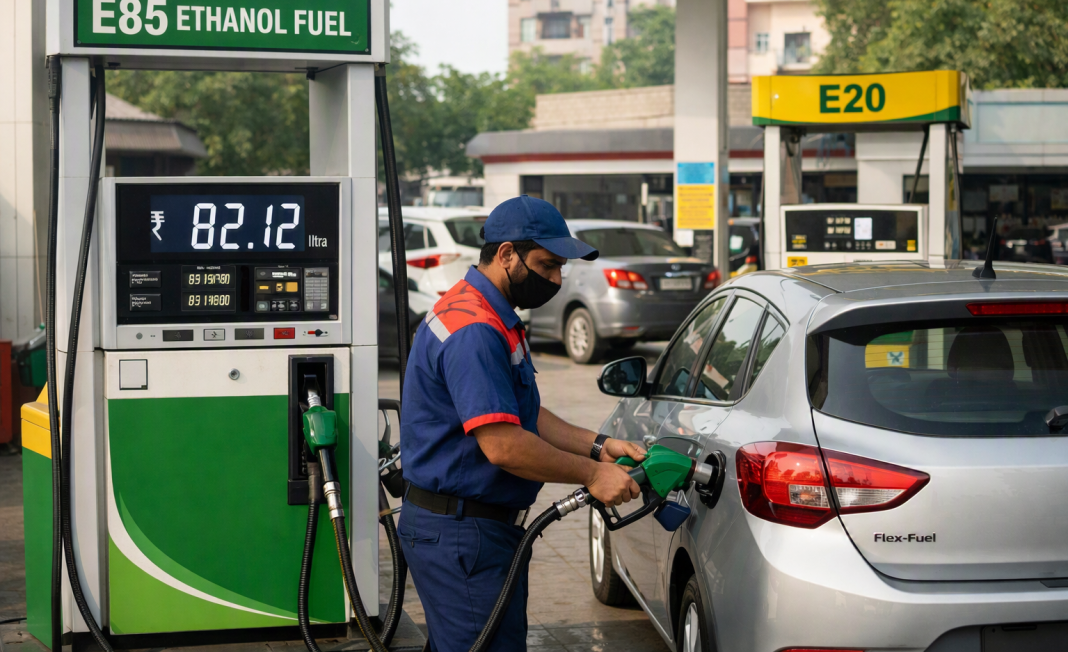

Delhi drivers have a new number to notice at the fuel pump: ₹82.12 a litre. E85, a high-ethanol fuel launched in the capital on June 5, 2026, is priced ₹20 below the city’s regular E20 petrol rate of ₹102.12. That sounds like an easy saving.
The headline, however, leaves out two details. E85 is not meant for an ordinary petrol car, and its lower price per litre may not produce the same saving per kilometre. The fuel contains 80% to 85% ethanol. Only vehicles designed to handle high ethanol blends should use it.
The official E85 launch note from PIB says the rollout began through 48 public-sector fuel outlets. Petroleum Minister Hardeep Singh Puri also shared the Delhi launch through an official post on X.
Key Highlights
- E85 was introduced in New Delhi on World Environment Day, June 5, 2026.
- Its Delhi launch price was ₹82.12 per litre, against ₹102.12 for E20 petrol.
- The fuel is reserved for flex-fuel vehicles, not standard petrol-only or E20-only vehicles.
- Availability is limited today, although 500 outlets are planned by December 2026.
What Changed At Delhi Fuel Pumps?
According to the government, E85 consists of 80% to 85% ethanol and 14% to 19% petrol. A flex-fuel vehicle can automatically adjust to blends ranging from E20 to E85 or even E100, depending on its certified design.
India’s first phase covers 48 outlets operated by public-sector oil marketing companies. The government plans to raise that count to 500 by December 2026 and about 5,000 by December 2027. For now, finding a pump may take planning, unlike E20 petrol, which is sold widely.
There is also fresh policy context. On July 20, the government said it had not decided to raise the ethanol content of ordinary nationwide petrol beyond 20%. E85 follows a different route: it is a separate, clearly identified fuel for compatible vehicles, rather than a replacement that every petrol vehicle must accept.
Why The ₹20 Price Gap Has A Mileage Catch
Ethanol carries less energy per litre than petrol. The US Department of Energy’s E85 guide notes that E85 generally delivers lower fuel economy, with the size of the drop changing by blend, vehicle and conditions. Its fuel-properties data places E85 at roughly 73% to 83% of gasoline’s energy per equivalent volume.
That changes the calculation. At ₹82.12 versus ₹102.12, E85 costs about 19.6% less. Therefore, it needs to retain more than roughly 80.4% of the vehicle’s E20 mileage to lower the running cost per kilometre.
Take a simple example. A flex-fuel vehicle returning 20 kilometres per litre on E20 costs about ₹5.11 per kilometre at Delhi’s current petrol price. If mileage falls 20% on E85, to 16 kilometres per litre, the cost becomes about ₹5.13 per kilometre. The pump bill looks cheaper, but the distance travelled nearly cancels the gain.
A well-optimised flex-fuel engine may perform better than that example. Traffic, load, air-conditioning, riding style and the exact ethanol percentage will also alter mileage. Owners should compare full-tank distance and cost per kilometre, not only the glowing price board.
Which Vehicles Can Use E85 Safely?
This is the biggest catch. Filling E85 into a regular petrol vehicle is not a harmless experiment. High ethanol content needs compatible fuel lines, seals, injectors, engine calibration and cold-start systems. The PIB release states directly that E85 is exclusively for specially designed flex-fuel vehicles.
Hero MotoCorp has introduced the Splendor+ Flex Fuel and HF Deluxe Flex Fuel. The company’s official flex-fuel motorcycle page lists compatibility from E20 to E85, while deliveries are scheduled from July 30, 2026. Maruti Suzuki has also launched a flex-fuel passenger vehicle based on the WagonR platform.
Before refuelling, owners should check the fuel-lid label, manual, manufacturer website, or dealership confirmation. “E20 compliant” does not automatically mean “E85 compliant”. Drivers with ordinary cars should keep using the fuel grade approved by their manufacturer.
What Comes Next For E85 In India?
E85 offers India a route to use more domestically produced ethanol, reduce petrol consumption and expand choices for buyers who select flex-fuel vehicles. The government says E85 can cut lifecycle greenhouse-gas emissions by around 61% against conventional petrol vehicles and produces very low particulate emissions. Those are system-level claims, while an owner’s personal saving will still depend on mileage and pump access.
For Delhi motorists, the verdict is straightforward. E85 can be cheaper, but it is not a ₹20-per-litre gift for every car. Compatibility comes first. After that, calculate kilometres travelled from a full tank. The cheaper option is the one that lowers cost per kilometre without risking the vehicle.
FAQs
Can any petrol car use E85?
No. E85 belongs only in flex-fuel vehicles built with ethanol-resistant engines, seals and fuel systems.
Why is E85 cheaper than petrol?
The discount compensates for reduced energy per litre and supports early adoption of flex-fuel vehicles.
Will E85 always cut my fuel bill?
Not necessarily. Savings depend on your vehicle’s E85 mileage, route, traffic, load and driving habits.
Where is E85 available?
It launched across 48 public-sector outlets, with expansion planned to 500 pumps by December 2026.
Is E85 replacing E20 petrol nationwide?
No. The government currently treats E85 as a separate fuel exclusively for compatible flex-fuel vehicles.