

A payment habit built around tea stalls, taxi rides and grocery counters is steadily travelling beyond India. The latest government update says UPI has 12 live international payment arrangements, giving Indian tourists and the diaspora more ways to pay or transfer money across borders.
There is one detail behind that headline. The official list contains 12 overseas linkages, but 10 distinct countries. Singapore and Nepal appear twice because both have separate person-to-merchant and person-to-person connections. For travellers wanting to scan a QR code at a shop, hotel or restaurant, the active merchant-payment list currently covers nine countries.
What Did The Government Actually Announce?
In a Lok Sabha reply released on July 20, 2026, the Ministry of Finance said 55.49 crore users had joined UPI by June 2026. During FY 2025-26, the network processed 24,161.69 crore transactions worth ₹314.23 lakh crore. The official Ministry of Finance update also named every overseas partner and marked each connection as P2M, meaning merchant payment, or P2P, meaning personal remittance.
The table counts 12 arrangements: nine P2M connections and three P2P connections. Singapore has merchant acceptance and a PayNow remittance link. Nepal has FonePay merchant acceptance plus a Nepal Clearing House remittance channel. Greece appears only under P2P in the government list.
The announcement was also shared through PIB India’s official X account, highlighting the user count and FY26 transaction totals.
Where Can Indian Travellers Make UPI Payments?
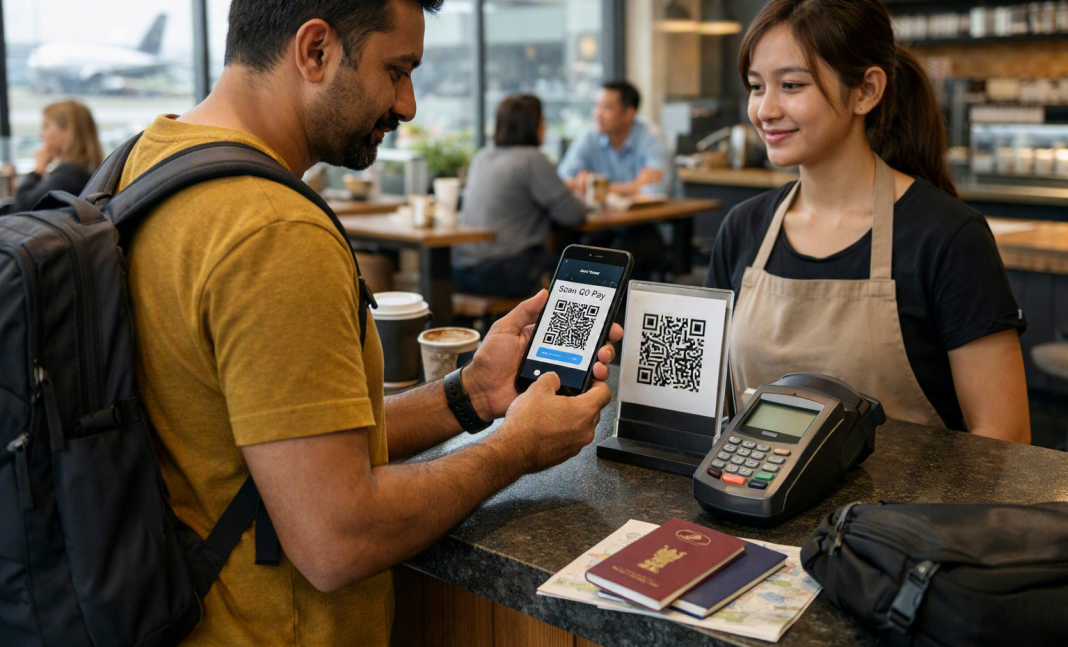
Indian visitors can currently make UPI merchant payments in these nine countries, although acceptance depends on the local partner, merchant and supported app:
- Bhutan: Live since July 2021 through the Royal Monetary Authority, UPI’s first overseas P2M market.
- Singapore: Supported through NETS, HitPay and Liquid Group at participating retail and hospitality merchants.
- United Arab Emirates: Available through NeoPay, Network International and Magnati at selected shopping, dining and travel outlets.
- France: Live through LYRA Network since February 2024, mainly at participating tourist-facing merchants.
- Mauritius: Indian travellers can pay selected merchants through the Bank of Mauritius-linked arrangement.
- Sri Lanka: LankaPay supports QR-based UPI payments at participating visitor and retail locations.
- Nepal: FonePay enables merchant payments, while a separate June 2026 link handles personal transfers.
- Qatar: Qatar National Bank launched P2M acceptance in September 2025 at supported merchant points.
- Cambodia: The newest P2M market lets Indians scan KHQR at more than 4.5 million merchants.
Cambodia’s June 2026 rollout is the biggest fresh travel development. NPCI International and ACLEDA Bank opened the first phase for Indian visitors, with a two-way corridor planned later. The official Cambodia launch note confirms access across over 4.5 million merchant locations. NPCI International also posted the launch on its official X account.
Greece is part of the 12-linkage announcement, but its Eurobank connection is classified as P2P. It supports remittance activity rather than confirmed nationwide merchant QR acceptance for Indian tourists. Travellers should not assume an Indian UPI app will work at Greek cafés or shops unless their bank or app shows a supported route.
How To Use UPI Abroad Without Payment Trouble
Before departure, travellers should check whether their bank and UPI app support international payments for the destination. Some apps require international UPI to be enabled separately. The user may also need an active Indian SIM, roaming access for verification messages, and enough money in the linked account.
At the counter, scan only the merchant’s supported UPI or local partner QR. The app should display the amount, converted rupee value, and merchant name before the UPI PIN is entered. Exchange rates or bank charges can vary, so check the final rupee debit before approval.
UPI abroad should remain one payment option, not the entire travel wallet. A small amount of local currency and an international card can help when a merchant is offline, the QR is unsupported, or mobile data fails. Never share the UPI PIN, approve an unexpected collect request, or follow a payment link from an unknown sender.
Which Countries Could Join The UPI Network Next?
Spain is one market to watch. India and Spain have begun technical discussions on linking UPI with Bizum, but the service is not live. Estonia has also featured in recent fintech talks, while several markets remain at discussion, pilot or partnership stages.
The next phase will probably bring more links between national instant-payment networks, not one identical UPI experience everywhere. For Indian tourists, the useful question is whether P2M payments are live, which merchants participate, and whether their chosen app supports that corridor.
Frequently Asked Questions
Can Indian tourists use UPI everywhere in these countries?
No, UPI works only at merchants connected through approved local payment partners and QR networks.
Which country most recently enabled UPI merchant payments?
Cambodia joined in June 2026, allowing Indian visitors to pay through KHQR at supported merchants.
Is Greece available for regular UPI shopping payments?
The government list classifies Greece as P2P, so merchant acceptance should not be assumed yet.
Do travellers need to activate international UPI before flying?
Some banks and apps require activation, so users should check settings and eligibility before departure.
Should travellers carry cash when UPI works abroad?
Yes, carrying cash or a card helps when QR acceptance, connectivity or app support fails.