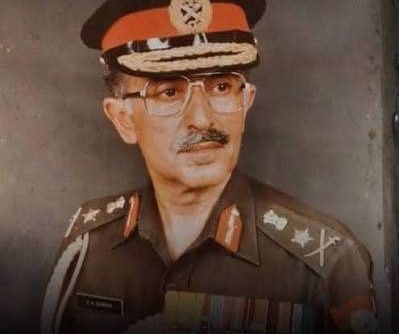

Former Army Chief General Vishwa Nath Sharma died in New Delhi early on Friday, July 31, 2026. He was 96 and reportedly died of natural causes. The veteran officer served as India’s 14th Chief of the Army Staff from May 1, 1988, to June 30, 1990. His death closes a chapter tied to the 1965 and 1971 wars, the Sumdorong Chu confrontation with China and the Indian Peace Keeping Force campaign in Sri Lanka.
The Indian Army’s official tribute said General Dhiraj Seth, the serving Army Chief, and all ranks mourned Sharma’s death. Defence Minister Rajnath Singh also posted a condolence message recalling his national service.
- General Sharma entered the 16th Light Cavalry in June 1950.
- He became the first post-Independence commissioned officer to rise to Army Chief.
- He fought in the Lahore sector during the 1965 India-Pakistan War.
- He held an operational staff appointment during the 1971 war.
- He commanded Eastern Command during the Sumdorong Chu crisis.
- His honours included the Param Vishisht Seva Medal and Ati Vishisht Seva Medal.
Who Was General VN Sharma Before He Became Army Chief?
Sharma began as an armoured corps officer. After joining the 16th Light Cavalry, he saw action as a Major in the Lahore sector during the 1965 war. He later commanded the 66 Armoured Regiment and taught at the Defence Services Staff College in Wellington.
During the 1971 India-Pakistan War, Sharma served as Colonel General Staff Operations of an armoured division on the western front. His later appointments included command of mountain, armoured and reserve formations across eastern and western sectors. He also served at Army Headquarters and led the College of Combat, now the Army War College. A detailed service profile traces these assignments.
Why Did Sumdorong Chu Define General Sharma’s Military Legacy?
General Sharma took charge of Eastern Command in June 1987, when India and China were locked in a dangerous confrontation near Sumdorong Chu in Arunachal Pradesh. Chinese troops had established positions in an area claimed by India, prompting Indian forces to occupy nearby heights and reinforce the sector.
The standoff revived memories of the 1962 war, yet India held its forward posture. Sharma’s responsibility covered troop readiness, command control and the eastern theatre while political leaders pursued diplomacy. A documented Sumdorong Chu account records how Indian formations were airlifted and deployed on commanding ridges during Operation Falcon.
His role is recalled because the crisis tested whether India could defend its position without allowing confrontation to become open war. The episode remains relevant whenever attention returns to high-altitude deployment, the Line of Actual Control and Tawang.
What Challenges Did Sharma Face As Army Chief From 1988 To 1990?
Sharma succeeded General K Sundarji and inherited an Army stretched across several fronts. The Indian Peace Keeping Force was fighting the LTTE in Sri Lanka, where a peacekeeping mission had become a difficult counter-insurgency campaign involving jungle warfare, urban combat and intelligence-led operations. IPKF withdrawal began during Sharma’s tenure and finished in March 1990.
At home, the Army supported civil authorities during militancy in Punjab. Conditions were also worsening in Jammu and Kashmir by 1989, while tensions with Pakistan and operations in Siachen kept conventional threats alive. The Army simultaneously absorbed new equipment while remaining deployed in active, politically sensitive theatres.
That combination explains why Sharma’s tenure occupies an important place in India’s military history. He led during a transition from conventional-war planning towards border vigilance, overseas deployment and internal-security duties happening together.
How Is India Remembering General VN Sharma And His Family Legacy?
General Sharma came from a noted military family. His father, Major General Amar Nath Sharma, served in uniform. His elder brother, Major Som Nath Sharma, became Independent India’s first Param Vir Chakra recipient after he died in the Battle of Budgam in 1947. His brother Lieutenant General Surindra Nath Sharma became Engineer-in-Chief, while sister Major Dr Kamla Tewari served in the Army Medical Corps.
Official tributes have placed Sharma’s death within a wider record of duty rather than one appointment. His career connected battlefield service, planning, military education and top command. For younger readers, General VN Sharma’s story offers a direct route into the security choices India faced from wars with Pakistan to the insurgency-heavy late 1980s.
Frequently Asked Questions
Who was General VN Sharma?
General VN Sharma was India’s 14th Army Chief and a veteran of two major wars.
When did General VN Sharma serve as Army Chief?
He led the Indian Army from May 1, 1988, until June 30, 1990, during turbulence.
What was his role at Sumdorong Chu?
As Eastern Army Commander, he helped oversee India’s firm military posture during the border standoff.
Which wars did General Sharma participate in?
He served during the 1965 war and held an operational staff role during 1971’s conflict.
Was Major Som Nath Sharma related to him?
Yes, Major Som Nath Sharma, India’s first Param Vir Chakra recipient, was his elder brother.