

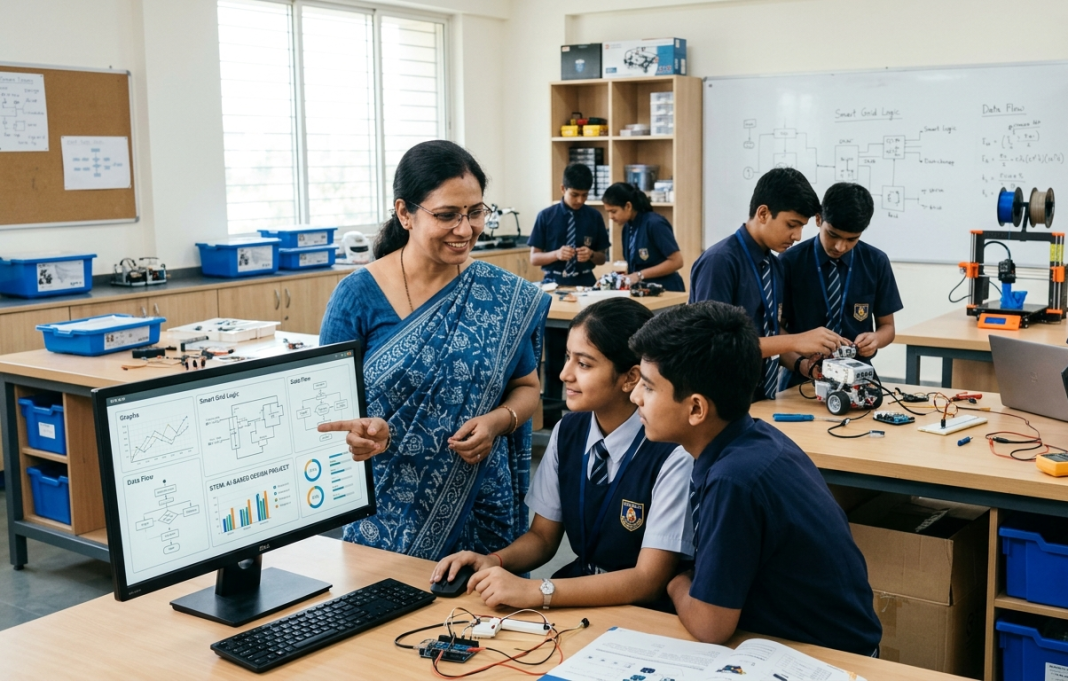

Indian teachers running Atal Tinkering Labs often face the same problem: exciting equipment is available, but planning a safe, grade-ready experiment can take hours. Google DeepMind and NITI Aayog’s Atal Innovation Mission have now launched ATL Saathi, a Gemini-powered desktop web application built to support those educators.
Announced on 14 July 2026, the tool is entering a live pilot across 100 schools. Google says the longer plan is to reach 10,000 schools covered by the ATL network. Rather than replacing teachers, ATL Saathi works like an always-available planning and training partner, helping them move from a student’s rough idea to a workable lab activity.
What Is ATL Saathi And Who Can Use It?
ATL Saathi is designed for educators attached to Atal Tinkering Labs, the school innovation spaces that introduce students to robotics, 3D printing, electronics, coding and the Internet of Things. The official Google DeepMind announcement says the platform has been shaped around teacher needs and ATL curriculum principles.
This is not currently a public app that every teacher can download from an app store. It is a desktop web application being introduced through a selected school pilot. Teachers outside the first 100 schools may need to wait for instructions from their ATL administration, regional coordinators or the Atal Innovation Mission before expecting access.
The launch is important because ATL already reaches more than 1.1 crore students. The new tool shifts attention from simply supplying lab equipment to helping educators run stronger sessions, guide projects and respond when students arrive with unusual ideas.
How Can Teachers Use ATL Saathi In Their Labs?
A teacher can begin with the curriculum module planned for the week, review its short learning material and then ask ATL Saathi for a project suitable for the class level. The platform can also help when a student proposes a project first, and the educator needs a route to build it safely.
Teachers may use it for:
- Reviewing summaries, infographics, video overviews, and quizzes from 12 core ATL curriculum modules.
- Generating different grade-appropriate project ideas linked to 10 core modules.
- Turning student problem statements into assembly steps, wiring diagrams, and safety instructions.
- Preparing explanations and learning material in a preferred supported language.
- Refreshing their own knowledge before leading robotics, electronics, or maker sessions.
For example, a Class 8 team may ask to build a water-level alert for homes. The teacher could use ATL Saathi to request a component list, age-suitable steps, a wiring plan, and safety checks. The output should still be reviewed against the available kit, school rules, and the educator’s own judgement before students begin.
What Teachers Should Check Before Using AI Output
AI-generated instructions can be helpful, but they should not be treated as automatic approval. Teachers should check voltage limits, tool use, sharp parts, heat, batteries, and internet-connected components. Personal details about students should not be entered unnecessarily. Any experiment involving higher risk, medical claims, or unsupervised outdoor testing needs separate adult review.
Which Features Make ATL Saathi Timely For Indian Schools?
One useful feature is micro-learning. Instead of asking teachers to sit through long training videos, the platform organises updated ATL material through NotebookLM and offers shorter formats. That may help educators revise a topic shortly before a lab period. Google says ATL Saathi starts with 8 languages and can expand further, which is relevant for schools where teaching moves between English and regional languages.
The launch also fits a wider education push. Google has announced a free AI Educator Series for India with NEP 2020-aligned, bite-sized training for K-12 and higher-education teachers. Separately, its AI Research Foundations programme offers a 56-hour learning route for students and AI builders.
Google for Developers India also highlighted ATL Saathi in its official I/O Connect India post on X, alongside MedGemma healthcare models, broader Indian-language support in Gemini Live and enterprise AI updates. That mix shows where the company is placing its India focus: classroom skills, local languages, research, healthcare and safer deployment.
For schools, the biggest test will come after the pilot. Useful measurements may include teacher preparation time, completion of projects, safety compliance, student participation and whether generated activities work with the kits schools actually possess. Expansion should depend on feedback from educators, not only the number of accounts created.
FAQs
1. Is ATL Saathi Available To Every Indian Teacher?
No, it currently begins with 100 pilot schools before wider expansion across eligible ATL institutions.
2. Is ATL Saathi A Mobile Application?
No, Google describes ATL Saathi as a desktop web application powered by its Gemini model.
3. What Subjects Can Teachers Support Through ATL Saathi?
Teachers can plan projects involving robotics, coding, electronics, IoT, 3D printing and related innovation skills.
4. Does ATL Saathi Provide Project Safety Instructions?
Yes, it can generate safety precautions, but teachers must review every instruction before classroom use.
5. How Many Languages Does ATL Saathi Support Initially?
The first version starts with 8 languages, with flexibility to add more languages later nationwide.