
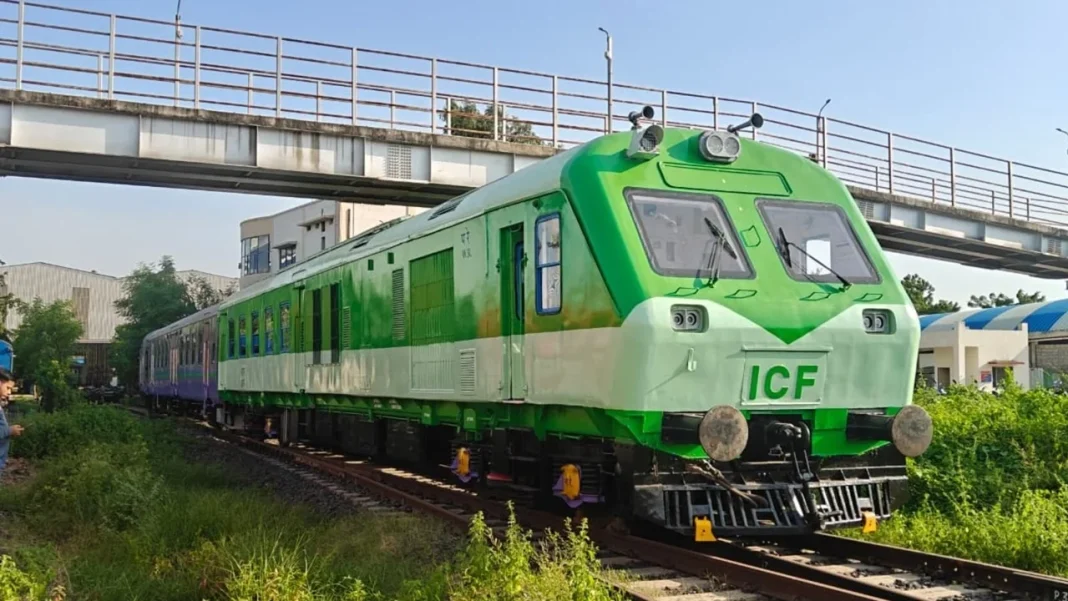

Indian Railways has put liquefied natural gas back in the spotlight after the formal flag-off of India’s first LNG-diesel dual-fuel DEMU from Sabarmati, Ahmedabad, on September 27, 2026. The train is not completely LNG-powered: its converted engines use LNG alongside diesel, with LNG designed to replace roughly 40% of diesel consumption. That makes the project less of a dramatic break from diesel and more of a practical bridge technology while railway electrification keeps expanding.
The timing is notable. Railways is already testing hydrogen traction, pushing Kavach deployment and adding high-capacity electric freight locomotives. So the LNG train is one piece of a wider fuel-and-technology shift rather than a standalone experiment.
India’s First LNG Train Is A Dual-Fuel DEMU, Not An LNG-Only Train
Two 1,400 HP Driving Power Cars at the Sabarmati Integrated Coaching Depot were converted to a diesel-plus-LNG system. More than 2,000 km of field trials were completed before the latest flag-off, and the inaugural eight-coach non-AC train ran between Sabarmati and Mahesana. Its regular route is still to be finalised, according to the latest Indian Express report on the LNG train.
There is also an interesting timeline detail. Akashvani reported on January 30, 2026 that the LNG-diesel DEMU had already been operationalised in Ahmedabad and was running in regular passenger service after trials. The September 27 event therefore appears to be the high-profile formal flag-off of technology already tested in service.
The key figures currently associated with the project are:
- LNG can replace about 40% of diesel used by the converted power cars.
- Each DPC has an LNG tank of around 2,200 litres.
- Usable LNG per tank is estimated at roughly 950–1,000 kg.
- One DPC can run about 444 km on a full LNG load.
- Estimated annual savings are about ₹11.9 lakh per DPC and ₹23.9 lakh for an eight-coach rake.
How LNG Could Reduce Diesel Use Without Waiting For Full Fleet Replacement
The appeal of LNG here is retrofitting. Railways does not have to scrap a functioning diesel power car and buy an entirely new propulsion platform. Instead, the existing internal-combustion setup is modified to burn LNG with diesel. For routes or duties where diesel equipment still remains useful, that can cut liquid-fuel consumption while keeping operational flexibility.
Railway project estimates say the dual-fuel arrangement should lower fuel costs and reduce carbon dioxide, nitrogen oxides and particulate emissions compared with running entirely on diesel. The official Ahmedabad railway division also described the launch as a move toward greener, more energy-efficient operations in its September 27 official X post.
Yet LNG is still a fossil fuel. The system also continues to consume diesel, so it cannot deliver the zero-tailpipe-carbon profile claimed for hydrogen fuel-cell traction. Its biggest near-term value may be in squeezing more efficiency from diesel assets while electrification and newer propulsion systems spread.
Could LNG Make A Big Dent In Indian Railways’ Diesel Consumption?
Potentially, but scale will decide the answer. At the Sabarmati project level, replacing around 40% of diesel is meaningful. Across Indian Railways, however, diesel use has already been falling sharply as electrification expands. At the September event, Amit Shah said railway diesel consumption had dropped from 293 crore litres in 2015-16 to 108 crore litres in 2024-25 and said the government aims to reduce it to zero by 2030.
He also said railway electrification had reached 99.6%. If the network becomes essentially fully electrified, LNG is unlikely to become the dominant passenger-traction fuel. Its stronger case may lie in selected DEMU operations, backup use, non-electrified pockets, maintenance situations or other applications where replacing diesel completely is not immediately practical.
LNG Versus Hydrogen Is Becoming The More Interesting Rail Story
India’s first hydrogen train was flagged off between Jind and Sonipat on July 17, 2026. By July 25, the Ministry of Railways said it had covered more than 1,200 km and saved over 3,200 litres of diesel. The official PIB update on India’s hydrogen train explains that hydrogen fuel cells generate electricity onboard, whereas the LNG DEMU still uses a combustion engine.
That contrast gives Railways two different pathways to test: LNG as a lower-diesel retrofit and hydrogen as a more radical propulsion change. At the same Sabarmati programme, projects involving Kavach, automatic signaling and a WAG-12 maintenance shed also showed how fuel transition is being paired with safety and freight upgrades.
For now, LNG looks less like the final destination and more like a practical way to cut diesel consumption from trains that may otherwise keep burning it.
FAQs
Is India’s first LNG train fully powered by LNG?
No. It uses LNG with diesel, replacing roughly 40% of diesel in converted power cars.
Where was India’s first LNG train flagged off?
It was formally flagged off from Sabarmati Railway Station in Ahmedabad, Gujarat, on September 27.
How much diesel can the LNG system replace?
The converted dual-fuel system is designed to replace about 40% of conventional diesel consumption overall.
What is the range of one LNG Driving Power Car?
A DPC can travel roughly 444 kilometers on one full LNG load, according to estimates.
Is LNG cleaner than Indian Railways’ hydrogen train?
LNG can reduce some emissions, while hydrogen fuel cells produce water vapor directly during operation.
What’s New on Indian Railways?
How Fast Will New Trains Go?
Check out the high-speed rail test track and its testing plans.
Why Is Tejas Getting A Brand?
Find out why Tejas Express will carry a unique brand name.
Where Will India’s Hydrogen Train Run?
Uncover the route, speed, and ticket details of the new train.
Could Winter Fog Disrupt More Trains?
Browse the latest railway changes and possible December disruptions.
When Will Puja Train Bookings Open?
See the special trains planned for North Bengal and Assam.