

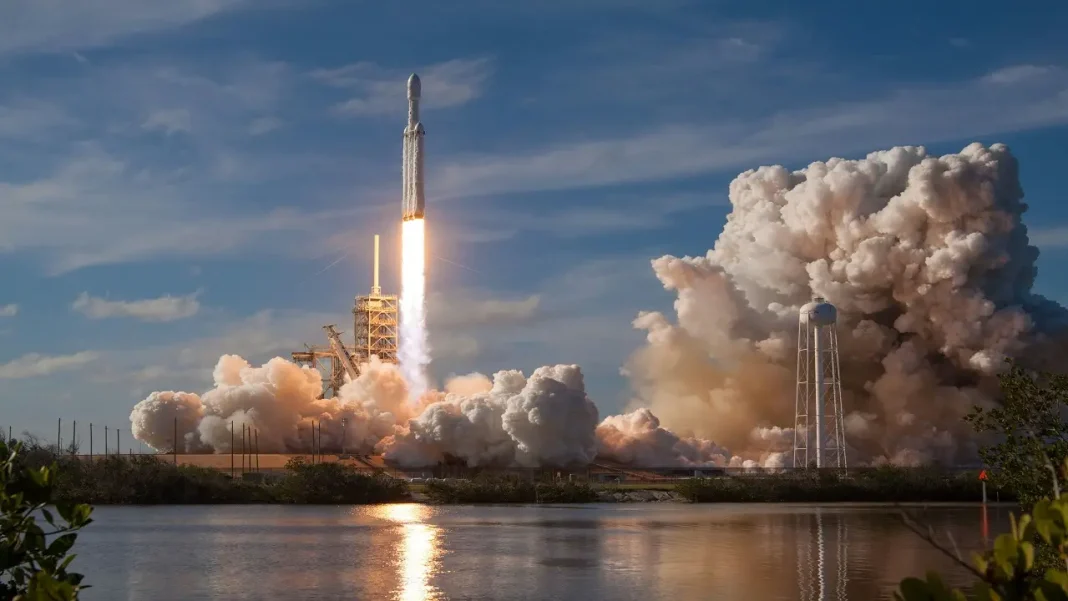

Amazon lost 40 Leo internet satellites after United Launch Alliance’s Vulcan rocket failed during its November 15, 2026 flight from Florida. The Vulcan rocket failure occurred about 10 minutes after liftoff. Its cause had not been confirmed in the statements available on November 16.
The rocket launched at 12:40 p.m. EST, or 11:10 p.m. IST. Amazon’s official mission update confirms that the payload was lost. The flight, called LV-01, was Vulcan’s first mission for Amazon Leo.
Key Highlights
- All 40 satellites aboard LV-01 were lost.
- ULA said the rocket failed to deliver the mission to orbit.
- The cause remains under investigation.
- Amazon’s next listed Ariane 6 mission targets no earlier than November 23.
What Happened During the November 15 Launch?
Vulcan lifted off from Space Launch Complex 41 at Cape Canaveral Space Force Station. Its six solid rocket boosters separated during the early flight, and the Centaur upper stage began operating.
The mission then encountered a problem. ULA confirmed an anomaly about 10 minutes into flight, but its initial statement did not identify a failed component. The launch broadcast ended without confirmation that the satellites had reached orbit. Spaceflight Now’s mission report describes the sequence.
The launch followed two earlier delays:
- November 13: A power interruption affected a gaseous nitrogen plant serving the launch.
- November 14: A communication problem between ground equipment and the rocket caused another delay.
- November 15: A late countdown hold was resolved before liftoff. Its connection to the later failure has not been established.
A postponed countdown and an in-flight failure are different events. The earlier delays do not establish why the mission was lost.
What Caused the Vulcan Rocket Failure?
The immediate answer is that investigators have not announced a cause. ULA said it would review the data with its customer and other relevant organisations, identify the problem and decide on corrective action.
Spaceflight Now reported that the first stage appeared to burn longer than the published timeline. The flight animation also showed unusual movements during the Centaur upper stage’s burn. Those observations describe what viewers saw; they do not identify the failed hardware or prove which event started the problem.
Earlier Booster Problems Do Not Establish the Cause
Vulcan had previously experienced solid booster nozzle problems in October 2024 and February 2026. Both missions still delivered their payloads to their intended orbits. The November flight followed a nine-month gap and changes intended to address those earlier problems.
Northrop Grumman said preliminary data indicated that its boosters performed as expected and separated before the anomaly. That statement is relevant to the investigation, but it does not settle the cause of the overall mission failure.
How the Loss Affects Amazon Leo’s Satellite Rollout
Amazon Leo, previously called Project Kuiper, is building a satellite network for broadband access beyond existing ground networks.
Vulcan has a substantial role in the deployment plan. Before launch, Amazon said its 38 contracted Vulcan missions were expected to carry more than 1,500 first-generation satellites. Amazon’s pre-launch briefing also described preparations for another Vulcan mission within weeks, conditional on a successful first flight. That earlier expectation is not a confirmed post-failure schedule.
Amazon uses several launch providers. Its updated mission page lists an Ariane 6 flight carrying 36 satellites, targeting no earlier than November 23 from French Guiana. A target date remains subject to change; it is not confirmation that the launch has happened.
Investigation and the Next Launches to Watch
The next useful updates will answer specific questions:
- Which system failed, and what flight data supports that finding?
- What repairs or design changes are required?
- When can Vulcan resume launches?
Amazon has expressed support for ULA following the loss. Neither that support nor preparations made before launch establish a return-to-flight date.
For readers in India, the Florida launch occurred late on November 15, while much of the reporting appeared on November 16. Follow the official Amazon Leo mission tracker for revised dates and confirmed deployment results.
FAQs
How many Amazon satellites were lost?
All 40 Amazon Leo satellites aboard LV-01 were lost. They were intended to expand the company’s low Earth orbit broadband network, but never reached their planned orbit.
Was this Vulcan’s first flight?
No. This was Vulcan’s fifth flight since its January 2024 debut, but its first mission carrying satellites for Amazon’s Leo broadband network into low Earth orbit.
Has ULA confirmed an engine failure?
No specific engine or component has yet been identified as the cause. Reports describing unusual flight behaviour should not be read as a completed investigation.
Did the earlier booster problems also destroy satellites?
No. The October 2024 and February 2026 flights reached their intended orbits despite booster nozzle problems. The November 15 mission instead resulted in payload loss.
When is Amazon’s next satellite launch planned?
Amazon lists an Ariane 6 mission carrying 36 satellites for no earlier than November 23, 2026. That target is separate from Vulcan’s return to flight.
Beyond the Launchpad: Explore Five Space Stories Making Headlines!
1. Who Will Manufacture India’s LVM3 Rockets?
Discover how private companies could reshape India’s LVM3 rocket manufacturing.
2. Why Is ISRO Shifting Rocket Manufacturing?
Uncover the reasons behind ISRO’s growing partnership with private rocket manufacturers.
3. Will Vikram-1 Transform India’s Space Industry?
Explore India’s private orbital rocket ambitions and Vikram-1’s launch significance.
4. How Will GSAT-7B Strengthen India’s Army?
Find out how GSAT-7B could improve military communication and connectivity.
5. Can Robotic Arms Catch SpaceX Starship?
See how SpaceX’s robotic catch technology could transform reusable rocket operations.