
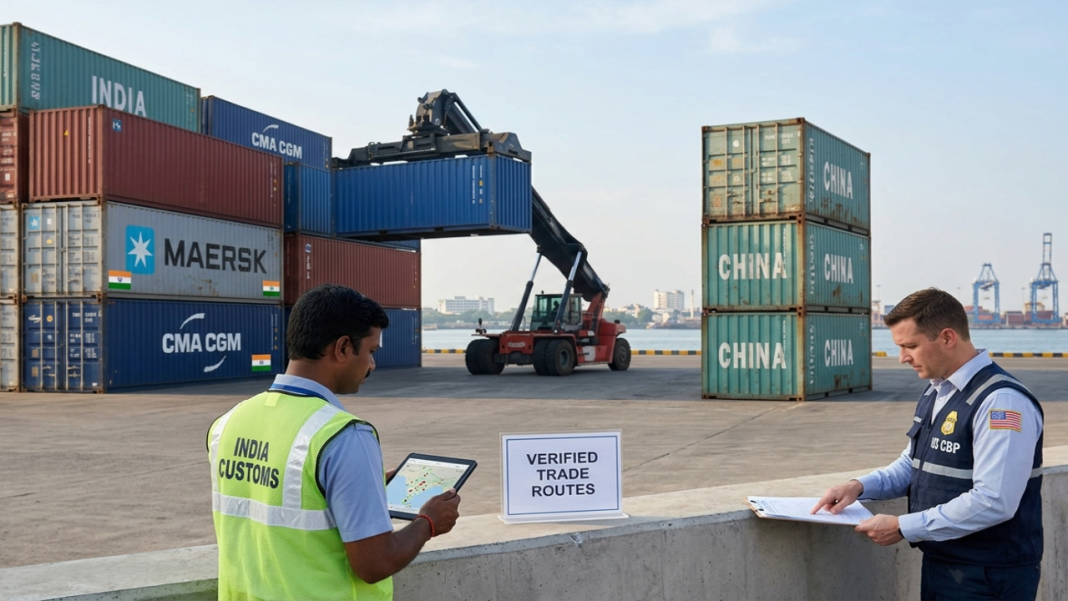

India has landed in a new White House trade report targeting alleged Chinese tariff evasion through third countries. The document, titled The Great Transshipment Scam, places India in its highest-scale category of jurisdictions where China-linked goods may enter US-bound supply chains after rerouting, relabelling or limited processing.
The timing is sensitive. New Delhi and Washington are still working toward a broader bilateral trade agreement, and Commerce Secretary Rajesh Agrawal said this week that both sides remain in “regular contact.” The US push could now add rules of origin, customs records and Chinese inputs to an already crowded negotiating table.
Why Has The US Put India In Its Top Transshipment-Risk Tier?
The White House Office of Trade and Manufacturing Policy divides the alleged network into three tiers. India sits in Tier 1, called “Diversified Scale Leaders,” alongside Canada, the European Union, Israel, Japan, Mexico, South Korea and Taiwan. The report says these economies handle large volumes of China-linked goods while also having substantial legitimate manufacturing and US-bound exports.
That distinction is important. Tier 1 status is not proof that Indian exporters, or the Indian government, systematically committed customs fraud. The report itself says the risk is embedded within broad legitimate trade flows, while Business Standard noted that the classification does not announce a new India-specific tariff.
Washington says warning signs can include Chinese components, ownership or financing, China-based production steps and routing histories. Its concern is that minimal transformation could be used to claim a new country of origin.
What Does the $67 Billion Figure Actually Say About India?
One number is likely to dominate headlines: $67 billion. It should not be described as $67 billion of Indian transshipment.
The report says the US Commerce Department’s Office of Trade and Economic Analysis estimated about $67 billion of US-bound goods were transshipped from China through the three leading hubs, Mexico, India and Vietnam, in 2025. It estimates roughly $28 billion in associated tariff revenue losses. Crucially, it does not break out India’s individual share.
The document reviews methodologies producing annual estimates from roughly $40 billion to $303 billion and uses $60 billion as a rounded benchmark. That spread shows how much the result depends on what researchers classify as potential illegal transshipment.
India-based trade research group GTRI has challenged the framing, arguing that the report identifies no Indian exporter or shipment involved in fraud and that Chinese inputs do not automatically make a finished product Chinese-origin.
CNBC-TV18 highlighted India’s inclusion in an official X post, showing how quickly the issue has entered the India-US trade debate.
Could The Crackdown Disrupt India-US Trade And Exporters?
Yes, mainly through compliance pressure rather than an automatic blanket tariff. The US imported $103.8 billion of goods from India in 2025 and exported $45.6 billion, according to the USTR India trade profile. Even slower origin verification could therefore affect large trade flows.
Indian exporters with China-linked supply chains could face four immediate pressures:
- More requests for bills of materials, supplier records and origin certificates.
- Longer customs reviews where routes or production capacity trigger alerts.
- Retrospective duties or penalties if US authorities reject declared origin.
- Pressure to localise inputs or document substantial manufacturing inside India.
Enforcement is also changing. President Donald Trump’s June 3 Strengthening Customs Enforcement order directed tougher importer accountability, bonding and ownership disclosures. The report also proposes an AI-enabled “Detective Border” comparing declared origin, shipment routes, components and production patterns to flag anomalies for CBP officers.
India remains a major US supplier. Its July 2026 goods exports reached $44.24 billion overall, with the United States still the country’s top export destination.
What Happens Next For The India-US Trade Deal?
The key question is whether Washington converts the report into India-specific enforcement. So far, it identifies risk and proposes stronger detection rather than a fresh blanket duty on Indian goods.
The relationship already carries tariff friction. In July, Washington imposed a new 10% tariff on part of Indian exports under a separate forced-labour action, while India said about 45% of its US-bound exports were exempt. Negotiations continued afterward.
For New Delhi, tighter origin verification could protect legitimate exporters from being grouped with pass-through shipments. For Washington, the challenge will be separating fraud from lawful global sourcing. If enforcement becomes too broad, genuine India-US trade could face delays and higher compliance costs without any new countrywide tariff.
FAQs
1. Why did the US name India in the transshipment report?
India handles large China-linked trade flows alongside significant manufacturing and exports bound for American markets.
2. Did the US accuse all Indian exporters of tariff evasion?
No, the report identifies transshipment risk and does not establish fraud by every Indian exporter.
3. Is the $67 billion figure entirely linked to India?
No, it combines estimated transshipment through India, Mexico and Vietnam during the year 2025 together.
4. Could Indian exports face tougher checks in the US?
Yes, China-linked shipments may face deeper origin checks, documentation demands and possible customs delays there.
5. Will this stop the India-US trade deal?
Not necessarily; negotiations continue, but origin rules and customs enforcement could become tougher bargaining points.
Explore more stories on India-US trade, Chinese goods, tariffs, customs rules, and global supply chains.
India Opens Attari Border And 10 More Ports For E-Visa Travellers: Who Can Use The New Entry Points?
Former Chinese Premier Zhu Rongji Dies At 97: How Did He Help Reshape China’s Modern Economy?