

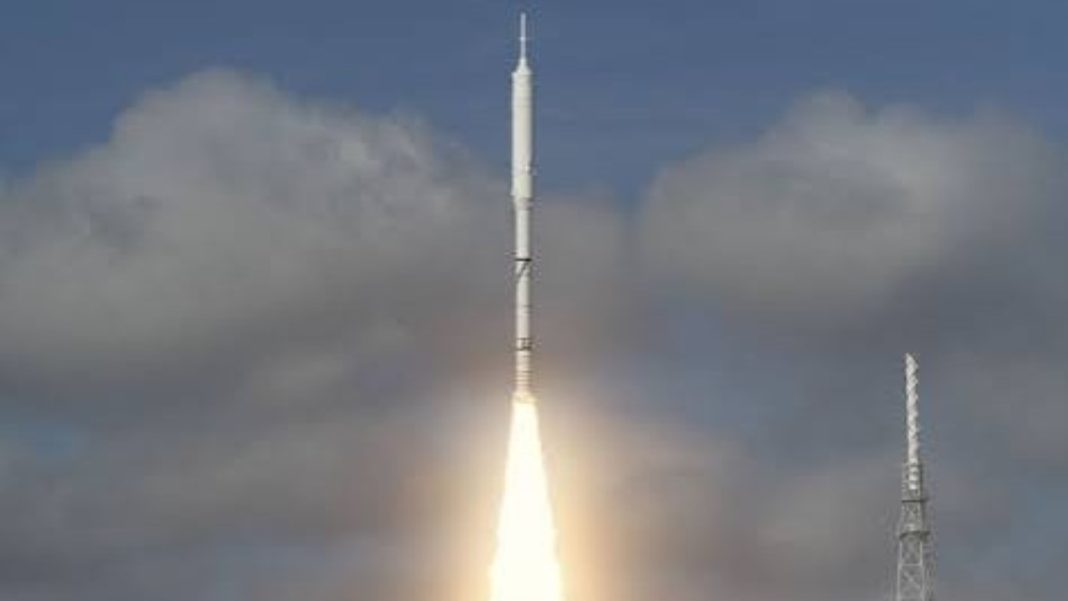

China’s Long March 7A rocket suffered a dramatic in-flight failure on August 10, 2026, destroying the ChinaSat-4B communications satellite less than 90 seconds after liftoff. The rocket left the Wenchang Space Launch Site in Hainan at 8:02 p.m. Beijing time, but video showed it breaking apart while still climbing through the atmosphere. Chinese state media later confirmed a “flight anomaly” and said the mission had failed. The precise cause remains under investigation, making any claim of a confirmed engine, guidance or structural fault premature.
What Happened During The Long March 7A Launch?
The Long March 7A lifted off carrying ChinaSat-4B, also called Zhongxing-4B, on a mission believed to be targeting a high orbit. According to Reuters, the rocket was destroyed at relatively low altitude and speed, meaning neither the spacecraft nor substantial debris reached orbit. Spaceflight analyst Jonathan McDowell reached that conclusion after reviewing launch footage.
The visible failure occurred about 85 seconds into flight. That timing is important because the Long March 7A normally remains in its initial powered phase for considerably longer. Space.com reported that first-stage separation typically occurs just under three minutes after liftoff, so the vehicle had not yet reached that milestone.
Key developments from the failed mission include:
- Liftoff occurred at 8:02 p.m. Beijing time from Wenchang in Hainan.
- The rocket broke apart roughly 85 seconds after leaving the launch pad.
- ChinaSat-4B was lost before reaching its intended orbit.
- Chinese authorities confirmed an in-flight anomaly and opened an investigation.
- It was the Long March 7A’s second failed mission since its 2020 debut.
What Went Wrong With Long March 7A?
For now, there is no official technical explanation. China’s state news agency said the cause was being analysed and investigated. That leaves several possibilities engineers will examine, including propulsion performance, fuel delivery, structural loads, guidance commands and interactions between the core stage and four boosters. None has been identified publicly as the trigger.
The timing may help investigators narrow the search. Because the vehicle failed well before normal first-stage separation, attention will initially centre on systems active during early ascent. Investigators can compare telemetry, engine pressures, acceleration data, guidance readings and onboard fault messages with successful Long March 7A missions. The areas listed here are investigative possibilities rather than confirmed causes.
The rocket’s history will also receive scrutiny. Its maiden flight in March 2020 failed after an in-flight malfunction. The vehicle returned successfully in 2021 and then completed more than a dozen successful missions before the latest accident. Space.com identifies the August 10 flight as the rocket’s 18th mission overall.
Footage of the latest accident was also shared by TRT World on X, showing the rocket breaking apart during ascent. The video confirms the visible breakup, but footage alone cannot establish which technical component caused the failure.
Why Was ChinaSat-4B Important For China?
ChinaSat-4B was a communications satellite in the same series as ChinaSat-4A, which was launched in 2024. China has said ChinaSat-4A supports voice, data, radio and television transmission. Reuters noted that ChinaSat-4B’s exact customers and capabilities had not been publicly confirmed, so its mission should not simply be treated as identical.
High-orbit communications satellites can cover large territories beyond dense terrestrial networks. Losing the spacecraft means China must decide whether to build a replacement, reassign capacity from another satellite or adjust future launch plans. Those operational decisions have not yet been announced publicly.
The failure also arrives while China is pushing several high-profile space projects. In June 2026, the country launched its new Long March 12B on a debut mission carrying satellites for the Qianfan internet constellation. China is also preparing the Chang’e-7 lunar mission, which is intended to explore the Moon’s south polar region.
Will The Failure Delay China’s Other Space Missions?
A broad slowdown is not automatic. The Long March 7A is mainly used for high-orbit payloads, particularly communications satellites, while many Chinese low-Earth-orbit constellation missions use other launch vehicles. The immediate effect is therefore likely to be strongest on future Long March 7A flights.
One question is whether investigators discover a fault in hardware shared with other rockets. If the issue is isolated to a unique Long March 7A component, disruption could remain limited. If it involves common engines, manufacturing processes or launch-site procedures, China may order additional checks elsewhere in the Long March fleet. Reuters noted that the investigation will determine whether wider inspections become necessary.
Reuters reported that analysts do not expect the accident to significantly disrupt Chang’e-7 because that lunar mission uses the larger Long March 5. Elon Musk also reacted to the failure on X, saying rockets are “insanely hard” and adding that he hoped China would recover quickly.
The next decisive update will come from China’s investigation. Until then, the clearest conclusion is simple: the Long March 7A was lost during early ascent, ChinaSat-4B never reached orbit, and the exact fault remains unconfirmed.
FAQs
When did the Long March 7A rocket explode?
It exploded about 85 seconds after launching from Wenchang on August 10, 2026, Chinese time.
What satellite was aboard the failed Chinese rocket?
The rocket carried ChinaSat-4B, also called Zhongxing-4B, a communications satellite intended for high-orbit operations there.
Has the Long March 7A failed before?
Yes, its maiden mission failed in March 2020 before it later returned to successful flights.
Will the failure delay China’s Chang’e-7 Moon mission?
Analysts expect limited impact because Chang’e-7 uses a different, larger Long March 5 launch vehicle.
What caused the Long March 7A explosion?
China has not announced a cause; investigators are examining telemetry and the rocket’s early-flight systems.
More space stories worth exploring next.
NASA Invites ISRO To Join Moon Base Programme After Bengaluru Space Talks
Isro Gaganyaan Mission Update: What The Latest Crew Escape Test Means For India’s Space Plans
Total Solar Eclipse To Turn Day Into Darkness Next Week: Where Will The Best Views Be?